Timpanogos Cave National Monument
The significance of Timpanogos Cave National Monument regarding Native American history is primarily linguistic and cultural, rooted in the region's deep…
What is the significance of Timpanogos Cave National Monument in terms of Native American history and culture?
The significance of Timpanogos Cave National Monument regarding Native American history is primarily linguistic and cultural, rooted in the region’s deep indigenous heritage. The name “Timpanogos” is believed to be derived from a Paiute word meaning “reclining woman,” reflecting the cultural connection between the landscape and the language of the Southern Numic peoples who inhabited the area, including the Ute and Gosiute Native Americans.12
While the cave system itself was formally discovered by settlers in the late 19th and early 20th centuries, the surrounding region of the Wasatch Range has been home to diverse indigenous cultures for millennia, ranging from ancient Paleoindian hunters to the Fremont and Ancestral Pueblo peoples. These groups established complex societies, including communal cliff dwellings and sophisticated agricultural systems, long before European exploration.23
Where is Timpanogos Cave National Monument located in Utah, and what are its main geological features?
Timpanogos Cave National Monument is located in American Fork Canyon in north-central Utah, situated on the northwestern slope of Mount Timpanogos within the Wasatch Range.
The monument consists of three primary limestone chambers—Timpanogos, Middle, and Hansen caves—which have been connected by man-made tunnels. These caves were naturally excavated millions of years ago by an underground stream.
The site is renowned for its diverse and delicate geological features, including:
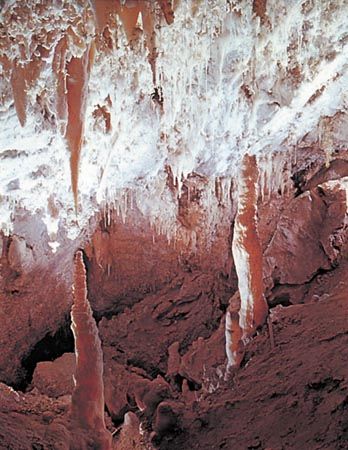
- Speleothems: The caves feature a variety of stalactites, stalagmites, and flowstones.
- Crystal Formations: The walls are noted for their pink and white crystal-filigreed appearance.
- Helictites: The caves contain delicate, twisted helictite formations.
- Unique Features: Notable formations include the “Great Heart of Timpanogos,” a stalactite shaped like a human heart, as well as underground pools.
The cave system maintains an average temperature of 45 °F (7 °C) and is accessible via a steep trail winding up the mountainside.
How were the caves at Timpanogos Cave National Monument formed, and what is their geological history?
The caves at Timpanogos Cave National Monument are a limestone system naturally excavated millions of years ago by an underground stream. This process is a classic example of a solution cave, where water acts as a chemical agent to shape the bedrock.16
Geological Formation
The formation of these caves began when rainwater infiltrated the soil, absorbing carbon dioxide to form a dilute carbonic acid. As this acidic water moved through joints and fractures in the limestone bedrock, it dissolved the rock, gradually carving out the passages that now form the Timpanogos, Middle, and Hansen caves.61
Geological History and Features
Over millions of years, the cave system has undergone complex cycles of deposition and excavation. Once the original underground streams drained, the environment became stable, allowing for the slow growth of speleothems through the precipitation of calcium carbonate. the precipitation of calcium carbonate.26
The caves are noted for their diverse mineral features, which include:
- Stalactites and Stalagmites: Formed by dripping water that leaves behind rings of mineral deposits.6
- Helictites: Delicate, twisted formations that grow in various directions, independent of gravity.6
- Flowstones: Massive sheets of calcite created by water flowing along walls and ledges.6
These features, combined with the pink and white crystal-filigreed walls, reflect the unique geological history of the Wasatch Range.1
What kind of wildlife and plant life can be found in and around Timpanogos Cave National Monument?
The provided search results do not contain specific information regarding the wildlife and plant life found within the boundaries of Timpanogos Cave National Monument.
While the monument is situated on the slopes of Mount Timpanogos within the Wasatch Range—a region known for supporting diverse ecosystems—the available data focuses primarily on the monument’s geological history, cave formations, and discovery. Information regarding flora and fauna in the broader Wasatch-Cache National Forest or other Utah monuments, such as the Grand Staircase–Escalante National Monument, cannot be definitively applied to the specific, small area of Timpanogos Cave National Monument.
Sources
- Timpanogos Cave National Monument — Encyclopædia Britannica
- Timpanogos Cave National Monument — Merriam-Webster
- Utah - Prehistory and European exploration — Encyclopædia Britannica
- Colorado River - Early inhabitants — Encyclopædia Britannica
- Wasatch Range — Encyclopædia Britannica
- cave - Depositional materials and features — Encyclopædia Britannica
- American Fork — Encyclopædia Britannica
- cave - Solutional sculpturings — Encyclopædia Britannica
- Grand Staircase–Escalante National Monument — Encyclopædia Britannica
- Grand Canyon - Biological past and present — Encyclopædia Britannica
- Wasatch-Cache National Forest — Encyclopædia Britannica
Published on · 3 min read