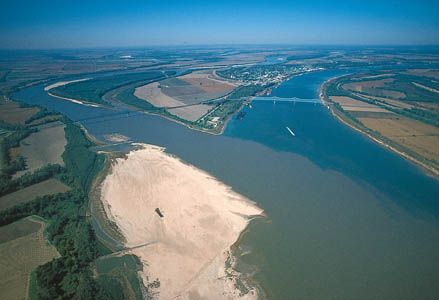
Tippecanoe River
The Tippecanoe River is a 166-mile-long (267 km) waterway located in northern Indiana, U.S. It originates in Tippecanoe Lake in Kosciusko County and flows in…
What is Tippecanoe River?
The Tippecanoe River is a 166-mile-long (267 km) waterway located in northern Indiana, U.S. It originates in Tippecanoe Lake in Kosciusko County and flows in a generally southwestern direction until it joins the Wabash River north of Lafayette. The name is believed to be derived from the Miami Indian term for buffalo fish.1
Along its lower course, between the towns of Buffalo and Springboro, the river is impounded by hydroelectric power dams to form Lakes Shafer and Freeman. The river is historically significant as the site of the Battle of Tippecanoe, which took place on November 7, 1811, near the river’s junction with the Wabash. During this conflict, Major General William Henry Harrison defeated the Shawnee forces led by the brother of Tecumseh, Laulewasikau (also known as The Prophet).1
What happened during the Battle of Tippecanoe?
The Battle of Tippecanoe, fought on November 7, 1811, was a decisive engagement between a U.S. force led by Major General William Henry Harrison and an intertribal confederation of Shawnee and other Indigenous warriors led by the Prophet, Laulewasikau.3
Harrison marched from Vincennes to Prophetstown to dismantle the defensive alliance organized by the Prophet and his brother, Tecumseh. While Tecumseh was away, the Prophet’s forces launched a surprise pre-dawn attack on Harrison’s camp. Despite intense hand-to-hand fighting, Harrison’s troops held their defensive formation and eventually repelled the assault. By dawn, the U.S. forces counterattacked, causing the Indigenous warriors to scatter, after which Harrison burned the village.3
The battle effectively broke the power of the Indian confederation and discredited the Prophet. It also solidified Harrison’s national reputation, famously fueling his 1840 presidential campaign slogan, “Tippecanoe and Tyler, too!” The conflict remains a significant event in the history of U.S. expansion into the Ohio Valley and the lead-up to the War of 1812.3
Who was the Shawnee leader Tecumseh?
Tecumseh (1768–1813) was a prominent Shawnee leader, orator, and military strategist who became the primary advocate for an intertribal alliance to resist white expansion in the Ohio River valley. A principled leader, he famously rejected the Treaty of Greenville, arguing that land was a communal possession that could not be sold by individual chiefs.4
Alongside his brother, the religious leader Tenskwatawa (the Prophet), Tecumseh sought to unify Indigenous nations to preserve their culture and sovereignty. His efforts were interrupted by the Battle of Tippecanoe, where his brother’s forces were defeated by William Henry Harrison. During the War of 1812, Tecumseh allied with the British, playing a decisive role in the capture of Detroit. He was killed on October 5, 1813, at the Battle of the Thames in present-day Ontario, Canada. His death effectively ended organized Indigenous resistance in the region, leading to the eventual displacement of many tribes.4
How do hydroelectric dams affect river ecosystems?
Hydroelectric dams significantly alter river ecosystems by transforming natural environments to serve human needs, often resulting in the destruction of local flora and fauna. These structures impact rivers in several critical ways:5
- Obstruction of Migratory Species: Dams act as physical barriers that block or impede the movement of fish, such as salmon, traveling to and from their spawning grounds. While technologies like fish passes—including fish ladders and locks—are used to mitigate these effects, they have struggled to sustain populations on heavily dammed rivers, sometimes leading to dramatic declines or the threat of extinction.56
- Sedimentation and Erosion: Reservoirs trap sediment that would otherwise flow downstream, which reduces the reservoir’s storage capacity over time. Because the water released from a dam is depleted of its natural sediment load, it possesses renewed transporting capacity, leading to increased erosion of the stream channel below the structure.78
- Habitat Inundation: The creation of large reservoirs often results in the flooding of vast areas, leading to the loss of natural landscapes, cultural homelands, and terrestrial ecosystems.57
Sources
- Tippecanoe River — Encyclopædia Britannica
- Tippecanoe — Merriam-Webster
- Battle of Tippecanoe — Encyclopædia Britannica
- Tecumseh — Encyclopædia Britannica
- dam - Rise of environmental and economic concerns — Encyclopædia Britannica
- dam - Fish passes — Encyclopædia Britannica
- reservoir — Encyclopædia Britannica
- river - Environments of deposition — Encyclopædia Britannica
Published on · 3 min read