Torcello
Torcello is an island-village located in the Venice Lagoon of Italy. Founded in 452 CE by refugees fleeing mainland invasions, it evolved into a flourishing…
What is Torcello?
Torcello is an island-village located in the Venice Lagoon of Italy. Founded in 452 CE by refugees fleeing mainland invasions, it evolved into a flourishing city and served as the administrative center for the lagoon’s communes until the seat of government shifted to the Rialto in 811 CE.123
Once home to an estimated 20,000 people, the island eventually declined due to silted canals and malaria, leading residents to relocate to the growing city of Venice. Today, it remains a quiet area inhabited primarily by fishermen and market gardeners.31
The island is renowned for its significant historical architecture, including:
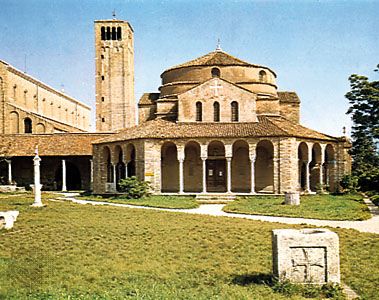
- Basilica di Santa Maria Assunta: Founded in 639 CE, it features a 9th-century baptistery and remarkable 13th-century mosaics, including a dramatic Last Judgment and the golden Madonna Teoteca created by Greek artists.13
- Church of Santa Fosca: A 12th-century structure that stands alongside the basilica as a remnant of the island’s Byzantine past.13
Why did people flee to the Venetian lagoon in the 5th century?
During the 5th century, the Italian peninsula faced a period of intense military crisis and instability as the Western Roman Empire struggled to defend its borders against various barbarian invasions.4
The primary catalyst for the migration to the Venice Lagoon was the destructive campaign of Attila and his Huns. In 452 CE, Attila invaded Italy and sacked several major cities, including Aquileia, Padua, and Milan. Refugees from mainland settlements, such as Altino, fled to the islands of the lagoon to escape these violent incursions and the resulting famine and pestilence.56
This movement was part of a broader era of upheaval in the Western Empire, characterized by the movement of Germanic tribes—such as the Visigoths, Vandals, and others—who were themselves often displaced by the Huns or seeking new lands due to overpopulation and climate pressures. As the coherence of the Roman state dissolved under these continuous emergencies, the relative safety of the marshy, isolated lagoon islands provided a refuge for those fleeing the collapse of mainland urban centers.746
What are the defining features of Veneto-Byzantine mosaics?
Veneto-Byzantine mosaics represent a unique artistic synthesis, blending the dominant Byzantine tradition with local Venetian tendencies and strong Romanesque impulses.9
Defining features of this style include:
- Dominance of Byzantine Elements: The core aesthetic relies on Eastern iconographical prototypes and brilliant technical execution, characterized by the use of gold backgrounds to create a sense of “other-worldly” brilliance.910
- Local Modification: Unlike the pure Byzantine style found in Constantinople, the Venetian workshops operated with greater freedom. This allowed for the development of personal styles among artists and the integration of Western medieval influences.9
- Stylistic Disparity: Because the mosaic work at sites like St. Mark’s spanned over two centuries, the works exhibit marked stylistic variations. These reflect both the evolution of Byzantine art over time and the specific, freer organization of Venetian workshops.9
- Technical Integration: These mosaics often feature a sophisticated use of glass and stone tesserae. In notable examples like those at Torcello, the mosaics are celebrated for their emotive power, such as the 13th-century Last Judgment and the iconic Madonna Teoteca.911
How did the rise of Venice lead to the decline of Torcello?
The decline of Torcello was closely linked to the rise of Venice as the central power in the lagoon. Initially, Torcello served as the head of the association of lagoon communes and a flourishing city in its own right. However, its status shifted significantly in 811 CE when the seat of government was moved to the Rialto, marking the beginning of Venice’s political ascendancy.1
As Venice grew into a dominant maritime and political power, Torcello suffered from environmental challenges that accelerated its abandonment. The island’s canals became progressively silted up, and the area was plagued by malarial swamps. Consequently, the population and administrative functions—including the bishopric, which was eventually moved to Murano—migrated toward the more viable and expanding urban center of Venice. By the 16th century, despite having once supported a large population, Torcello had been largely abandoned, leaving its remaining structures as remnants of its former prominence.21
Sources
- Torcello — Encyclopædia Britannica
- 19 Essential Italian Churches - Torcello Cathedral — Encyclopædia Britannica
- Torcello — Merriam-Webster
- Italy - Fifth-century political trends — Encyclopædia Britannica
- history of Europe - The Germans and Huns — Encyclopædia Britannica
- Attila — Encyclopædia Britannica
- Italy - The end of the Roman world — Encyclopædia Britannica
- Italy - The late Roman Empire and the Ostrogoths — Encyclopædia Britannica
- mosaic - Medieval mosaics in western Europe — Encyclopædia Britannica
- mosaic - Late Byzantine mosaics — Encyclopædia Britannica
- mosaic - Early Byzantine mosaics — Encyclopædia Britannica
- mosaic - Renaissance to modern mosaics — Encyclopædia Britannica
- Venice - The patriciate — Encyclopædia Britannica
Published on · 3 min read