Tsavo National Park
Tsavo National Park was established in 1948 in southeastern Kenya. Covering more than 8,000 square miles, it is the largest national park in the country.…
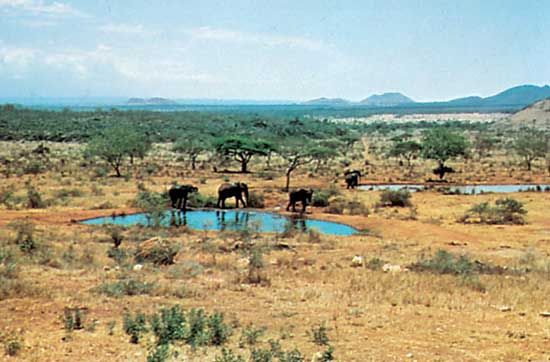
How was Tsavo National Park established, and what is its historical significance?
Tsavo National Park was established in 1948 in southeastern Kenya. Covering more than 8,000 square miles, it is the largest national park in the country. Shortly after its creation, the park was divided into two administrative units—Tsavo East and Tsavo West—separated by the Nairobi-Mombasa highway and railway line.12
The park is historically and ecologically significant for its vast, diverse landscape, which ranges from the relatively flat plains of the east to the volcanic terrain and springs of the west. It serves as a vital habitat for a wide array of wildlife, including elephants, lions, rhinoceroses, buffalo, and hippopotamuses. Despite its importance, the park has faced ongoing challenges regarding the protection of its biodiversity, particularly concerning the impact of brush fires and the poaching of elephants and rhinoceroses.12
What types of wildlife can be found in Tsavo National Park, and are there any species unique to this area?
Tsavo National Park is home to a diverse array of wildlife, including large mammals such as elephants, lions, rhinoceroses, buffalo, and hippopotamuses. The park also supports various species of antelope, including hartebeests, and is inhabited by hundreds of species of birds.12
Regarding your question about unique species, the provided information does not identify any wildlife species that are endemic or exclusive solely to Tsavo National Park. The park’s ecosystem is characterized by its vast semiarid plains, acacia and baobab trees, and volcanic terrain, which provide a habitat for these wide-ranging African species.12
How do the Tsavo lions differ from other African lion populations?
The premise that Tsavo lions differ biologically from other African lion populations is not supported by scientific evidence. While the lions of Tsavo National Park are often discussed in historical contexts, they belong to the same species, Panthera leo, as other lions across Africa.34
The fame of Tsavo lions stems primarily from a historical event in 1898, when two male lions—nicknamed the “Ghost” and the “Darkness”—repeatedly attacked workers constructing a railroad bridge over the Tsavo River. While popular accounts once claimed these lions killed as many as 140 people, modern historical analysis suggests the actual death toll was closer to 35. These specific animals were not a distinct subspecies, but rather two individual predators that became infamous for their behavior during that period.4
Like all lions, the appearance of those in the Tsavo region can vary between individuals, particularly regarding the size and color of the male’s mane, which serves to intimidate rivals or attract mates.3
What is the geographical location and size of Tsavo National Park in Kenya?
Tsavo National Park is located in southeastern Kenya, situated to the east of Mount Kilimanjaro. Established in 1948, it is the largest national park in Kenya, covering an area of 8,036 square miles (20,812 square km).12
For administrative purposes, the park is divided into two distinct units, Tsavo East and Tsavo West, which are separated by the Nairobi-Mombasa highway and railway line. The landscape of the park is characterized by semiarid plains, acacia and baobab trees, and volcanic terrain in the western section.12
Sources
- Tsavo National Park — Encyclopædia Britannica
- Tsavo National Park — Merriam-Webster
- lion - General characteristics — Encyclopædia Britannica
- 6 Real-Life Man-Eating Animals — Encyclopædia Britannica
Published on · 2 min read