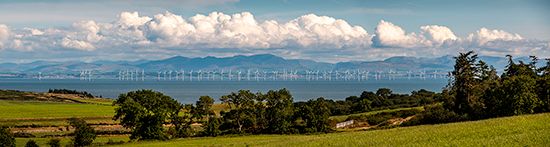
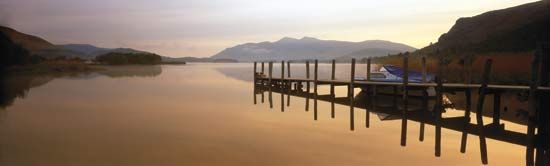
Ullswater
Ullswater is located in the Lake District of England, situated within the administrative county of Cumbria on the border of the historic counties of…
Where is Ullswater located in England, and what are its key geographical features?
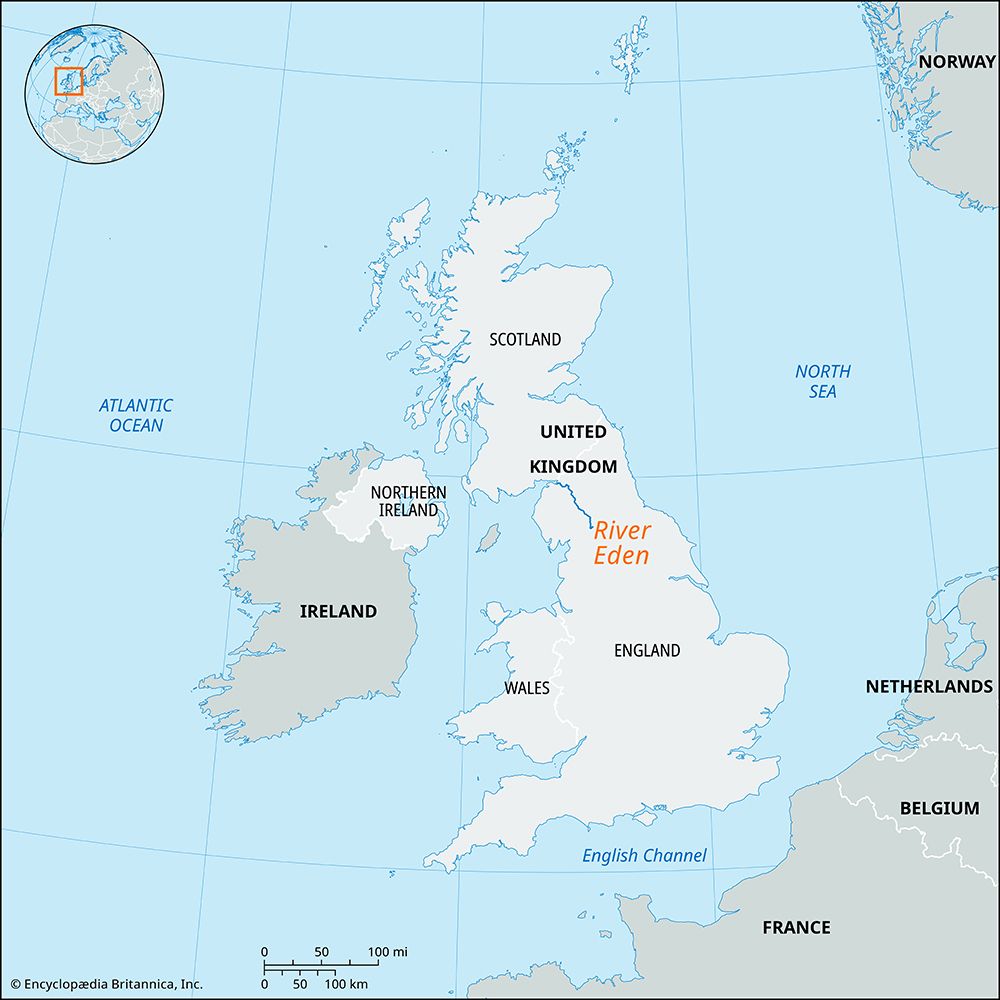
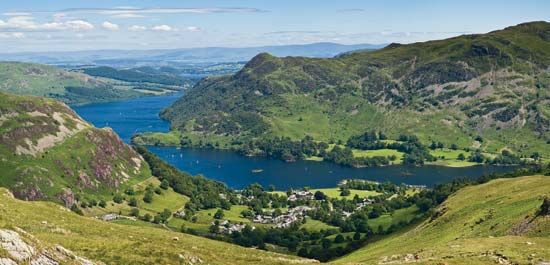
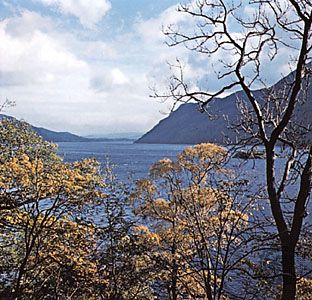
Ullswater is located in the Lake District of England, situated within the administrative county of Cumbria on the border of the historic counties of Cumberland and Westmorland.1
As the second-largest lake in the Lake District, it features a long, narrow shape measuring approximately 7.5 miles (12 km) in length and 0.5 miles (0.8 km) in width, with a maximum depth of 205 feet (62 meters). Key geographical characteristics include:1
- Drainage: The lake is drained by the River Eden, which flows toward the Solway Firth.1
- Islands: There are four small islands located in the northern part of the lake.1
- Nearby Landmarks: The area is home to the Aira Force waterfall and the village of Pooley Bridge, which sits at the lake’s outlet.1
What is the historical significance of Ullswater in the Lake District?
Ullswater holds significant historical and cultural importance, primarily due to its role in the development of English Romantic literature. The lake served as a profound source of inspiration for the poet William Wordsworth and his sister, Dorothy Wordsworth.1
The siblings frequently explored the landscapes surrounding the lake, with Dorothy recording her observations in her private journals. Her vivid description of daffodils at Ullswater in April 1802 provided the foundational imagery for William’s famous poem, “I Wandered Lonely as a Cloud.” Scholars generally view the pair as equal collaborators, noting that Dorothy’s keen powers of description significantly influenced William’s creative output and poetic development.1
Beyond its literary legacy, the area surrounding the lake has long been recognized for its natural beauty. The adjacent Gowbarrow fell was established as a national park in 1910, reflecting the region’s enduring status as a protected landscape within the Lake District.4
How does Ullswater compare in size and depth to other lakes in the Lake District?
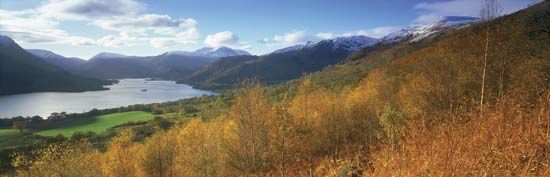
Ullswater is the second-largest lake in the Lake District, surpassed in size only by Windermere.12
In terms of physical dimensions, Ullswater is significantly larger and deeper than other notable bodies of water in the region, such as Derwent Water. A comparison of their key metrics is provided below:
Lake
Length
Maximum Depth
Ullswater
~7.5 miles (12 km)
205 feet (62 meters)
Derwent Water
~3 miles (5 km)
72 feet (22 meters)
While Ullswater maintains a consistent width of approximately 0.5 miles (0.8 km), Derwent Water varies in width from 0.5 to 1.25 miles (0.8 to 2 km). The substantial depth of Ullswater is a result of the glacial action that shaped the region, carving out deep rock basins throughout the Lake District.152
What is the origin of the name ‘Ullswater’ and its significance?
The name “Ullswater” is widely believed to be of Old Norse origin, likely derived from the name of a Norse chieftain, “Ulf,” combined with the Old English word “water” or the Old Norse “watre.” This reflects the historical influence of Norse settlers in the Lake District during the early medieval period.
While the name itself serves as a linguistic marker of the region’s Viking-age heritage, its primary significance today lies in its geography and cultural legacy. Located on the border between the historic counties of Cumberland and Westmorland, the lake is the second-largest in the region, spanning approximately 7.5 miles in length. It is a vital part of the local landscape, drained by the River Eden and surrounded by notable landmarks such as the Aira Force waterfall and the protected grounds of Gowbarrow.
We could dive deeper into the history of Norse settlement in Cumbria or explore the etymology of other prominent lakes in the region.
Sources
- Ullswater — Encyclopædia Britannica
- Lake District — Encyclopædia Britannica
- Ullswater — Merriam-Webster
- William Wordsworth - Influence of Dorothy Wordsworth — Encyclopædia Britannica
- Derwent Water — Encyclopædia Britannica
Published on · 3 min read