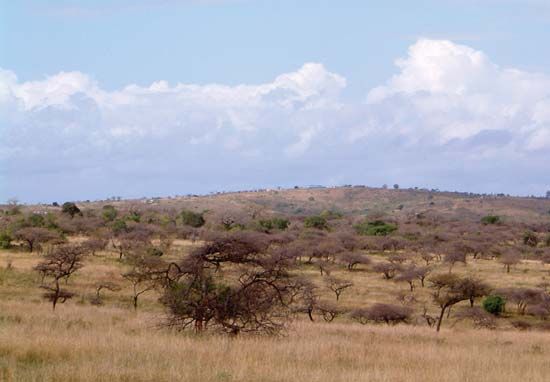
Umfolozi Game Reserve
Umfolozi Game Reserve is a wild animal sanctuary located in the northern KwaZulu-Natal province of South Africa. Established in 1897, the reserve covers an…
What is Umfolozi Game Reserve?
Umfolozi Game Reserve is a wild animal sanctuary located in the northern KwaZulu-Natal province of South Africa. Established in 1897, the reserve covers an area of 185 square miles (478 square km) and is situated southwest of the Hluhluwe Game Reserve.12
The landscape consists of a wooded savanna characterized by thorn trees. The reserve is particularly notable as a habitat for the rare white rhinoceros, as well as the black rhinoceros. In addition to these species, the area supports a diverse array of wildlife, including various species of antelope, wildebeests, zebras, giraffes, and numerous bird species.1
How did the reserve help save the white rhinoceros from extinction?
The Umfolozi Game Reserve played a pivotal role in one of the most significant success stories in conservation. Around 1900, the population of the southern white rhinoceros had been decimated by habitat loss and sport hunting, leaving fewer than 100 individuals remaining in the wild.
By providing a protected sanctuary, the reserve allowed this small remnant population to recover. Through dedicated protection and management, the population of the southern white rhinoceros rebounded remarkably, with numbers reaching approximately 20,000 by the 2020s. This recovery is widely regarded as a landmark achievement in wildlife preservation, demonstrating the effectiveness of establishing secure habitats to prevent the extinction of threatened species.13
While this success is a testament to the importance of protected areas, the species continues to face ongoing threats from poaching, which remains a critical challenge for conservationists today.4
What is the difference between black and white rhinoceroses?
The terms “black” and “white” rhinoceros are misleading, as both species are actually grayish to brownish in color. The names are well-established in common usage, but the primary differences between these two African species lie in their physical characteristics, diet, and social behavior.46
Physical and Dietary Differences
- Muzzle Shape: The white rhinoceros is often called the “square-lipped” rhinoceros because it possesses a broad, square muzzle adapted for grazing on short grasses. In contrast, the black rhinoceros is a “prehensile-lipped” species, featuring a pointed upper lip used for browsing on shrubs, thickets, and succulent plants.748
- Size: The white rhinoceros is significantly larger, with males weighing up to 2,400 kg (5,300 pounds). The black rhinoceros is smaller, typically weighing between 700 and 1,300 kg (1,500 and 2,900 pounds). Additionally, white rhinoceroses are the only species where males are noticeably larger than females, whereas male and female black rhinoceroses are similar in size.78
Behavior and Temperament
- Social Structure: White rhinoceroses are more social and may live in groups of up to 10 individuals. Black rhinoceroses are generally solitary animals.76
- Temperament: The black rhinoceros is known for being ill-tempered and unpredictable, often charging at unfamiliar sounds or smells. While white rhinoceroses can also be aggressive if provoked, they are generally less volatile than their black counterparts.68
What are the main threats to wildlife in South African game reserves?
Wildlife in South African game reserves faces several significant threats, primarily driven by human activity and environmental pressures.
Major Threats to Wildlife
- Poaching: This is currently the most critical threat to species such as the rhinoceros. Poachers enter protected reserves to kill animals for their horns, which are in high demand for traditional medicines and ornamental items. The immense cost of patrolling vast areas to deter these illegal activities places a heavy financial burden on conservation budgets.3
- Habitat Loss and Encroachment: Historically, the conversion of land for agricultural use, pastoralism, and human settlement has significantly reduced the natural range of many species. Urban growth and the expansion of market agriculture continue to alter ecosystems, forcing large mammals to rely almost exclusively on protected reserves for survival.3910
- Invasive Species: Nonnative plants and animals can disrupt local ecosystems by outcompeting indigenous species for food and living space. These invasive organisms may also introduce diseases or act as predators, leading to a decline in native biodiversity and, in some cases, localized extinction.11
- Historical Overexploitation: While modern reserves provide protection, many species populations were severely thinned in the past due to mass slaughter and unregulated trophy hunting during the 18th and 19th centuries.910
Sources
- Umfolozi Game Reserve — Encyclopædia Britannica
- Hluhluwe Game Reserve — Encyclopædia Britannica
- conservation - Protecting species — Encyclopædia Britannica
- southern white rhinoceros — Encyclopædia Britannica
- northern white rhinoceros — Encyclopædia Britannica
- perissodactyl - Rhinoceroses — Encyclopædia Britannica
- rhinoceros — Encyclopædia Britannica
- black rhinoceros — Encyclopædia Britannica
- veld - Animal life — Encyclopædia Britannica
- South Africa - Conservation of South Africa — Encyclopædia Britannica
- South Africa - Flora and fauna — Encyclopædia Britannica
- invasive species — Encyclopædia Britannica
Published on · 3 min read