Vale of Eden
The Vale of Eden is a broad valley located in the administrative county of Cumbria, Englandcom/place/Cumbria), England. It serves as a geographical separator…
What is Vale of Eden?
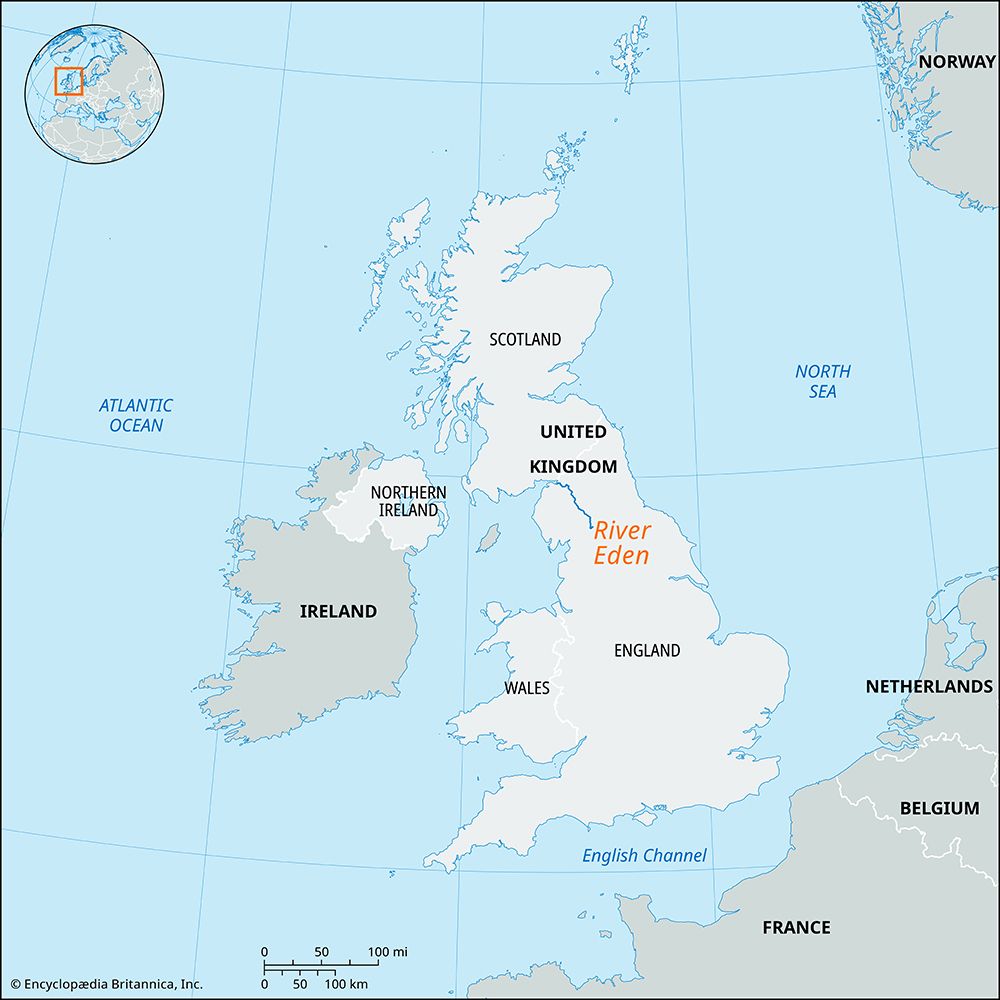
The Vale of Eden is a broad valley located in the administrative county of Cumbria, Englandcom/place/Cumbria), England. It serves as a geographical separator between the northern Pennines and the Lake District massif.1
The area is drained by the River Eden, which flows into the Solway Firth the Solway Firth. Geologically, the vale is composed of Permian and younger marls and sandstones, which contribute to its status as a rich agricultural region. While the term “Eden” is often associated with a paradise or a place of pristine natural beauty, the Vale of Eden specifically refers to this distinct physical landscape in Northern England.12
What is the Lake District known for?
The Lake District is a renowned scenic region and national park in Cumbria, England, celebrated for its distinctive landscape and cultural heritage.3
Key features and associations include:
- Geography and Scenery: The region is defined by its lake-strewn valleys radiating from a central mountain core. It contains the largest English lake, Windermere, and the highest mountains in England, including Scafell Pike. The area’s dramatic topography, shaped by glacial action, features rock basins and “hanging valleys” with waterfalls.3
- Literary History: The district is famously associated with the “Lake poets,” including William Wordsworth, Samuel Taylor Coleridge, and Robert Southey, who lived there in the early 19th century. Wordsworth, a native of the region, drew significant inspiration from its natural beauty.34
- Tourism and Economy: Since becoming a national park in 1951, the area has been a major tourist destination. Towns like Keswick serve as central hubs for visitors, offering access to the region’s rich geologic and folk history.35
How do rivers shape the landscape of a valley?
Rivers are primary agents of landscape evolution, fundamentally shaping the valleys through which they flow. While some valleys are created by tectonic activity, the vast majority are carved by the erosive power of the rivers themselves.6
Mechanisms of Valley Formation
- Vertical Entrenchment: During the initial stages of development, rivers expend most of their energy in vertical downcutting, creating narrow, deep valleys. This process is most rapid in areas experiencing significant tectonic uplift.78
- Lateral Erosion: As a river reaches an elevation closer to its baselevel, it expends more energy laterally than vertically. This process progressively broadens the valley floor, transforming narrow forms into wider ones over time.7
- Bedrock Influence: The final morphology of a valley is heavily dependent on the underlying geology. Rocks that resist erosion, such as quartzites or igneous rocks, often result in steeper, narrower valleys.7
- Sedimentation and Terraces: Rivers also shape landscapes through the deposition of materials. When sediment supply exceeds a river’s transport capacity, the valley floor may aggrade (fill). Subsequent entrenchment into these deposits can create river terraces, which serve as records of a valley’s geomorphic history.910
What is the significance of the River Eden in England?
The River Eden is a significant waterway in northern England that serves as a vital drainage system and a historical corridor between the Lake District and the Pennines.1213
Its significance is defined by several key factors:
- Geographical Role: Rising in the fells, the river flows 90 miles northwest to the Solway Firth. It acts as the primary drainage artery for the Vale of Eden, a broad, fertile lowland that separates the Lake District massif from the northern Pennines.1213
- Agricultural Importance: The river’s valley provides the only relatively low-lying and fertile land in the otherwise mountainous Eden district. This area supports dairy and beef cattle farming, as well as the cultivation of oats and fodder crops.1
- Historical and Strategic Value: The river valley has been a site of human settlement for millennia, evidenced by Roman, Viking, and Anglo-Saxon antiquities. Historically, towns like Carlisle, Penrith, and Appleby served as strategic centers, often facing devastation during medieval border conflicts between England and Scotland.121
Sources
- Vale of Eden — Encyclopædia Britannica
- Eden — Merriam-Webster
- Lake District — Encyclopædia Britannica
- Lake poet — Encyclopædia Britannica
- Keswick — Encyclopædia Britannica
- river - Valleys and canyons — Encyclopædia Britannica
- river - Valley evolution — Encyclopædia Britannica
- valley — Encyclopædia Britannica
- river - Origin of river terraces — Encyclopædia Britannica
- glacial valley — Encyclopædia Britannica
- river - Terraces and geomorphic history — Encyclopædia Britannica
- River Eden — Encyclopædia Britannica
- Eden — Encyclopædia Britannica
Published on · 3 min read