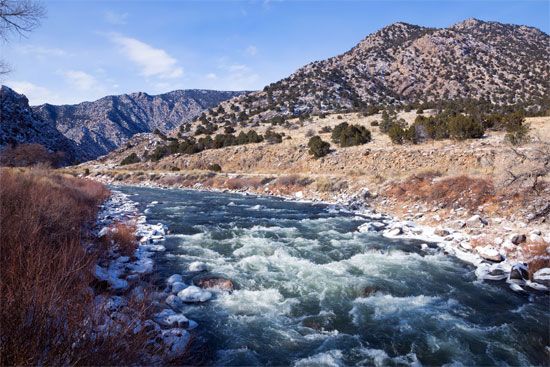
Verdigris River
The Verdigris River is a 350-mile (560-km) waterway that rises southwest of Emporia, Kansas, and flows south and southeast through cities such as Neodesha…
What is Verdigris River?
The Verdigris River is a 350-mile (560-km) waterway that rises southwest of Emporia, Kansas, and flows south and southeast through cities such as Neodesha, Independence, and Coffeyville. Upon entering Oklahoma, it joins the Arkansas River northeast of Muskogee.1
The river’s name is believed to originate from a French term describing a greenish-gray substance, reminiscent of copper ore. Its primary tributaries include the Caney, Fall, and Elk rivers. To manage water flow, the river features flood-control reservoirs near Toronto and Neodesha, Kansas, as well as Oologah, Oklahoma. Additionally, the lower portion of the river is part of the Arkansas River Navigation System, which provides a navigable waterway for the transport of regional resources like coal, lumber, and agricultural products.12
How do dams and locks help with river navigation?
Dams and locks are essential engineering components used to regulate rivers and facilitate inland waterway navigation. By controlling water levels and overcoming changes in topography, these structures allow vessels to travel along routes that would otherwise be impassable.4
The Role of Locks
A lock is a basin with gates at each end that acts as a “water elevator.” It enables boats to move between different water levels, known as pounds.25
- Operation: When a vessel enters the chamber, the gates are closed. Water is then added or drained via sluices until the chamber’s level matches the next section of the river. Once equalized, the opposite gate opens, allowing the vessel to proceed.25
- Design: Modern locks are often integrated into hydroelectric dams, where the dam creates the necessary depth and water control for navigation.5
The Role of Dams
Dams serve as impounding barriers that create “level steps” in a river, a process known as canalization. By raising the water level, dams ensure a consistent depth for shipping, which is particularly important for transporting bulk commodities like coal, grain, and lumber. Many of these projects are multipurpose, simultaneously providing flood control, irrigation, and the generation of hydroelectric power.564
What are the main tributaries of the Arkansas River?
The Arkansas River receives its primary tributaries within the state of Oklahoma. These major waterways include:
Additionally, the Purgatoire River joins the Arkansas River in Colorado, just above the John Martin Reservoir near Las Animas.8
How is hydroelectric power generated from rivers?
Hydroelectric power is generated by converting the potential energy of falling or fast-flowing water into mechanical energy, which is then transformed into electricity.9
The process typically involves the following steps:
- Water Collection: Dams are used to impound rivers, creating a reservoir that stores water at a higher elevation. The vertical distance between this reservoir and the turbine level is known as the head level is known as the head.11
- Conveyance: Water is directed from the reservoir through large pipes or tunnels called penstocks, which funnel the water downward toward the powerhouse.9
- Energy Conversion: As the water exits the penstocks, its force causes turbines to rotate. These turbines are designed to convert the energy of the moving fluid into mechanical work.109
- Electricity Generation: The rotating turbines drive generators, which convert the mechanical energy into electricity. Finally, transformers increase the voltage for efficient long-distance transmission.9
While this process provides a renewable energy source, it is important to acknowledge that the construction of large dams can have significant negative environmental impacts, including the disruption of fish migration and the displacement of ecological communities.119
Sources
- Verdigris River — Encyclopædia Britannica
- Arkansas River Navigation System — Encyclopædia Britannica
- Verdigris — Merriam-Webster
- lock — Encyclopædia Britannica
- canals and inland waterways - Locks — Encyclopædia Britannica
- canals and inland waterways — Encyclopædia Britannica
- canals and inland waterways - Economic significance — Encyclopædia Britannica
- Arkansas River — Encyclopædia Britannica
- Did you know? — Merriam-Webster
- turbine — Encyclopædia Britannica
- hydroelectric power — Encyclopædia Britannica
- turbine - History of water turbine technology — Encyclopædia Britannica
Published on · 3 min read