What Is the Deadliest Wildfire in History?
The Peshtigo Fire, which occurred on October 8, 1871, is the deadliest wildfire in recorded history. Ignited in the vicinity of the logging community of…
What Is the Deadliest Wildfire in History?
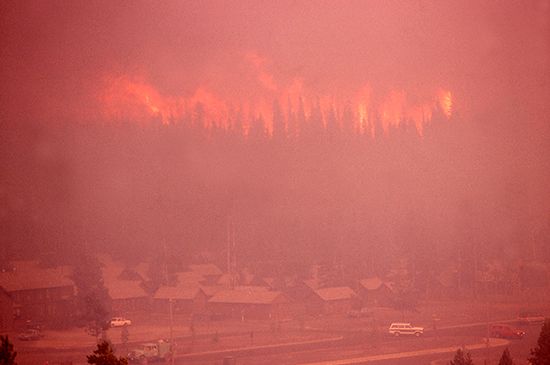
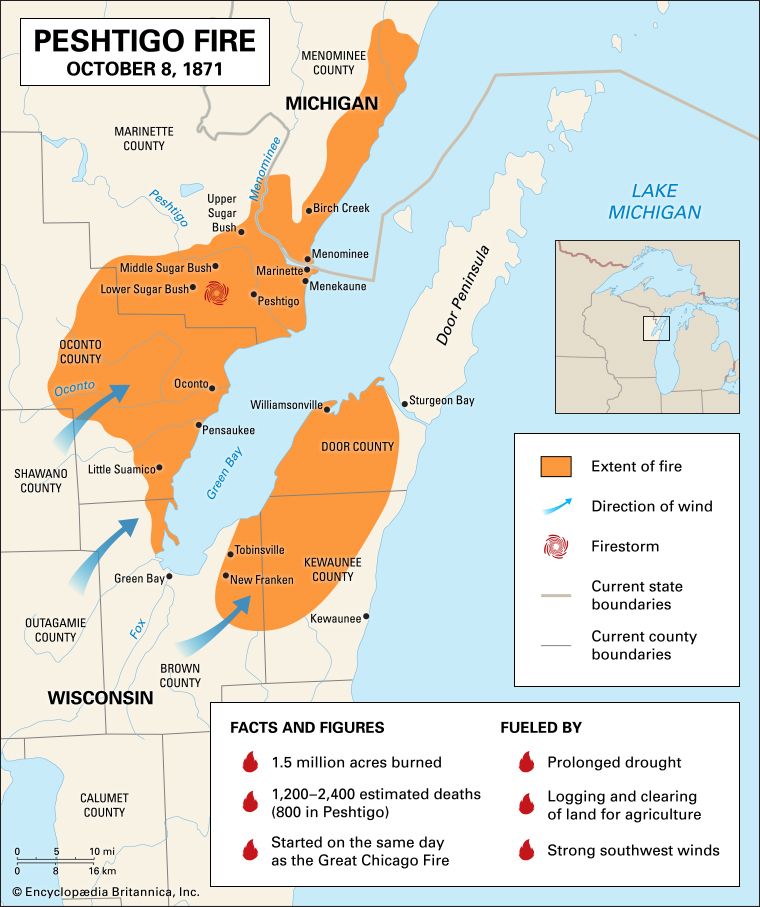
The Peshtigo Fire, which occurred on October 8, 1871, is the deadliest wildfire in recorded history. Ignited in the vicinity of the logging community of Peshtigo, Wisconsin, the fire was fueled by extreme drought, heat, and high winds, creating a massive firestorm that destroyed hundreds of square miles of forest and farmland.12
While there were 1,152 verified deaths, the true toll is difficult to determine because the fire destroyed town records and many victims in remote areas were never identified. Some estimates suggest the total number of fatalities may have been as high as 1,200 to 2,400. Despite its severity, the event is often overshadowed in historical memory by the Great Chicago Fire, which occurred on the same night.21
Why is the Peshtigo Fire less famous than the Great Chicago Fire?
The Peshtigo Fire is often overshadowed by the Great Chicago Fire primarily because the latter occurred in a major, rapidly growing urban center, which garnered significant national and international media attention. While the Peshtigo Fire was far deadlier—claiming between 1,200 and 2,400 lives compared to approximately 300 in Chicago—it took place in a remote logging region, limiting its immediate visibility to the broader public.314
Furthermore, the Great Chicago Fire became the subject of a persistent and sensationalized narrative involving the O’Leary family and their cow. This myth, fueled by anti-Irish and anti-Catholic sentiment, kept the Chicago fire in the public consciousness for generations. In contrast, the Peshtigo Fire lacked such a high-profile, albeit inaccurate, cultural focal point to anchor its story in the national memory. The sheer scale of the destruction in Chicago, which left 100,000 people homeless and devastated a major economic hub, also ensured that its recovery and rebuilding efforts became a central part of American history, further cementing its fame.143
What environmental conditions make a wildfire turn into a firestorm?
A firestorm is an exceptionally intense and destructive fire characterized by violent convection and powerful surface indrafts. Unlike a standard wildfire, a firestorm creates its own weather system, often generating tornado-like whirls of flame as hot air rapidly rises from the burning fuel.678
The transition from a wildfire to a firestorm is driven by specific environmental and physical conditions:
- Continuous Fuel Source: A firestorm requires a large, continuous area of intense fire. This massive heat output is necessary to sustain the powerful updraft that defines the phenomenon.67
- Violent Convection: As the fire consumes fuel, the rising hot air creates a vacuum at the surface. This causes strong, inrushing winds to be drawn into the fire from the surrounding area, which further fuels the combustion and increases the fire’s intensity.68
- Atmospheric Dynamics: The intensity of the fire creates a self-perpetuating cycle where the rising air and surface winds interact to create extreme turbulence, sometimes resulting in fire-driven whirlwinds.68
While wildfires are often exacerbated by drought, heat, and wind, a firestorm represents a level of intensity that is typically beyond human intervention, subsiding only when all available combustible material in the area has been consumed.69
How do modern firefighting techniques differ from those used in the 19th century?
Modern firefighting has evolved from a reactive, manual process into a highly technical, data-driven discipline. While 19th-century efforts relied primarily on basic hand tools and physical labor, contemporary techniques integrate advanced technology, chemical science, and strategic planning.
Key Differences in Approach and Technology
- Detection and Monitoring: In the 19th century, detection relied on human observation, such as tower lookouts. Today, this is augmented by satellites, radar, and drones equipped with infrared sensors and artificial intelligence to provide real-time data on fire movement and intensity.111213
- Suppression Agents: While water remains the primary tool, modern firefighting utilizes a sophisticated array of chemical agents. These include foaming agents for oil fires, “wet” water to reduce surface tension, and ablative water to create heat-absorbing blankets. Specialized substances like carbon dioxide, dry chemicals, and halogenated hydrocarbons are now used to combat specific fire classes, such as electrical or metal fires, which were far more difficult to manage in the past.11713
- Mechanization and Aerial Support: Modern fire departments employ specialized heavy equipment, such as bulldozers for creating firebreaks and the StormCell—a vehicle using jet engines to counter wind. Aerial firefighting has also advanced significantly; aircraft now drop water and fire-retardant slurries with high precision, a capability that did not exist in the 19th century.11121413
- Prevention and Codes: Unlike the 19th-century focus on purely extinguishing blazes, modern fire management emphasizes prevention. This includes strict building codes, the installation of automatic sprinkler systems, and the use of fire-retardant materials. Furthermore, prescribed fires are now used strategically to reduce fuel loads and maintain ecosystem health, a practice that contrasts with the historical tendency toward total fire suppression.111413
Sources
- Peshtigo — Encyclopædia Britannica
- What Is the Deadliest Wildfire in History? — Encyclopædia Britannica
- Great Chicago Fire — Encyclopædia Britannica
- Today in History—October 8: The Day Chicago Burned — Encyclopædia Britannica
- What Is the Deadliest Wildfire in History?: Top Questions — Encyclopædia Britannica
- fire storm — Encyclopædia Britannica
- Wildfire — Encyclopædia Britannica
- Santa Ana winds — Encyclopædia Britannica
- firestorm — Merriam-Webster
- 8 Words for Storms the Weather Report Didn't Mention | Firestorm — Merriam-Webster
- fire prevention and control — Encyclopædia Britannica
- Los Angeles wildfires of 2025 - Firefighting — Encyclopædia Britannica
- fire extinguisher — Encyclopædia Britannica
- forestry - Fire prevention and control — Encyclopædia Britannica
Published on · 4 min read