Fire Storm
A fire storm is a violent meteorological phenomenon characterized by a continuous area of intense fire that generates its own wind system. As hot air rises…
What is fire storm?
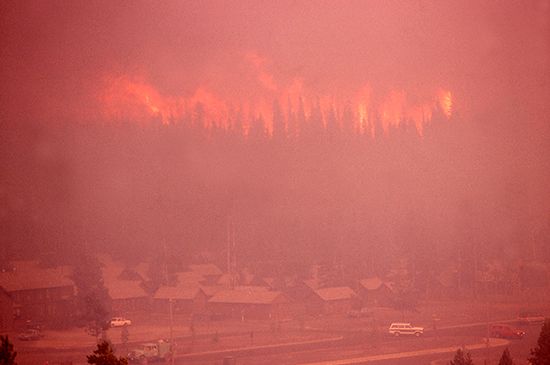
A fire storm is a violent meteorological phenomenon characterized by a continuous area of intense fire that generates its own wind system. As hot air rises rapidly from the burning fuel, it creates a powerful updraft that pulls in strong surface winds from the surrounding area, often resulting in destructive, tornado-like whirls of flame.12
These events are typically beyond human intervention and continue to rage until all combustible material in the locality is consumed. While the term can refer to intense natural wildfires, it is also specifically associated with conflagrations ignited by nuclear or incendiary weapons, which create the extreme heat and massive updrafts necessary to sustain such powerful inrushing winds. Figuratively, the term is also used to describe sudden, turbulent outbursts or raging controversies.132
How does the intense heat of a firestorm create its own wind system?
The intense heat of a fire storm creates its own wind system through a process of violent convection. As the fire consumes fuel over a continuous area, it generates extreme heat that causes the air above the burning material to rise rapidly.12
This rising hot air creates a powerful updraft, which acts like a vacuum, pulling in strong surface winds from the surrounding area toward the center of the fire. These inrushing winds serve to further fuel the conflagration, often resulting in destructive, tornado-like whirls of flame. Because this system is self-sustaining, it typically continues to rage until all combustible material in the immediate vicinity is consumed, rendering the event beyond human intervention.241
What is the difference between a standard wildfire and a firestorm?
The primary difference between a standard wildfire and a fire storm lies in the intensity of the convection and the resulting wind systems.
While a wildfire is an uncontrolled fire in vegetation, it can sometimes escalate into a fire storm if the heat becomes extreme enough to create its own self-sustaining weather system. The key distinctions include:14
- Wind Dynamics: A fire storm is defined by violent surface indrafts. The intense heat creates a massive updraft that pulls in strong winds from the surrounding area, often generating tornado-like whirls of flame. Standard wildfires are generally driven by ambient environmental winds rather than creating their own localized wind systems.164
- Control and Intervention: Standard wildfires can often be managed or suppressed through human intervention, such as prescribed fire or firefighting efforts. In contrast, a fire storm is typically beyond human control and continues until all combustible material in the area is exhausted.14
- Origins: While wildfires often start from natural causes like lightning, fire storms are frequently associated with the extreme, concentrated heat generated by nuclear or incendiary weapons.6
Why are firestorms considered impossible for humans to extinguish?
Fire storms are considered impossible for humans to extinguish because they function as self-sustaining, large-scale atmospheric systems rather than localized blazes.
The extreme heat generated by a continuous area of fire creates a powerful, violent convection process. This process produces intense surface indrafts—strong winds that pull air toward the center of the fire—which effectively feed the flames with a constant supply of oxygen. Because the fire creates its own weather system, it operates on a scale and intensity that overwhelms conventional fire-fighting equipment and suppression tactics. Consequently, these events typically continue to rage until all combustible material in the locality is completely consumed, at which point the system naturally subsides.1
Sources
- fire storm — Encyclopædia Britannica
- firestorm — Merriam-Webster
- What Is the Deadliest Wildfire in History? — Encyclopædia Britannica
- 8 Words for Storms the Weather Report Didn't Mention | Firestorm — Merriam-Webster
- 10 of the World’s Largest Fires — Encyclopædia Britannica
- convection: Top Questions — Encyclopædia Britannica
- Forest fire — Encyclopædia Britannica
- fire prevention and control — Encyclopædia Britannica
Published on · 3 min read