Why Is Nitrogen Essential to Life?
Nitrogen is essential to life because it serves as a fundamental building block for the molecules that compose all living organisms. It is a critical…
Why is nitrogen essential to life?
Nitrogen is essential to life because it serves as a fundamental building block for the molecules that compose all living organisms. It is a critical component of amino acids, which link together to form proteins, and it is vital for the structure of DNA and RNA, the molecules that carry genetic information.12
Beyond its role in genetic and structural material, nitrogen is necessary for energy processes. It is a core component of chlorophyll, which allows photosynthetic organisms to capture light energy, and adenosine triphosphate (ATP), the primary molecule used for energy transfer within cells.1
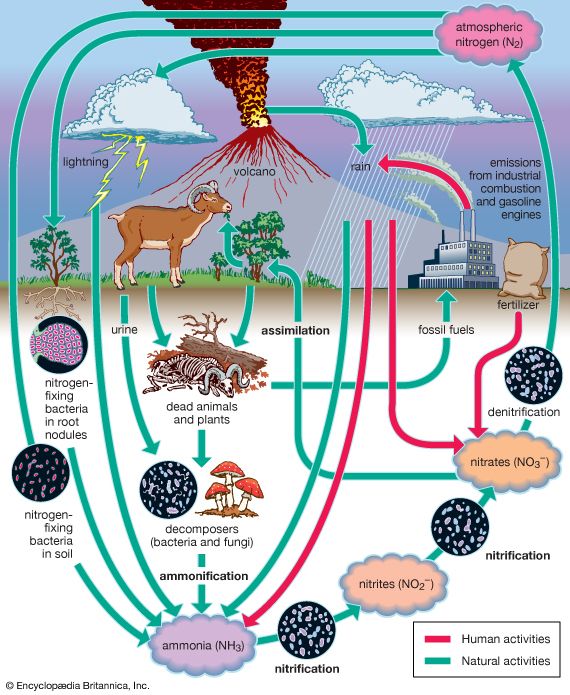
Although nitrogen makes up about 78 percent of Earth’s atmosphere, most organisms cannot use it in its gaseous form. Life relies on nitrogen fixation—a process primarily performed by bacteria and archaea—to convert atmospheric nitrogen into reactive compounds like ammonia and nitrates that plants and animals can incorporate into their tissues.13
How do bacteria perform nitrogen fixation?
Bacteria perform nitrogen fixation by converting atmospheric nitrogen (N2N_2) into ammonia, a reactive compound that living organisms can utilize for growth and development. This process is primarily catalyzed by an enzyme called nitrogenase, which is found in various nitrogen-fixing bacteria.6789
These microorganisms are categorized into two main groups:
- Free-living (nonsymbiotic) bacteria: These organisms, such as Azotobacter, Clostridium, and cyanobacteria like Anabaena and Nostoc, fix nitrogen independently in their environments.68
- Mutualistic (symbiotic) bacteria: These bacteria, such as Rhizobium, form intimate relationships with host plants. They invade the root hairs of plants, stimulating the formation of root nodules. Within these nodules, the bacteria receive nutrients from the plant while converting nitrogen into ammonia, which the host plant then uses for its development.67810
Together, these bacteria are responsible for more than 90 percent of all biological nitrogen fixation, serving as a vital link in the nitrogen cycle.68
What is the role of chlorophyll in photosynthesis?
Chlorophyll is the primary pigment responsible for driving photosynthesis, the process by which light energy is converted into chemical energy to synthesize organic compounds like carbohydrates.1112
Its role functions through two main mechanisms:
- Light Harvesting: Chlorophyll molecules act as an antenna, absorbing sunlight and transferring the resulting electronic excitation energy to a specialized reaction centre within the chloroplasts.1312
- Energy Conversion: Within the reaction centre, a special pair of chlorophyll molecules initiates a charge-transfer reaction. By absorbing light, these molecules become excited and transfer an electron to adjacent pigments. This movement of electrons across a membrane creates a difference in electrical charge, effectively storing energy that is later used to power the production of high-energy chemical species.13
Structurally, chlorophyll consists of a magnesium atom at the center of a porphyrin ring, with a long phytol chain attached. This design allows it to efficiently capture light energy across the solar spectrum.1112
How does the Haber-Bosch process impact agriculture?
The Haber-Bosch process revolutionized agriculture by providing an economically feasible method to synthesize ammonia from atmospheric nitrogen and hydrogen.1415
Before its development, the world faced a potential food crisis because natural sources of nitrogen—essential for plant growth—could not keep pace with the demands of a growing global population. While nitrogen makes up 78 percent of the atmosphere, it is inert and unavailable to plants unless “fixed” into reactive compounds like ammonia or nitrates.158
By enabling the large-scale production of synthetic fertilizers, the Haber-Bosch process allowed for a massive increase in crop yields, supporting intensive agriculture worldwide. This innovation effectively bypassed the limitations of relying on scarce natural deposits, such as Chile saltpetre, and remains a fundamental pillar of the modern chemical industry and global food security.15814
Sources
- Why is nitrogen essential to life? — Encyclopædia Britannica
- How the Nitrogen Cycle Works — Encyclopædia Britannica
- Nucleic acid - Basic structure — Encyclopædia Britannica
- Plant disease - Adverse environment — Encyclopædia Britannica
- Nitrogen-fixing bacteria: Top Questions — Encyclopædia Britannica
- Nitrogen-fixing bacteria — Encyclopædia Britannica
- Bacteria: Top Questions — Encyclopædia Britannica
- nitrogen fixation — Encyclopædia Britannica
- Fabaceae - Nitrogen fixation — Encyclopædia Britannica
- nitrogenase — Merriam-Webster
- Chlorophyll: Top Questions — Encyclopædia Britannica
- photochemical reaction - Photochemical steps in photosynthesis — Encyclopædia Britannica
- Chlorophyll — Encyclopædia Britannica
- Haber-Bosch process — Encyclopædia Britannica
- Fritz Haber - Early research — Encyclopædia Britannica
Published on · 3 min read