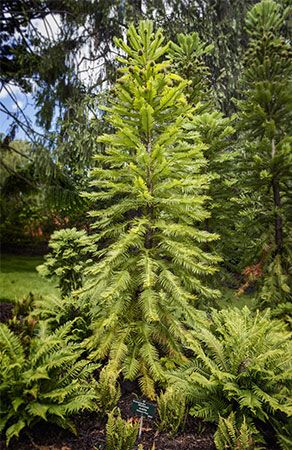
Wollemi Pine
The scientific classification of the Wollemi pine (Wollemia nobilis) is as follows:
What is the scientific classification of the Wollemi pine?
The scientific classification of the Wollemi pine (Wollemia nobilis) is as follows:
- Kingdom: Plantae
- Division: Pinophyta
- Class: Pinopsida
- Order: Pinales
- Family: Araucariaceae
- Genus: Wollemia1
This rare coniferous tree is the only living member of its genus and is often referred to as a “living fossil” because it is nearly identical to ancestors that existed during the Jurassic Period.1
Where was the Wollemi pine discovered, and how long was it thought to be extinct?
The Wollemi pine (Wollemia nobilis) was discovered in 1994 within a remote canyon in Wollemi National Park, located approximately 200 km (120 miles) northwest of Sydney, Australia1.1
While the species is often called a “living fossil” because it is morphologically similar to ancestors dating back to the Jurassic Period, it was not previously thought to be extinct in the sense of a recently vanished species. Rather, the genus Wollemia had been absent from the fossil record for approximately 10 million years, as other species within the genus gradually became extinct over that timeframe. The discovery of W. nobilis revealed that this specific lineage had survived in a sheltered microclimate, despite the group having been much more widespread and diverse millions of years ago.2
What are the unique characteristics and features of the Wollemi pine tree?
The Wollemi pine (Wollemia nobilis) is a rare coniferous tree with several distinct physical and evolutionary characteristics:
Physical Description
- Growth and Bark: Adult trees can reach heights of up to 40 meters (about 130 feet). As they age, they frequently become multistemmed. Their dark, reddish-brown bark is uniquely characterized by spongy nodules, giving it a distinct “bubbly” appearance.1
- Leaves: The tree features resinous leaves that vary by branch type. Fertile branches have stiff, flattened, strap-shaped leaves up to 8 cm long arranged in four ranks, while shade and juvenile branches have shorter, narrower leaves arranged in two ranks.1
- Reproduction: The tree is monoecious, meaning both male (microsporangiate) and female (megasporangiate) cones grow on the same tree. The male cones are slender and pendulous, while the female cones are massive, globose, and appear spiny due to their outwardly curved scales. A single female cone can produce over 300 winged seeds.1
Evolutionary Significance
Often called a “living fossil,” the species is nearly identical to ancestors from the Jurassic Period. Its pollen is virtually indistinguishable from fossils dating back over 90 million years to the Cretaceous Period.1
How tall can Wollemi pines grow, and what is their typical lifespan?
The Wollemi pine (Wollemia nobilis) can reach heights of up to 40 meters (approximately 130 feet).1
Regarding the typical lifespan of the tree, the provided information does not specify a duration. While the species is recognized as a “living fossil” with a lineage dating back to the Jurassic Period, specific data regarding the longevity of individual trees is not available in the current knowledge base.1
Sources
- Wollemi pine — Encyclopædia Britannica
- New South Wales - Plant and animal life — Encyclopædia Britannica
Published on · 2 min read