Bunya Pine
The bunya pine (Araucaria bidwillii) is a large evergreen conifer native to the humid regions of southeastern Queensland, Australia. Despite its name, it is…
What is Bunya pine?
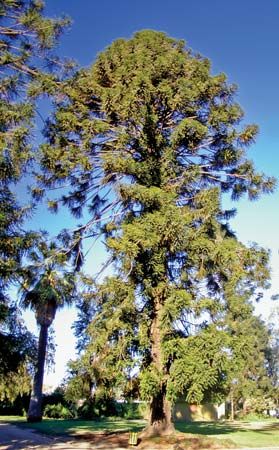
The bunya pine (Araucaria bidwillii) is a large evergreen conifer native to the humid regions of southeastern Queensland, Australia. Despite its name, it is not a true pine but a member of the Araucariaceae family pine but a member of the Araucariaceae family.1
The tree is characterized by a symmetrical branch structure, a dome-shaped crown, and thick, resinous bark. It can reach heights of 30 metres (100 feet) or more. Its female cones are massive, weighing up to 18 kg (40 pounds), and contain large seeds that were traditionally roasted and eaten by Australian Aboriginal peoples. These seeds exhibit a unique “cryptogeal” germination strategy, where the root develops into a tuber to protect the plant from wildfires.12
Beyond its ecological significance, the bunya pine is valued for its cream-coloured wood and is frequently cultivated as an ornamental or, in its sapling stage, as a houseplant.13
What is cryptogeal germination and why is it useful?
Cryptogeal germination is a specialized reproductive strategy observed in certain plants, most notably the bunya pine (Araucaria bidwillii). In this process, the seed’s emerging root develops into a tuber beneath the soil surface, which then serves as the base from which the plant’s sprout eventually grows.1
This adaptation is considered highly useful for survival in fire-prone environments for several reasons:
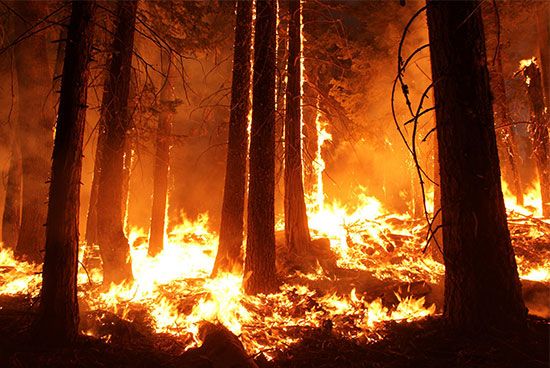
- Protection from Wildfires: By establishing an underground tuber, the plant protects its vital growth tissues from the intense heat of surface fires. Even if the above-ground portion of a young plant is destroyed by flames, the underground structure allows the plant to survive and potentially resprout.14
- Strategic Emergence: This mechanism allows the young plant to remain in a protected, dormant-like state until environmental conditions are optimal for growth, ensuring the seedling has the best chance of establishing itself successfully.1
This strategy is one of several ways plants have evolved to endure or thrive in habitats frequently impacted by fire, alongside other adaptations like thick, fire-retardant bark and the ability to resprout from underground woody organs.4
How does the monkey puzzle tree compare to the Bunya pine?
The monkey puzzle tree (Araucaria araucana) and the bunya pine (Araucaria bidwillii) are both members of the Araucariaceae family, sharing a genus characterized by symmetrical, whorled branches and evergreen foliage.2
While they share a family, they differ in native geography and specific traits:
Feature
Monkey Puzzle Tree
Bunya Pine
Native Region
Andes Mountains
, South America
Queensland
, Australia
Height
Up to 50 metres (164 feet)
Typically 30+ metres
Leaves
Rigid, needle-pointed, spirally arranged
Stiff, flattened, pointed
Common Use
Ornamental and timber
Ornamental and houseplant (as sapling)
The monkey puzzle tree is famous for its prickly, challenging branch structure, which inspired its name, and it can live for over 700 years. In contrast, the bunya pine is noted for its massive, edible cones and unique cryptogeal germination strategy, which helps it survive wildfires. Both species are valued for their distinct growth habits, though the monkey puzzle tree is currently listed as an endangered species due to habitat loss.72
What are some other unique plants found in Australia?
Australia is home to a diverse array of unique flora, many of which have evolved specialized adaptations to survive the continent’s often harsh, nutrient-poor, and fire-prone environments.8
Notable Australian Plants
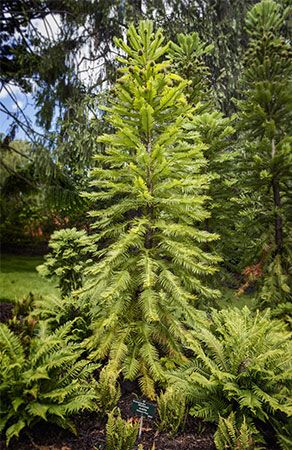
- Wollemi Pine: Often called a “living fossil,” this rare coniferous tree was discovered in a remote canyon in 1994. It is the only member of its genus and represents a lineage that dates back to the Jurassic Period.9
- Eucalyptus: With over 400 species, these trees range from small mallees to forest giants. Many species are highly adapted to fire, possessing specialized buds under their bark that allow them to resprout after a blaze.810
- Grass Trees: These plants are well-known for their ability to flower prolifically following a wildfire. They often retain dense, dead leaves around their stems, which serve as thermal insulation against intense heat.10
- Western Australian Pitcher Plant: As the only member of the family Cephalotaceae, this small perennial herb is unique for bearing both “traditional” leaves and specialized pitfall traps to capture prey in nutrient-poor, swampy soils.6
- Kangaroo Paws: These distinctive plants are part of the Haemodoraceae family and are iconic examples of Australia’s unique, autochthonous (native) flora.811
- Spinifex Grasses: Widespread in Australian deserts, these spiny, hummock-forming grasses (Triodia and Plectrachne) are highly adapted to arid conditions and help define the character of the landscape.1213
Sources
- bunya pine — Encyclopædia Britannica
- Araucaria — Encyclopædia Britannica
- bunya bunya — Merriam-Webster
- Germination — Encyclopædia Britannica
- Seed - Afterripening, stratification, and temperature effects — Encyclopædia Britannica
- Playing with Wildfire: 5 Amazing Adaptations of Pyrophytic Plants — Encyclopædia Britannica
- monkey puzzle tree — Encyclopædia Britannica
- Australia - Plant life — Encyclopædia Britannica
- Wollemi pine — Encyclopædia Britannica
- pitcher plant — Encyclopædia Britannica
- Plants on Fire - Learn more — Encyclopædia Britannica
- Desert - Flora — Encyclopædia Britannica
- Emblems of Australia — Encyclopædia Britannica
- South Australia - Plant and animal life — Encyclopædia Britannica
- Xerophyte — Encyclopædia Britannica
Published on · 3 min read