Yosemite National Park
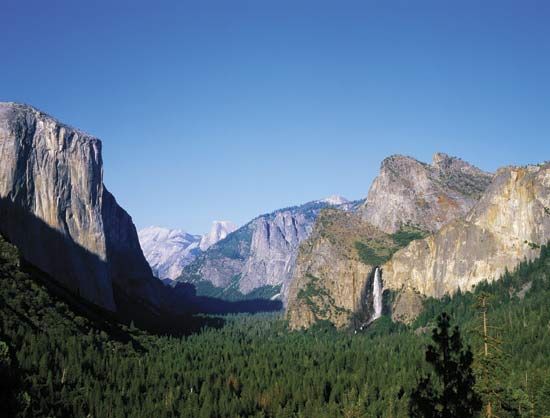
Yosemite National Park is home to several iconic natural landmarks, many of which are concentrated within the glacially carved Yosemite Valley.
What are some of the most famous natural features and landmarks in Yosemite National Park?
Yosemite National Park is home to several iconic natural landmarks, many of which are concentrated within the glacially carved Yosemite Valley.
Famous Landmarks and Natural Features
- Yosemite Falls: One of the world’s highest cataracts, this series of waterfalls has a total drop of 2,425 feet (740 meters), comprising the Upper Yosemite Fall, a series of cascades, and the Lower Yosemite Fall.12
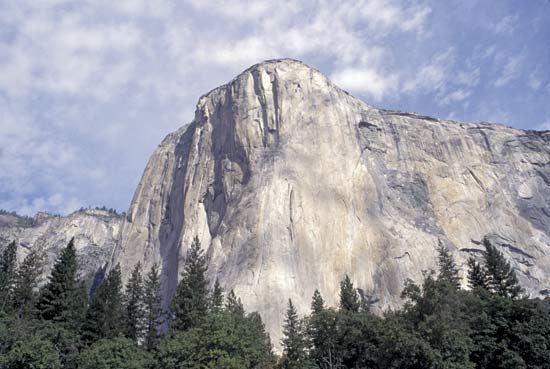
- El Capitan: A massive granite monolith that towers approximately 3,600 feet (1,100 meters) above the floor of Yosemite Valley. It is a world-renowned destination for rock climbers.32
- Half Dome: Located at the head of the valley, this prominent peak reaches an elevation of 8,836 feet (2,693 meters) and offers commanding views of the surrounding region.32
- Waterfalls: Beyond Yosemite Falls, the park features several other notable cascades, including Bridalveil Fall, Nevada Fall, Ribbon Fall, and Vernal Fall.2
- Mariposa Grove: Located in the southern part of the park, this area is famous for its stands of giant sequoias.2
What are some popular activities and attractions for visitors to Yosemite National Park?
Visitors to Yosemite National Park can enjoy a wide variety of recreational activities and cultural attractions:
- Outdoor Recreation: Hiking is a primary activity, with hundreds of miles of trails available, including sections of the Pacific Crest National Scenic Trail and the John Muir Trail. The park is also a premier destination for rock climbing, with thousands of climbers scaling its famous granite domes and peaks annually. During the warmer months, rafting is permitted on parts of the Merced River, while the Badger Pass Ski Area serves as a hub for winter sports.
- Sightseeing: Visitors frequently explore the iconic Yosemite Valley to view massive landmarks like El Capitan and Half Dome, as well as spectacular waterfalls such as Yosemite Falls, Bridalveil Fall, and Vernal Fall.
- Education and Culture: The Yosemite Museum in Yosemite Village offers exhibits on the region’s native Miwok and Paiute peoples. Additionally, visitors can explore the Mariposa Grove to see giant sequoias.
What types of flora and fauna can be found in Yosemite National Park?
Yosemite National Park features a diverse range of flora and fauna that varies significantly with elevation.4
Flora
The park’s vegetation changes markedly as one moves from the lower elevations to the high alpine zones:
- Lower Elevations: Characterized by scattered deciduous and coniferous trees, shrubs, and meadows that bloom with wildflowers in the spring.4
- Yosemite Valley: Home to larger stands of conifers, including the famous giant sequoias found in the Mariposa Grove.4
- Higher Elevations: Closer to the timberline, the landscape supports mountain hemlocks and lodgepole pines.4
- Alpine Zones: These rocky, high-altitude areas support only cold-tolerant species, such as lichens.4
Fauna
The park hosts a plentiful and varied animal population:
- Mammals: Large mammals include mule deer, black bears, coyotes, mountain lions, and the endangered Sierra Nevada bighorn sheep. Smaller mammals include various squirrels, chipmunks, bats, and the rare Pacific fisher.4
- Birds: More than 250 species have been observed, including Steller’s jays, western meadowlarks, and mountain bluebirds.4
- Other Wildlife: The park also supports populations of amphibians (salamanders, toads, and frogs), lizards, and fish, particularly trout.4
Where is Yosemite National Park located, and how large is it?
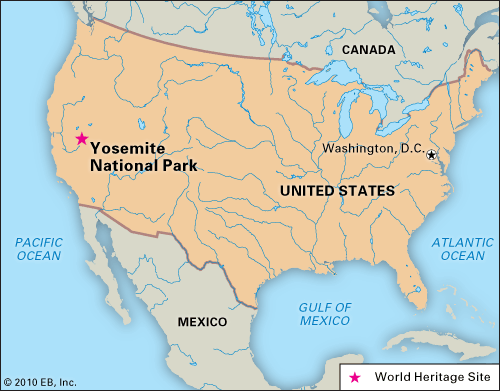
Yosemite National Park is located in the scenic mountain region of east-central California, U.S. It is situated approximately 140 miles (225 km) east of San Francisco and about 100 miles (160 km) southeast of Sacramento.5
The park encompasses a total area of 1,189 square miles (3,080 square km).5
Sources
- Yosemite Falls — Encyclopædia Britannica
- El Capitan — Encyclopædia Britannica
- Yosemite National Park — Encyclopædia Britannica
- Sierra Nevada - Plant life — Encyclopædia Britannica
- Sierra National Forest — Encyclopædia Britannica
Published on · 3 min read