9 (Lives Of) Famous Cat Lovers
Throughout history, many influential figures have shared their lives with cats, celebrating the unique character and companionship of these felines. While…
What are 9 (Lives of) Famous Cat Lovers?
Throughout history, many influential figures have shared their lives with cats, celebrating the unique character and companionship of these felines. While the “9 Lives” list is a curated collection, notable examples include:
- Ai Weiwei: The Chinese artist and activist has famously remarked on the distinct personality of every cat, regardless of how many one owns.1
- Taylor Swift: A prominent modern cat enthusiast, Swift owns three cats—Meredith Grey, Olivia Benson, and Benjamin Button—who frequently appear in her media and even joined her on the cover of Time magazine.2
- Literary Figures: Writers such as Théophile Gautier, Charles Baudelaire, Rudyard Kipling, Colette, and T.S. Eliot all paid homage to cats in their work.3
- Presidential Pets: Several U.S. presidents have kept cats, including the famous Socks, who lived with the Clinton family and became the first presidential pet to have his own website.4
How were cats viewed in ancient Egyptian culture?
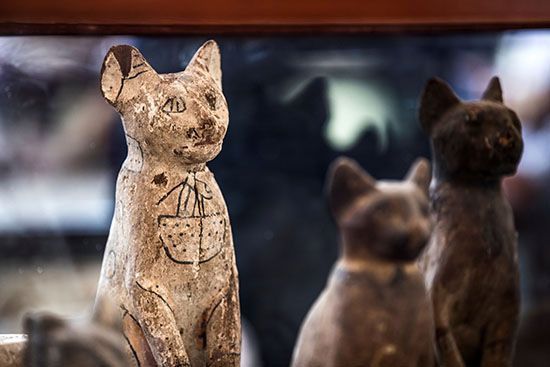
In ancient Egypt, cats held a position of profound social and cultural importance, evolving from practical predators into revered symbols of divinity. Initially valued for their role in protecting granaries and crops from rodents, they eventually became cherished companions and talismans of good fortune became cherished companions and talismans of good fortune.56
Their status was deeply intertwined with religion. Cats were associated with the goddess Bastet, who was often depicted as a woman with a cat’s head. While goddesses were typically represented as lionesses in their fiercer aspects, they were viewed as cats when in a milder, more benevolent state. Egyptians believed that cats were divine protectors in both this life and the afterlife, and that their bodies might even be inhabited by gods.65
This reverence was reflected in Egyptian society:
- Art and Adornment: Cat imagery appeared prominently on tomb walls and household artifacts, while royalty adorned their cats in gold.5
- Mummification: Thousands of cats were mummified and buried with the same care as humans, sometimes accompanied by mouse mummies to provide food in the afterlife.57
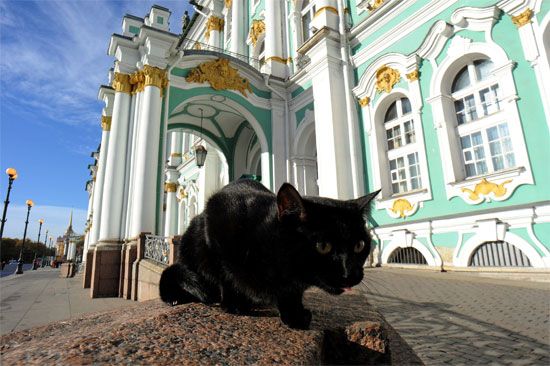
What are some common superstitions about black cats around the world?
Superstitions surrounding black cats vary significantly across cultures, often reflecting historical fears or local folklore.
In many Western cultures, black cats are traditionally viewed as harbingers of bad luck. This belief is rooted in medieval European folklore, where black cats were frequently associated with witchcraft and demonology. During the 14th to 18th centuries, they were often depicted as familiars—low-ranking demons gifted to witches by the devil—leading to their widespread mistreatment. Consequently, the superstition that crossing paths with a black cat brings misfortune became a common cultural trope, similar to other warnings like walking under a ladder.9310
Conversely, other cultures view black cats as symbols of prosperity and good fortune:
- Japan: Black cats are widely considered an omen of good luck.93
- Scotland: Folklore in this region has historically associated black cats with the arrival of prosperity.10
- Ancient Egypt: Cats of all colors were held in high regard and considered sacred to the goddess Bastet, serving as divine protectors.10
Despite these varying superstitions, there is no scientific evidence to suggest that black cats differ from other felines in their capacity to be loving and deserving pets.9
Who are some famous authors who have written about cats?
Throughout history, many notable authors have incorporated cats into their work or expressed a deep appreciation for them. Here are some prominent writers who have written about or paid homage to cats:
- T.S. Eliot: The Nobel Prize-winning poet is perhaps most famous in this regard for his collection of whimsical poems, Old Possum’s Book of Practical Cats (1939), which served as the inspiration for the long-running Broadway musical Cats.6
- Rudyard Kipling, Colette, and Théophile Gautier: These 20th-century writers are recognized for their literary contributions featuring cats, with Gautier and Charles Baudelaire notably paying homage to the species in their writings.11
- Aesop: The ancient Greek writer frequently included cats in his famous fables.11
- Ernest Hemingway: While known primarily for his novels, Hemingway’s life and home in Key West were famously associated with his beloved polydactyl (six-toed) cats, which have become a cultural fixture of his legacy.12
Additionally, cats have appeared in various historical documents and cultural texts, such as the Cat-Book Poems from the Ayutthayan period in Siam (now Thailand), which contain detailed descriptions and illustrations of different feline breeds.11
Sources
- 9 (Lives of) Famous Cat Lovers — Encyclopædia Britannica
- 11 Popular—Or Just Plain Odd—Presidential Pets — Encyclopædia Britannica
- cat - Associations with human culture — Encyclopædia Britannica
- 9 (Lives of) Famous Cat Lovers - Taylor Swift — Encyclopædia Britannica
- Bastet — Encyclopædia Britannica
- cat - Domestication — Encyclopædia Britannica
- ancient Egyptian religion - The Gods — Encyclopædia Britannica
- 7 Surprising Uses for Mummies — Encyclopædia Britannica
- Why are black cats unlucky? — Encyclopædia Britannica
- Halloween - Cats and bats — Encyclopædia Britannica
- Ernest Hemingway - The Spanish influence — Encyclopædia Britannica
- Cats — Encyclopædia Britannica
- Haruki Murakami — Encyclopædia Britannica
- Japanese literature - The postwar novel — Encyclopædia Britannica
Published on · 4 min read