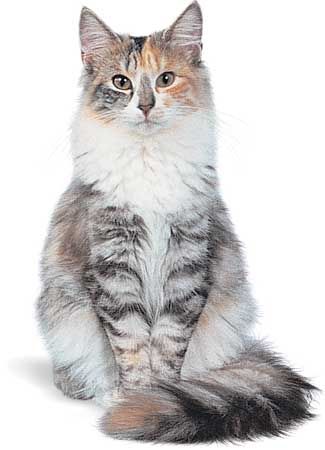
Cat
Domestic cat breeds are groups of related felines that share common physical characteristics, known as conformation, or originate from the same geographic…
What are the different breeds of domestic cats, and how do they vary?
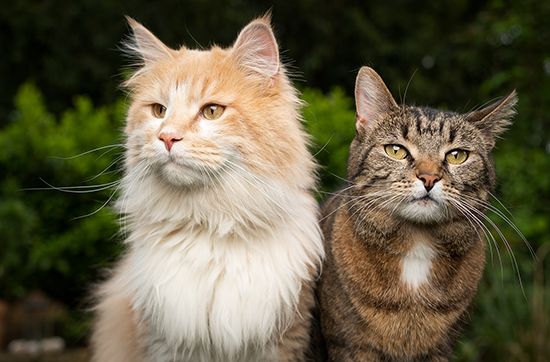
Domestic cat breeds are groups of related felines that share common physical characteristics, known as conformation, or originate from the same geographic region. While most pet cats are categorized as “Companion Cats,” pedigreed breeds are defined by specific “standards” that describe their ideal attributes.12
Body Types
Most breeds fall into three primary body types:3
- Cobby: Compact and deep-chested with broad shoulders and a large, round head (e.g., Persian).
- Svelte: Slim and lithe with long, tapering lines and a wedge-shaped head (e.g., Siamese).
- Moderate: A balance between the cobby and svelte types (e.g., Burmese).
Variation Factors
Breeds vary significantly due to environmental adaptations and genetic mutations. For instance, the Siberian and Norwegian Forest Cat developed dense coats for cold climates. Other variations include:14
- Size: Maine Coon cats can weigh up to 22 pounds, while the Munchkin is noted for its short legs.3
- Coat: Variations range from the hairless Sphynx to curly-coated breeds like the Cornish Rex.5
- Color/Pattern: Traits like the colorpoint pattern in Himalayans result from temperature-sensitive albinism.54
How do cats’ sleep patterns differ from humans, and why do they sleep so much?
Cats and humans have distinct sleep patterns rooted in their evolutionary history as predators. While humans typically follow a monophasic sleep cycle, cats are crepuscular, meaning they are most active during the twilight hours of dawn and dusk when their prey, such as rodents and birds, are active.10
Cats sleep an average of 15 hours daily, with some reaching up to 20 hours. Their sleep is divided into two types:10
- Slow-wave sleep (SWS): Comprising about three-fourths of their rest, this is a shallow, “ready” state where their senses remain alert. These 15–30 minute catnaps allow them to react instantly to their environment.10
- Deep sleep: Occurring for the remaining one-fourth of their rest, this includes REM sleep. During these five-minute increments, cats may dream, often indicated by trembling paws.10
Cats sleep extensively because they are hardwired by heredity to conserve energy for the intense physical effort required to hunt. Even domestic cats, who do not need to hunt for food, follow this internal clock, often sleeping out of boredom.10

What are some common health issues that affect domestic cats?
Domestic cats are susceptible to a variety of health issues, ranging from infectious diseases and parasites to chronic conditions. Maintaining a cat’s health often requires regular veterinary checkups and preventative care.
Infectious Diseases
Several viral infections can significantly impact a cat’s immune system or respiratory health:
- Feline leukemia virus (FeLV): A retrovirus that suppresses the immune system, making cats vulnerable to secondary infections.11
- Feline infectious peritonitis (FIP): Caused by a feline coronavirus, this can lead to severe illness, particularly in young cats.11
- Feline immune deficiency virus (FIV): Similar to human HIV, this virus weakens the immune response and is primarily transmitted through bite wounds.11
- Respiratory and Systemic Viruses: Feline panleukopenia virus (FPV), Feline viral rhinotracheitis (FVR), and Feline caliciviruses (FCV) are highly contagious and often require vaccination for prevention.11
Parasites
Cats can host various external and internal parasites:
- External: Fleas are the most common, causing skin irritation and anemia. Ticks and mites are also frequent concerns.12
- Internal: Common internal parasites include tapeworms, heartworms, roundworms, and hookworms, which can cause serious digestive or respiratory distress.12
Other Common Concerns
- Feline lower urinary tract disease (FLUTD): A group of disorders that can cause painful or obstructed urination, requiring immediate medical attention.11
- Dental disease: Often overlooked, dental issues can lead to systemic health problems, including heart and kidney disease.13
- Zoonotic diseases: Some illnesses, such as rabies, toxoplasmosis, and ringworm, can be transmitted to humans, making hygiene and preventative care essential.12
How and when did cats first become domesticated?
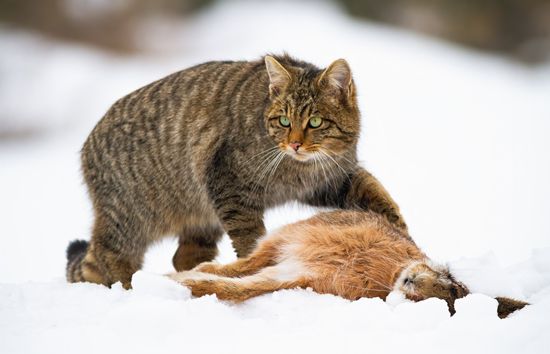
The domestication of cats was not a sudden event but a gradual process of mutual benefit. Unlike dogs, which were actively bred for specific roles, cats are often not considered fully domesticated because they remain genetically similar to their wild ancestor, the wildcat (Felis silvestris lybica), and retain their independent nature.14
The association between humans and cats likely began 15,000–10,000 years ago in the Middle East alongside the origins of agriculture. As humans transitioned to farming, stored grain attracted rodents, which in turn drew wildcats. This created a symbiotic relationship: humans gained natural pest control, and cats found a reliable food source.14
Evidence of this deepening bond includes a 9,500-year-old burial in Cyprus containing both a human and a cat. Since cats are not native to the island, they must have been transported there by boat, suggesting they were already valued as companions. By the time of ancient Egypt, cats had evolved from useful predators into revered symbols of divinity and cherished household pets.14
Sources
- cat - Body types and features — Encyclopædia Britannica
- cat - Breed origins — Encyclopædia Britannica
- Siamese — Encyclopædia Britannica
- List of cat breeds — Encyclopædia Britannica
- cat - Dominant and recessive genes — Encyclopædia Britannica
- longhair — Encyclopædia Britannica
- 16 Questions About Pets Answered - What is the most common household pet in the United States? — Encyclopædia Britannica
- cat - Colors and patterns — Encyclopædia Britannica
- cat - List of selected longhair breeds — Encyclopædia Britannica
- Why Do Cats Sleep So Much? — Encyclopædia Britannica
- cats as pets - Common diseases and ailments — Encyclopædia Britannica
- cats as pets - Zoonotic diseases — Encyclopædia Britannica
- cats as pets - Nail, tooth, and ear care — Encyclopædia Britannica
- cat - Domestication — Encyclopædia Britannica
Published on · 4 min read