Rodent
Rodents are characterized by a specialized dental structure adapted for gnawing. Their most notable feature is a pair of constantly growing, rootless…
What are the unique dental characteristics of rodents?
Rodents are characterized by a specialized dental structure adapted for gnawing. Their most notable feature is a pair of constantly growing, rootless incisors in both the upper and lower jaws. These teeth possess a hard layer of enamel on the front and softer dentine on the back; this differential wear during gnawing creates and maintains perpetually sharp, chisel-like edges.12
Because rodents lack canine teeth and other incisors, they have a distinct gap, known as a diastema, between their incisors and their cheek teeth (premolars and molars). The jaw articulation is uniquely arranged to ensure that the incisors do not meet while the animal is chewing, and the cheek teeth do not make contact while the animal is gnawing. These movements are powered by complex, intricately divided masseter muscles attached to the skull and jaw. Depending on the species, cheek teeth may be rooted or rootless and can vary in crown height.1
How have rodents evolved over time, and what are some extinct rodent species?
The evolutionary history of rodents (order Rodentia) spans at least 56 million years, with the earliest known fossil evidence appearing in the Late Paleocene Epoch of North America. While these fossils are the oldest recorded, experts believe the order originated earlier in Eurasia. Understanding their precise evolutionary relationships remains a “continuing quest,” as scientists rely on a combination of fossil discoveries, comparative anatomy, and DNA analysis to test hypotheses regarding their classification into suborders.1
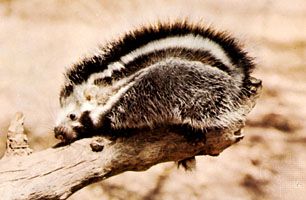
The fossil record reveals that rodent diversity was once significantly higher than it is today. For instance, while the maned rat is the only living member of its subfamily, fossil fragments from the Pliocene Epoch in Morocco indicate the existence of at least two additional extinct species in that genus.5
Extinct rodents also reached remarkable sizes. The largest rodent ever recorded, Josephoartigasia monesi, lived during the Pliocene and Pleistocene epochs; it is estimated to have reached 3 meters (10 feet) in length and weighed nearly 1,000 kg—comparable to a small rhinoceros or black bear.6
What are the defining characteristics of rodents as mammals?
Rodents (order Rodentia) are the largest group of mammals, comprising nearly half of all known mammalian species. Their defining characteristic is a specialized dental arrangement featuring a single pair of constantly growing, rootless incisors in both the upper and lower jaws.89
These incisors are uniquely structured with a hard layer of enamel on the front and softer dentine on the back. As the animal gnaws, this differential wear naturally maintains the teeth as perpetually sharp, chisel-like tools. Because rodents lack canine teeth and additional incisors, they possess a distinct gap, or diastema, between their incisors and their cheek teeth (premolars and molars).9
Beyond their teeth, rodents are defined by complex masseter muscles that power their chewing and gnawing. Their jaw articulation is specifically adapted to ensure that the incisors do not meet while the animal is chewing, and the cheek teeth do not make contact while the animal is gnawing. While they exhibit diverse body forms—ranging from fossorial burrowers to arboreal gliders—they all share these fundamental tools for cutting, digging, and foraging.91
What are some examples of well-known rodent species?
The order Rodentia is the largest group of mammals, encompassing more than 2,050 living species across 27 distinct families. These animals are found in nearly every land environment on Earth, excluding Antarctica and a few isolated islands.8
Below are some well-known examples of rodent species, categorized by their common groupings:
- True Rats and Mice (Family Muridae): This family includes the house mouse (Mus musculus) and the brown rat (Rattus norvegicus), both of which are closely associated with human habitats.81110
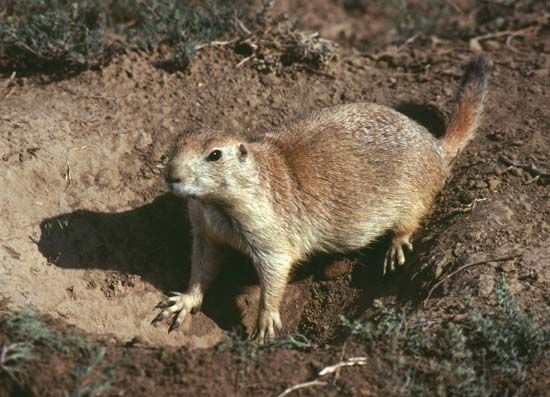
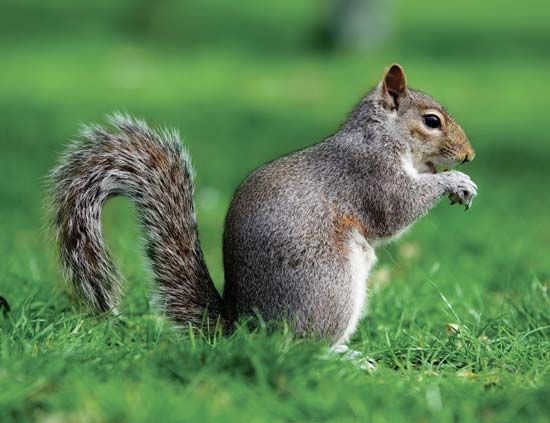
- Squirrels (Family Sciuridae): This diverse family includes tree squirrels, flying squirrels, chipmunks, marmots, groundhogs, and prairie dogs.810
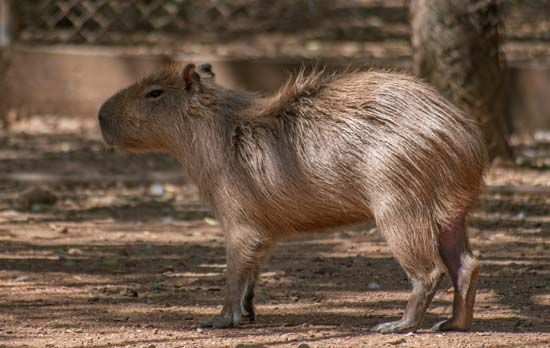
- Cavy Family (Family Caviidae): This group features the capybara—the world’s largest living rodent—as well as the guinea pig and the mara.1012
- Other Notable Rodents:
- Beavers: Known for their aquatic adaptations and dam-building behavior.810
- Porcupines: Distinguished by their sharp, defensive quills, found in both New World and Old World varieties.810
- Chinchillas: Valued for their soft fur and often kept as pets.81110
- Hamsters: Popular household pets, such as the golden hamster.1110
- Pocket Gophers: Known for their burrowing habits and specialized cheek pouches.810
Sources
- rodent - General features — Encyclopædia Britannica
- 16 Questions About Pets Answered - Why does my guinea pig have buck teeth? — Encyclopædia Britannica
- primate - Teeth — Encyclopædia Britannica
- enamel — Encyclopædia Britannica
- rodent - Evolution and classification — Encyclopædia Britannica
- maned rat — Encyclopædia Britannica
- mammal - Teeth — Encyclopædia Britannica
- rodent — Encyclopædia Britannica
- rodent - Form and function — Encyclopædia Britannica
- rodent - Importance to humans — Encyclopædia Britannica
- chipmunk — Encyclopædia Britannica
- list of rodents — Encyclopædia Britannica
- guinea pig — Encyclopædia Britannica
Published on · 3 min read