Aardvark
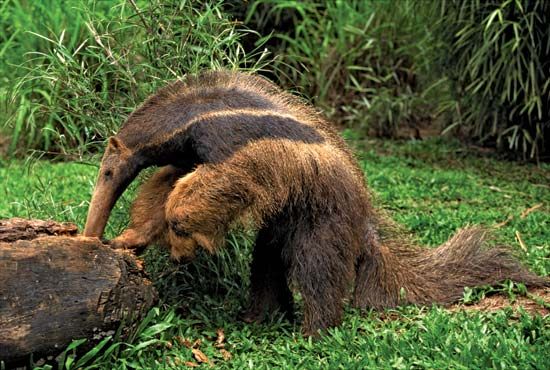
Although aardvarks and anteaters share a similar diet of ants and termites and possess tubular muzzles, they are not closely related. This is a classic…
How do aardvarks compare to other insectivorous mammals like anteaters?
Although aardvarks and anteaters share a similar diet of ants and termites and possess tubular muzzles, they are not closely related. This is a classic example of convergent evolution, where unrelated species develop similar physical traits to adapt to similar ecological niches.
Evolutionary Differences
- Aardvarks: The aardvark (Orycteropus afer) is the only living member of the order Tubulidentata. It is actually more closely related to elephants, hyraxes, and manatees than to other insectivores.
- Anteaters: These animals belong to the suborder Vermilingua within the order Pilosa, placing them in the magnorder Xenarthra, which also includes sloths.
Physical and Behavioral Comparisons
Feature
Aardvark
Anteater
Habitat
African savannas and semiarid areas.
Tropical forests and savannas (Americas).
Shelter
Excavates its own complex, branching
burrows
.
Generally does not use permanent dens; rests in secluded spots.
Defense
Digs rapidly to escape or slashes with strong claws.
Uses hind legs and tail as a tripod to slash with front claws.
Teeth
Possesses unique columnlike tubules of dentine.
Entirely toothless.
Where are aardvarks typically found in the wild, and what type of habitat do they prefer?
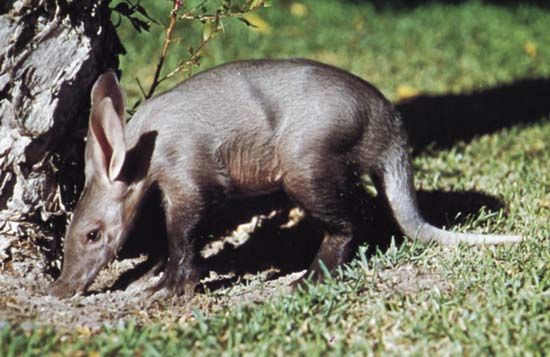
Aardvarks (Orycteropus afer) are found throughout sub-Saharan Africa. They are highly adaptable creatures that primarily inhabit savanna environments and semiarid regions.13
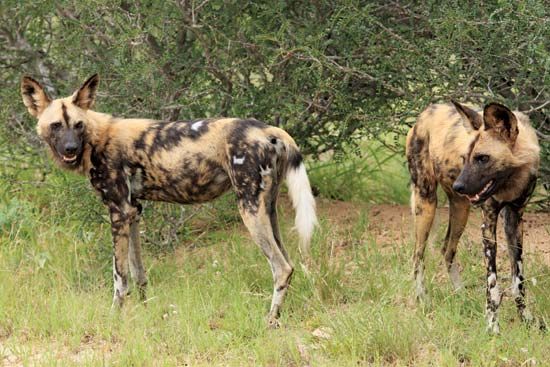
These nocturnal mammals are well-known for their specialized burrowing habits, which define much of their interaction with their habitat. They excavate complex, branching burrows that can reach lengths of up to 13 meters and include multiple sleeping chambers. Because they frequently abandon old dens to dig new ones, their burrowing activity plays an important role in the ecosystem, providing essential shelter for various other species, such as the African wild dog.1
How are aardvarks classified within the animal kingdom, and what other animals are they related to?
The aardvark (Orycteropus afer) is classified within the animal kingdom as the sole living member of the order Tubulidentata and the family Orycteropodidae. The name of the order, which means “tube teeth,” refers to the unique structure of their molars, which are composed of fused, columnlike tubules of dentine.15
Despite their physical resemblance to anteaters, aardvarks are not closely related to them. Instead, they belong to a group of primitive ungulates known as uranotherians. Their closest evolutionary relatives include:1
- Elephants (order Proboscidea)
- Hyraxes (order Hyracoidea)
- Dugongs and manatees (order Sirenia)
Molecular data also suggests a potential evolutionary link between these groups and elephant shrews, which are thought to have descended from the same ancient African stock. This lineage diverged from other mammalian orders, such as carnivores and xenarthrans, approximately 90 million years ago.14
What are the unique physical characteristics of an aardvark?
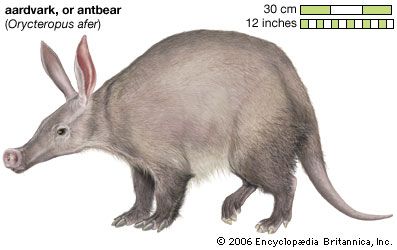
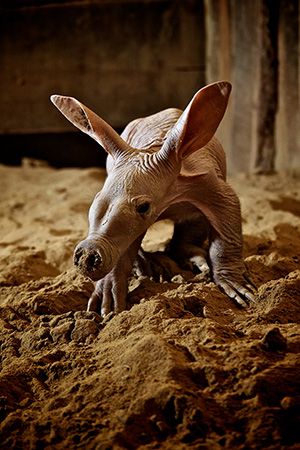
The aardvark (Orycteropus afer) possesses several unique physical characteristics adapted for its specialized lifestyle as a burrowing insectivore:
- Body and Build: It is a stocky mammal that can weigh up to 65 kg (145 pounds) and reach lengths of 2.2 meters, including a heavy, 70-cm tail. Its coat is scant and yellowish-gray, while its thick hide provides protection against insect bites and stings.1
- Head and Snout: The face is narrow with an elongated snout, very reduced eyes, and large ears that can grow up to 24 cm long. Fleshy sensory organs on the nasal septum help detect underground movements, and the nostrils can be squeezed shut to exclude dust.1
- Feeding Adaptations: Aardvarks lack incisors and canine teeth. Their molars are composed of fused, columnlike tubules of dentine, which gives the order Tubulidentata its name. They possess a sticky tongue that can extend up to 30 cm to lap up termites and ants.1
- Limbs: The front feet have four toes, while the hind feet have five. These are equipped with strong, flattened, spade-like nails used for rapid excavation.1
Sources
- aardvark — Encyclopædia Britannica
- anteater — Encyclopædia Britannica
- aardwolf — Encyclopædia Britannica
- aardvark — Merriam-Webster
- Tubulidentata — Merriam-Webster
- elephant shrew — Encyclopædia Britannica
Published on · 3 min read