Canna
A canna is a genus of about 10 species of tropical flowering plants and the sole member of the family Cannaceae, which belongs to the order Zingiberales.…
What is canna?
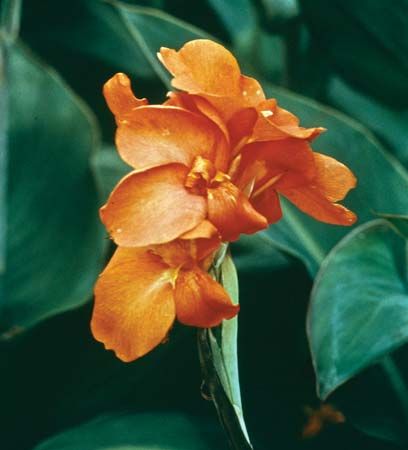
A canna is a genus of about 10 species of tropical flowering plants and the sole member of the family Cannaceae, which belongs to the order Zingiberales. These plants are native to regions ranging from southeastern North America through South America.1
Cannas are characterized by their rhizomes (underground stems) and erect stems that can reach up to 3 meters (10 feet) in height. They are widely recognized for their showy flowers and attractive leaves, which may be green or bronze. While many varieties are grown as ornamentals, such as the dwarf French canna, others are cultivated for their edible, starchy rhizomes, including Indian shot and Canna edulis (often referred to as edible canna).123
How do rhizomes help plants grow?
Rhizomes are horizontal, typically subterranean plant stems that play a vital role in a plant’s survival and expansion. They facilitate growth and development through several key functions:
- Vegetative Reproduction: Rhizomes allow plants to propagate asexually. By branching and spreading through the soil, they enable the plant to multiply and form new colonies. Many plants, such as bamboos and grasses, rely on the fragmentation of these stems to propagate.45
- Food and Water Storage: These stems store essential starches and proteins. This stored energy is critical for the plant to survive periods of dormancy, such as extended winters or drought.45
- Perennation: By remaining underground, rhizomes help plants survive annual unfavorable seasons. They act as a protected base from which new shoots and root systems can emerge when conditions become favorable again.45
Unlike roots, rhizomes possess nodes with reduced leaves and internodes, which serve as the points from which new growth originates.5
What are some other plants in the Zingiberales order?
The order Zingiberales is a diverse group of flowering plants comprising eight families. Beyond the Cannaceae family, other notable members include:
- Zingiberaceae: The largest family in the order, known for aromatic herbs and significant spices, including ginger, turmeric, and cardamom. Other ornamental members include the ginger lily and shellflower.78
- Musaceae: The banana family, which includes plants of major economic importance such as the banana, plantain, and abaca, the latter being a source of strong fibers.79
- Marantaceae: This family includes the West Indian arrowroot, various Calathea species, and the popular decorative prayer plant.7
- Strelitziaceae: Home to the bird-of-paradise flower and the traveler’s tree, which is the largest member of the order.7
Other families, such as Heliconiaceae, Lowiaceae, and Costaceae, are primarily cultivated for their horticultural value.7
How are ornamental plants different from agricultural crops?
The primary distinction between ornamental plants and agricultural crops lies in their intended purpose. While agricultural crops are generally grown and harvested for profit or subsistence—such as for food, livestock feed, fiber, or industrial use—ornamental plants are cultivated primarily for their aesthetic beauty and decorative value in landscape gardening.1112
Despite this functional difference, ornamentals are still considered a category of crop within the broader agricultural industry. The production of ornamentals, known as ornamental horticulture, is divided into two main sectors:11
- Floriculture: Focuses on the production of flowers and pot plants, often within greenhouse environments that require precise environmental control and strict scheduling to meet seasonal demand.13
- Landscape Horticulture: Involves the nursery business, which produces woody and herbaceous plants, including trees, shrubs, and bulb crops like rhizomes and tubers, for permanent planting.13
While the distinction between these categories is sometimes blurred—as some nurseries also produce fruit plants or perennial vegetables—the core objective remains the defining factor.13
Sources
- canna — Encyclopædia Britannica
- edible canna — Merriam-Webster
- French canna — Merriam-Webster
- rhizome — Encyclopædia Britannica
- plant reproductive system - Reproduction by special asexual structures — Encyclopædia Britannica
- angiosperm - Shoot system modifications — Encyclopædia Britannica
- Zingiberales - Families — Encyclopædia Britannica
- Zingiberales — Encyclopædia Britannica
- Zingiberales - General features — Encyclopædia Britannica
- Zingiberaceae — Encyclopædia Britannica
- horticulture - Ornamental horticulture — Encyclopædia Britannica
- Crop — Encyclopædia Britannica
- ornamental — Merriam-Webster
- horticulture - Shrubs — Encyclopædia Britannica
- ornamental — Merriam-Webster
Published on · 3 min read