Acorn and Nut Weevil
The acorn and nut weevil refers to any of approximately 45 species of weevils belonging to the subfamily Curculioninae and the family Curculionidae. These…
What is acorn and nut weevil?
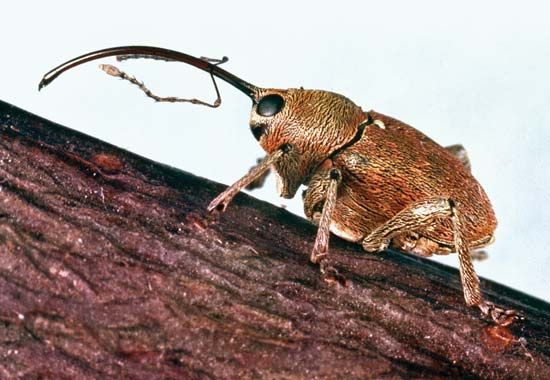
The acorn and nut weevil refers to any of approximately 45 species of weevils belonging to the subfamily Curculioninae and the family Curculionidae. These insects are characterized by their extremely long, slender snouts, which in females can reach nearly twice the length of their bodies, with mandibles positioned at the very tip.1
Common throughout Europe and North America, these weevils are named for their reproductive habits: females use their snouts to chew holes into nuts, where they then deposit their eggs. The resulting larvae develop inside the nut. Different species exhibit specific preferences for their hosts; for instance, Curculio proboscides typically targets large chestnuts, while C. rectus and C. baculi are known to feed on acorns.123
How do these weevils use their long snouts to lay eggs?
Female acorn and nut weevils utilize their specialized snouts as a tool for both feeding and reproduction. Because the mandibles are located at the very tip of this long, slender snout, the female is able to bore deep, precise holes into the hard shells of nuts.13
Once the female has successfully chewed a hole through the nut’s exterior, she uses the same opening to deposit her eggs inside. This process ensures that the developing larvae have immediate access to a food source, as the larvae of these weevils feed exclusively on the interior of the nut. This evolutionary adaptation of the snout is a primary reason for the success of the Curculionidae family, allowing them to exploit plant seeds and fruits that would otherwise be inaccessible to many other insects.153
What is the life cycle of a typical weevil?
Like all beetles, weevils undergo complete metamorphosis, a life cycle consisting of four distinct developmental stages: egg, larva, pupa, and adult.5
- Egg: The cycle begins when the female uses her snout to bore a hole into a plant part—such as a seed, fruit, stem, or root—and deposits her eggs inside.78
- Larva: Upon hatching, the legless, white, and soft-bodied larvae begin to feed on the plant tissue. As they grow, they undergo a process called molting, where they shed their skin (cuticle) three to five times to accommodate their increasing size.795
- Pupa: Once the larva reaches maturity, it enters a nonfeeding prepupal stage before transitioning into the pupa. During this stage, the insect is soft and pale, with its wings and appendages folded against its body.5
- Adult: The adult emerges from the pupal skin, at which point its outer skeleton hardens and gains its final coloration. Once the adult stage is reached, the insect does not grow further.5
The duration of each stage is heavily influenced by environmental factors such as climate, habitat, and food availability.5
How do trees defend themselves against these insects?
Trees have evolved a diverse array of physical and chemical strategies to defend themselves against insects like weevils and other herbivores. These defenses are categorized into several primary mechanisms:
Chemical Defenses
Plants produce a variety of defensive substances to deter or poison insects. These include:
- Secondary Metabolites: Trees synthesize chemicals such as alkaloids and aromatic terpenes that can be toxic or unpalatable to herbivores.11
- Exudates: Some species, such as rubber trees, produce sticky latex that can entrap insects, preventing them from feeding or laying eggs.11
Structural Defenses
Trees utilize physical barriers to make their tissues difficult to consume or penetrate:
- Toughened Tissues: Mature leaves are often reinforced with structural materials, making them harder to chew than young, soft leaves.11
- Surface Structures: Many trees feature trichomes (hairy projections), spines, or thorns—such as the 30 cm spines found on some palms—to physically deter insects.11
- Crystalline Substances: The presence of oxalic acids within plant tissues can act as a deterrent to feeding.11
Biological and Strategic Defenses
- Defensive Mutualisms: Some trees engage in symbiotic relationships, such as providing housing for ants that, in turn, defend the tree against caterpillars and other insects.11
- Growth Strategies: Trees may protect their vulnerable new growth by producing many leaves simultaneously to “satiate” herbivores, or by carefully timing the allocation of expensive nutrients like chlorophyll until leaves have toughened.11
- Vigor and Health: A healthy, vigorous tree is generally more resistant to infestation. Forest management practices, such as selective cutting of susceptible trees, help maintain forest health and reduce the breeding grounds for pests.12
Sources
- acorn and nut weevil — Encyclopædia Britannica
- nut weevil — Merriam-Webster
- acorn weevil — Merriam-Webster
- List of insects - beetles and weevils (order Coleoptera) — Encyclopædia Britannica
- weevil — Encyclopædia Britannica
- Curculio — Encyclopædia Britannica
- Coleoptera - Larvae — Encyclopædia Britannica
- Coleoptera - General features — Encyclopædia Britannica
- primitive weevil — Encyclopædia Britannica
- Coleoptera - As plant feeders — Encyclopædia Britannica
- forestry - Insect and disease control — Encyclopædia Britannica
- Eating the rainforest — Encyclopædia Britannica
- Coleoptera - Special ecological relationships — Encyclopædia Britannica
Published on · 3 min read