Climacograptus
Climacograptus is an extinct genus of graptolites, which were small, aquatic colonial animals related to primitive chordates. These organisms lived during…
What is Climacograptus?
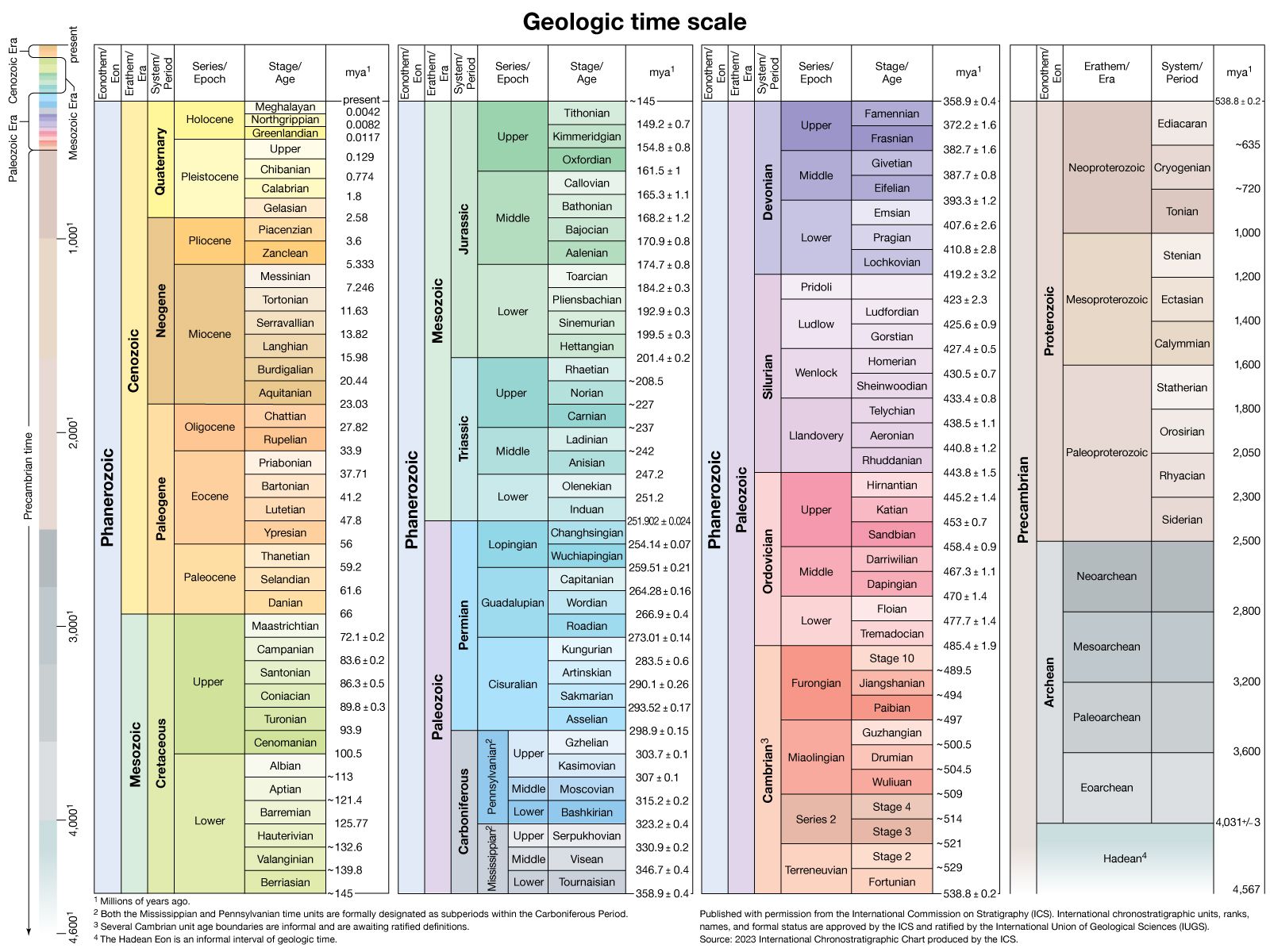
Climacograptus is an extinct genus of graptolites, which were small, aquatic colonial animals related to primitive chordates. These organisms lived during the Middle and Late Ordovician Period, approximately 472 million to 444 million years ago.12
Physically, Climacograptus is identified by a single, serrated branch that hangs from a thin stem beneath an irregular float, giving it a distinctively angular outline. Like other graptolites, they possessed a chitinous outer covering rather than mineralized hard parts and are frequently found as fossils in marine rocks.12
Because they show a clear development over time, Climacograptus species serve as valuable index fossils, helping geologists correlate and divide smaller time units within the Ordovician period.12
What are index fossils and why are they important to geologists?
An index fossil is any plant or animal preserved in the Earth’s rock record that serves as a marker for a specific geologic time or environment. To be considered a useful index fossil, an organism must meet several criteria: it must be easily recognizable, abundant, widely distributed geographically, and have a relatively short existence through time.4
These fossils are essential to geologists because they provide the foundation for defining boundaries within the geologic time scale and allow for the correlation of rock strata across different regions. By identifying these specific species, scientists can determine the relative age of sedimentary layers. For example, while many trilobites are useful for regional dating, pelagic species like Agnostida are particularly valued for intercontinental correlation due to their wide distribution. Similarly, conodonts are considered excellent global indexes for rocks ranging from the uppermost Cambrian to the Triassic Period.45
How do scientists determine the age of fossils found in marine rocks?
Scientists determine the age of fossils found in marine rocks by using a combination of relative and absolute dating methods.
Relative Dating
Relative dating establishes the sequence of events without providing a specific numerical age. This is primarily achieved through:
- Principle of Superposition: In undisturbed sedimentary sequences, older layers are deposited at the bottom, while younger layers accumulate on top.6
- Biostratigraphy: Geologists use index fossils—organisms that were abundant, widely distributed, and existed for a short time—to correlate rock layers across different regions.78
- Microfossils: Because they are abundant in marine sediments, microscopic organisms like foraminifera and ostracods are used to classify and divide Mesozoic and Cenozoic sediments into detailed time units.59
Absolute Dating
Absolute dating provides a numerical age by measuring the decay of radioactive isotopes within minerals.1011
- Radiometric Dating: Scientists analyze the ratio of parent isotopes to daughter isotopes in a sample. Because decay occurs at a constant, known rate, this ratio reveals the time elapsed since the mineral formed.11
- Specialized Methods: Techniques such as protactinium-231–thorium-230 dating are specifically used to date marine sediments by measuring the decay of these isotopes.12
What are hemichordates and how are they related to graptolites?
Hemichordates are a group of wormlike marine invertebrates that serve as a significant link in evolutionary biology. Often considered a phylum, they are primitive deuterostomes that share evolutionary connections with both chordates and echinoderms, though molecular studies suggest they are more closely related to the latter. The phylum includes three main classes: the solitary, wormlike acorn worms; the minute, colonial pterobranchs; and the planktonic Planctosphaeroidea.1314
Graptolites are an extinct group of small, colonial marine animals that are widely considered to be related to hemichordates. Specifically, they are often classified as a diverse group of Paleozoic hemichordates. Like modern pterobranchs, graptolites were colonial, tube-building organisms.14213
Because they were abundant, widely distributed, and evolved rapidly, graptolites such as Phyllograptus are highly valued by geologists as index fossils. These fossils allow scientists to correlate rock units across vast distances and provide a precise method for dating Lower Paleozoic strata.1423
Sources
- Climacograptus — Encyclopædia Britannica
- graptolite — Encyclopædia Britannica
- Phyllograptus — Encyclopædia Britannica
- index fossil — Encyclopædia Britannica
- Cambrian Period - Correlation of Cambrian strata — Encyclopædia Britannica
- dating: Top Questions — Encyclopædia Britannica
- dating - Determination of sequence — Encyclopædia Britannica
- dating - Distinctions between relative-age and absolute-age measurements — Encyclopædia Britannica
- protactinium-231–thorium-230 dating — Encyclopædia Britannica
- dating - Principles of isotopic dating — Encyclopædia Britannica
- Earth sciences - Micropaleontology — Encyclopædia Britannica
- geology - Micropaleontology — Encyclopædia Britannica
- hemichordate — Encyclopædia Britannica
- Animal - Appearance of animals — Encyclopædia Britannica
Published on · 3 min read