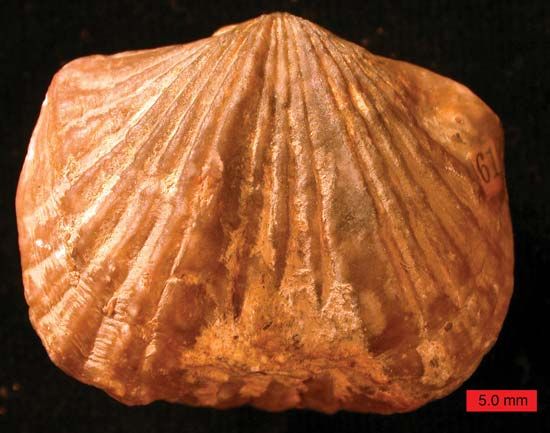
Diplograptus
Diplograptus is a genus of extinct, colonial marine animals belonging to the group known as graptolites. These organisms are believed to be related to…
What is Diplograptus?
Diplograptus is a genus of extinct, colonial marine animals belonging to the group known as graptolites. These organisms are believed to be related to primitive chordates or hemichordates.12
Physically, Diplograptus was relatively large for a graptolite and featured a caplike float from which featherlike assemblages of individual organisms were suspended. Because they existed during the Ordovician period (approximately 505 to 438 million years ago), they serve as important index fossils, helping geologists correlate rock units found in different locations. Like other graptolites, they lacked mineralized hard parts and possessed a chitinous outer covering, which is why they are often preserved as carbonaceous impressions in shale.12
What are index fossils and why are they important?
An index fossil is a plant or animal remain preserved in the Earth’s rock record that serves as a diagnostic marker for a specific span of geologic time or a particular environment.3
To be considered an ideal index fossil, a specimen should possess the following characteristics:
- Short temporal range: The species existed for only a brief moment in geologic history, allowing for precise dating.34
- Wide geographic distribution: The organism was cosmopolitan, meaning it can be found in many locations globally.34
- Abundance: The fossils are common enough to be easily discovered.34
- Distinctive appearance: They are easily recognizable, which prevents misidentification.34
Index fossils are essential because they provide the basis for defining boundaries in the geologic time scale and for the correlation of rock strata across different regions. By applying the principle of faunal succession, geologists can determine the relative age of fossiliferous rocks, a sequence that has been consistently validated by modern radiometric dating.34
How do scientists determine the age of fossils?
Scientists determine the age of fossils and the rocks in which they are found using two primary approaches: relative dating and absolute dating.5
Relative Dating
Relative dating establishes the sequence of events without providing a specific numerical age. This method relies on:
- Stratigraphy: By applying the law of superposition, scientists know that in undisturbed sedimentary layers, the oldest rocks and fossils are at the bottom, while the youngest are at the top.3
- Index Fossils: These are remains of organisms that were abundant, widespread, and existed for a short period. Because they are characteristic of specific time spans, they allow geologists to correlate rock layers across different geographic regions.65
Absolute Dating
Absolute dating provides a numerical age by measuring the decay of radioactive isotopes within minerals.75
- Isotopic Dating: Scientists measure the ratio of “parent” radioactive atoms to “daughter” atoms produced by decay. Because this decay occurs at a constant, known rate, the ratio reveals how much time has passed since the mineral formed.85
- Carbon-14 Dating: Used for organic materials up to about 60,000 years old, this method tracks the decay of radioactive carbon absorbed by living organisms.9
- Precision: Techniques like uranium-lead dating offer high precision, allowing scientists to calibrate the fossil record and date Earth’s oldest rocks.75
What are hemichordates and how are they related to graptolites?
Hemichordates are a group of wormlike marine invertebrates that serve as a significant evolutionary link between chordates and echinoderms. Although their name suggests a “half-chordate” status due to a structure once mistaken for a notochord, molecular studies now indicate they are more closely related to echinoderms. They are typically divided into three classes: the solitary acorn worms, the colonial pterobranchs, and the planktonic Planctosphaeroidea.10
Graptolites are an extinct group of small, colonial marine animals that are widely considered to be related to hemichordates. While hemichordates are relatively inconspicuous today, they were highly diverse during the Paleozoic Era, and most of these ancient forms are classified as graptolites.112
Because graptolites were abundant, widespread, and evolved rapidly during the Ordovician and Silurian periods, they are highly valued as index fossils. Their fossils, such as those of the genera Phyllograptus and Tetragraptus, allow geologists to correlate rock units across vast distances and refine the dating of Paleozoic strata.1121213
Sources
- Diplograptus — Encyclopædia Britannica
- graptolite — Encyclopædia Britannica
- index fossil — Encyclopædia Britannica
- dating - Principles and techniques — Encyclopædia Britannica
- dating: Top Questions — Encyclopædia Britannica
- stratigraphy — Encyclopædia Britannica
- dating - Principles of isotopic dating — Encyclopædia Britannica
- dating - Carbon-14 dating and other cosmogenic methods — Encyclopædia Britannica
- dating - Distinctions between relative-age and absolute-age measurements — Encyclopædia Britannica
- hemichordate — Encyclopædia Britannica
- Animal - Appearance of animals — Encyclopædia Britannica
- Phyllograptus — Encyclopædia Britannica
- Chordate — Encyclopædia Britannica
- Tetragraptus — Encyclopædia Britannica
Published on · 3 min read