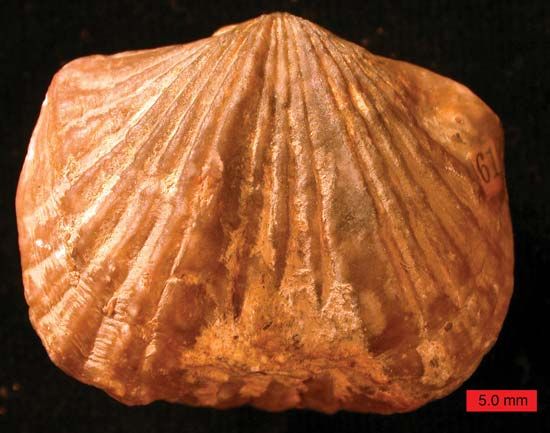
Phyllograptus
Phyllograptus is a genus of extinct graptolites, which were small, colonial marine animals related to primitive chordates. They are easily identified by…
What is Phyllograptus?
Phyllograptus is a genus of extinct graptolites, which were small, colonial marine animals related to primitive chordates. They are easily identified by their distinct, leaflike structure.12
These organisms are highly significant in geology as index fossils for Ordovician rocks, which date from approximately 488.3 million to 443.7 million years ago. Because they evolved over time, they allow scientists to correlate and date rock units found in widely separated locations. Like other graptolites, they were aquatic, possessed a chitinous outer covering, and lacked mineralized hard parts, often leaving behind carbonaceous impressions in shale.12
What are index fossils and why are they important?
An index fossil is any plant or animal preserved in the Earth’s rock record that serves as a marker for a specific span of geologic time or a particular environment. To be effective, these fossils must be easily recognizable, abundant, widely distributed geographically, and possess a short temporal range.3
These fossils are essential to geology for several reasons:
- Defining Time Boundaries: They provide the foundational basis for establishing the boundaries within the geologic time scale.3
- Correlation of Strata: They allow scientists to correlate rock layers across different regions, helping to synchronize the history of sedimentary deposits globally.3
- Biostratigraphy: By identifying specific fossil assemblages, researchers can create high-resolution zones—such as those developed by micropaleontologists using plankton—to map historical geology across vast distances.4
While modern geochronology now integrates radioisotopic dating and magnetostratigraphy, index fossils remain a primary tool for biostratigraphic correlation.4
How are graptolites related to modern hemichordates?
Graptolites are widely considered to be related to hemichordates, a primitive group of invertebrate deuterostomes that also includes modern pterobranchs and acorn worms.15
The connection between these groups is supported by several key observations:
- Colonial Structure: Like modern pterobranchs such as Rhabdopleura and Cephalodiscus, many graptolites lived in secreted tubes organized into colonial structures.2
- Evolutionary Lineage: It is widely suggested that pterobranchs may be the modern descendants of the extinct graptolites, which flourished in the oceans during the Paleozoic Era.2
- Biological Features: Both groups share characteristics of primitive chordate ancestors. Graptolites were bilaterally symmetrical, tentacled animals that possessed a chitinous outer covering, similar to the biological organization found in hemichordates.52
While hemichordates are sometimes grouped near chordates due to their shared evolutionary history, they remain a distinct phylum because they lack certain defining chordate features.16
What characterizes the Ordovician Period?
The Ordovician Period (485.4 to 443.8 million years ago) was the second period of the Paleozoic Era, characterized by profound changes in plate tectonics, climate, and biological evolution.89
Geological and Climatic Conditions
Rapid seafloor spreading led to some of the highest global sea levels in the Phanerozoic Eon, causing extensive flooding of the continents. Atmospheric carbon dioxide levels were significantly higher than today, fostering a warm, greenhouse climate. However, the period ended with a brief, intense interval of glaciation over the Southern Hemisphere, which contributed to a major drop in sea levels.891011
Biological Diversification and Extinction
The period is famous for the “Ordovician radiation,” an intense diversification of marine life that saw the emergence of almost every modern phylum of marine invertebrate. Common organisms included brachiopods, bryozoans, trilobites, mollusks, echinoderms, and graptolites. Additionally, the first plants appeared on land., the first plants appeared on land.8912
The period concluded with the second-largest mass extinction in Earth’s history, which claimed roughly 85 percent of all species, likely driven by rapid cooling and fluctuating sea levels.811
Sources
- Phyllograptus — Encyclopædia Britannica
- graptolite — Encyclopædia Britannica
- index fossil — Encyclopædia Britannica
- Tertiary Period - Correlation of Tertiary strata — Encyclopædia Britannica
- Animal - Appearance of animals — Encyclopædia Britannica
- pterobranch — Encyclopædia Britannica
- Chordate - Critical appraisal — Encyclopædia Britannica
- A Journey Through Time Since the Precambrian - Ordovician Period: 485.4 million to 443.4 million years ago — Encyclopædia Britannica
- Ordovician Period — Encyclopædia Britannica
- Ordovician Period - Invertebrates — Encyclopædia Britannica
- Ordovician Period - Paleoclimate — Encyclopædia Britannica
- Ordovician Period - Mass extinction at the end of the Ordovician — Encyclopædia Britannica
Published on · 3 min read