Tetragraptus
Tetragraptus is a genus of extinct graptolites, which were small, aquatic colonial animals related to the chordates. These organisms lived during the Early…
What is Tetragraptus?
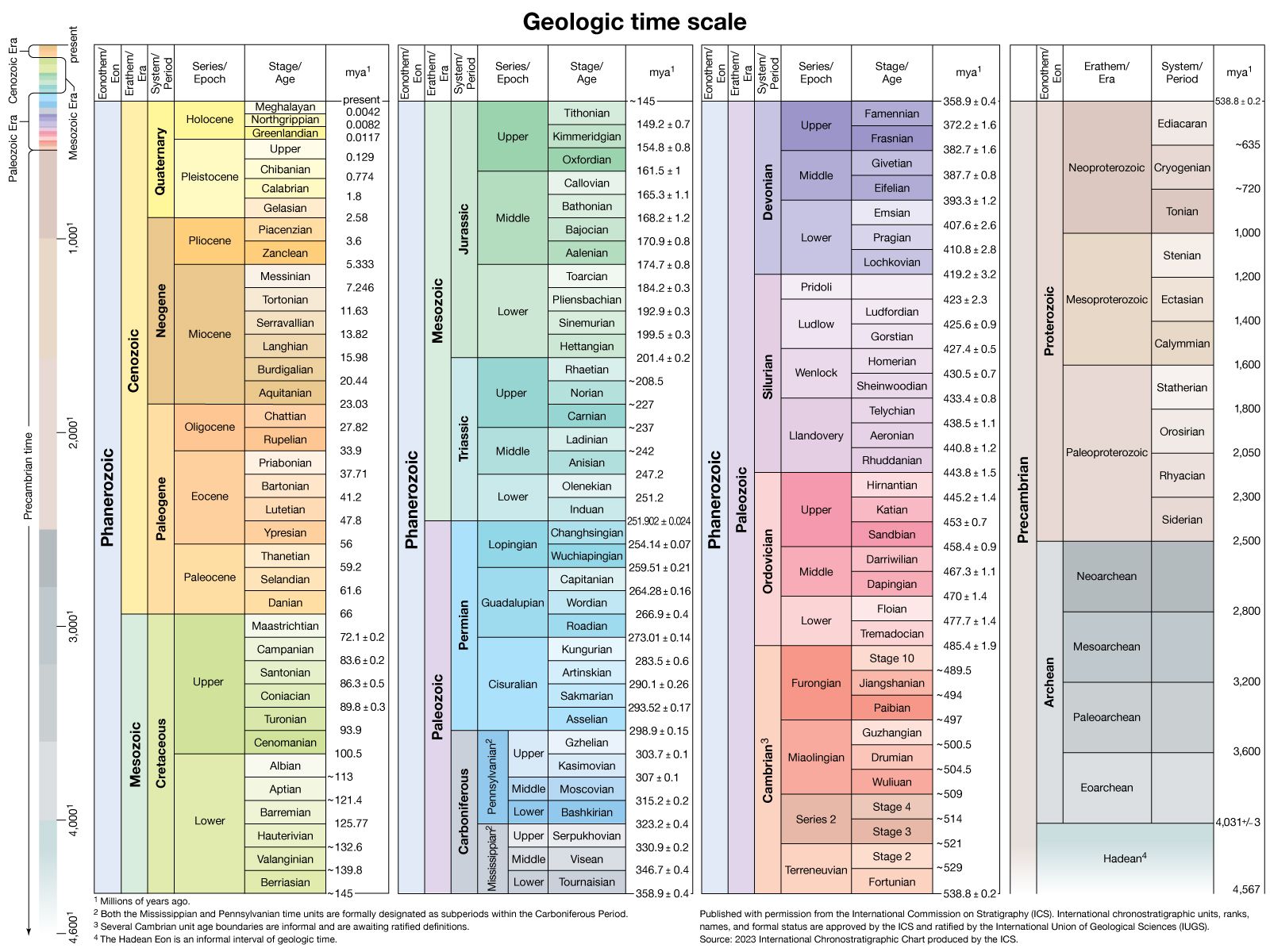
Tetragraptus is a genus of extinct graptolites, which were small, aquatic colonial animals related to the chordates. These organisms lived during the Early Ordovician Epoch, approximately 505 to 478 million years ago.12
As their name suggests, Tetragraptus specimens are characterized by four branches suspended from a thin, filamentous support. Because of their widespread distribution and distinct evolutionary development, they serve as valuable index fossils, allowing geologists to correlate rock units across great distances. Like other graptolites, they possessed a chitinous outer covering rather than mineralized hard parts and are most commonly found as carbonaceous impressions in marine rocks such as black shale.12
What are index fossils and why are they important?
An index fossil is any plant or animal preserved in the Earth’s rock record that serves as a diagnostic marker for a specific span of geologic time or a particular environment.3
To be considered a useful index fossil, a specimen should ideally possess the following characteristics:
- Short temporal range: The species existed for a relatively brief period, ensuring its presence indicates a specific moment in history.34
- Wide geographic distribution: It is found across large areas, allowing for the correlation of rock layers in different regions.34
- Abundance: The fossil is common enough that discovery is highly probable.34
- Distinctiveness: It is easily recognizable, which helps prevent misidentification.34
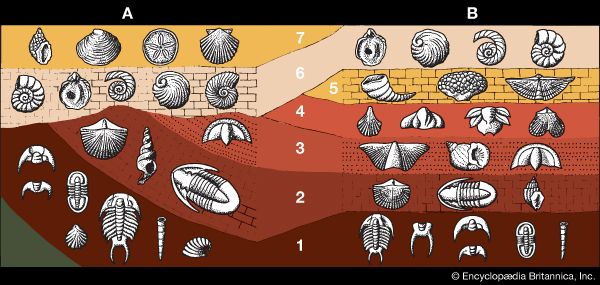
Index fossils are essential to stratigraphy because they provide the basis for defining boundaries in the geologic time scale and for piecing together the history of separated rock outcrops. By applying the principle of faunal succession, geologists can determine the relative age of fossiliferous rocks based on the unique assemblages of life they contain.34
How do scientists determine the age of fossils?
Scientists determine the age of fossils and the rocks in which they are found using two primary approaches: relative dating and absolute (radiometric) dating.
Relative Dating
Relative dating establishes the chronological order of events without providing a specific numerical age. This method relies on the principles of stratigraphy, such as the law of superposition, which states that in undisturbed sedimentary deposits, the oldest layers are at the bottom and the youngest are at the top. Scientists also use index fossils—distinctive, abundant, and widespread species that existed for a short geologic time—to correlate rock layers across different geographic locations.536
Absolute Dating
To determine a specific numerical age, scientists use geochronology, specifically radiometric dating. This method measures the decay of radioactive isotopes (parent atoms) into stable daughter atoms at a constant, known rate. By measuring the ratio of parent to daughter isotopes in a sample, scientists can calculate the time elapsed since the mineral or rock formed.78
Common decay schemes include:
- Uranium-Lead: Highly precise for dating very old igneous and metamorphic rocks.76
- Carbon-14: Used for dating organic materials from the past 60,000 years.9
- Potassium-Argon: Useful for dating potassium-bearing minerals.9
Because fossils are typically found in sedimentary rocks that are difficult to date directly, absolute dating is often used to calibrate the fossil record by dating associated volcanic layers.6
What are hemichordates and how are they related to graptolites?
Hemichordates are a group of wormlike marine invertebrates that include acorn worms and pterobranchs. Although their name suggests a relationship to chordates due to a structure once mistaken for a notochord, molecular studies indicate they are more closely related to echinoderms.10
Graptolites were small, extinct colonial marine animals that lived from the Cambrian Period through the early Carboniferous Period. Scientists suggest that graptolites are related to hemichordates, specifically noting their shared characteristics as bilaterally symmetrical, tentacled invertebrates. Like modern pterobranchs, which are colonial and tube-building, graptolites were colonial organisms that possessed a chitinous outer covering.210
Because of their rapid evolution and widespread distribution, many graptolite genera, such as Phyllograptus, serve as important index fossils for the stratigraphic correlation of Paleozoic rock units.211
Sources
- Tetragraptus — Encyclopædia Britannica
- graptolite — Encyclopædia Britannica
- index fossil — Encyclopædia Britannica
- dating - Principles and techniques — Encyclopædia Britannica
- dating: Top Questions — Encyclopædia Britannica
- stratigraphy — Encyclopædia Britannica
- dating - Principles of isotopic dating — Encyclopædia Britannica
- dating - Distinctions between relative-age and absolute-age measurements — Encyclopædia Britannica
- dating - Origin of radioactive elements used — Encyclopædia Britannica
- hemichordate — Encyclopædia Britannica
- Phyllograptus — Encyclopædia Britannica
Published on · 3 min read