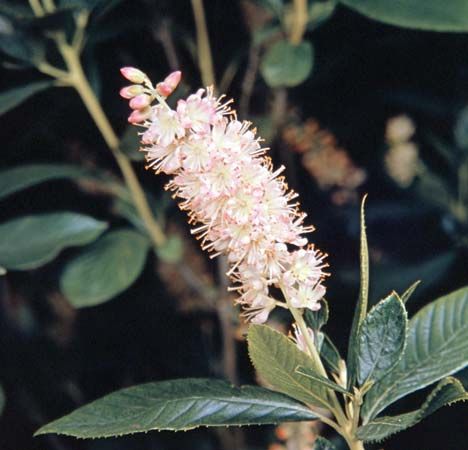
Actinidiaceae
Actinidiaceae is a family of flowering plants within the order Ericales. Comprising three genera and several hundred species, these plants typically grow as…
What is Actinidiaceae?
Actinidiaceae is a family of flowering plants within the order Ericales. Comprising three genera and several hundred species, these plants typically grow as shrubs, small trees, or lianas and are primarily found in tropical regions, particularly throughout Southeast Asia.12
The family includes the following genera:
- Saurauia: The largest genus, containing several hundred species distributed throughout the family’s range.12
- Actinidia: An Indo-Malesian and East Asian genus that includes the kiwi fruit (A. chinensis).12
- Clematoclethra: A smaller genus found primarily in central and western China.12
Botanically, these plants are characterized by spiral, often toothed leaves and flowers that are usually unisexual. A distinct feature is their many stamens, which invert before the flower opens, and their fruit, which is typically a berry.12
What are lianas and how do they grow?
Lianas are long-stemmed, woody vines that are rooted in the soil and rely on other plants for structural support. They are a prominent feature of tropical forest ecosystems, where they represent a significant portion of woody species and serve as a key structural difference between tropical and temperate forests.4
How Lianas Grow
Lianas avoid the high energy investment required to develop a self-supporting trunk by using other plants as scaffolding. Their growth process involves several distinct strategies:
- Climbing Mechanisms: Lianas ascend from the forest floor to the canopy by using specialized structures that resemble grapnel-like hooks to grip the trunks and limbs of host trees.5
- Support Exploitation: By twining around or climbing other plants, lianas position their own leaves into the well-lit portions of the forest canopy, where they can maximize photosynthesis.45
- Dynamic Growth: As their supporting trees die and decay, lianas often send shoots into the crowns of neighboring trees, allowing them to persist and expand across the forest. Mature lianas can reach lengths of up to 100 meters (about 330 feet) and diameters of 60 cm (about 24 inches).54
- Tangled Networks: Flattened or twisted lianas frequently become intertwined, creating complex, hanging networks of vegetation that can connect multiple trees.4
How does the kiwi fruit grow on its plant?
The kiwi fruit grows on a woody vine belonging to the family Actinidiaceae. These plants are dioecious, meaning that male and female flowers are produced on separate individual plants. Because of this, successful fruit production requires both male and female plants to be present to facilitate pollination; typically, one male plant is sufficient to pollinate three to eight female plants.71
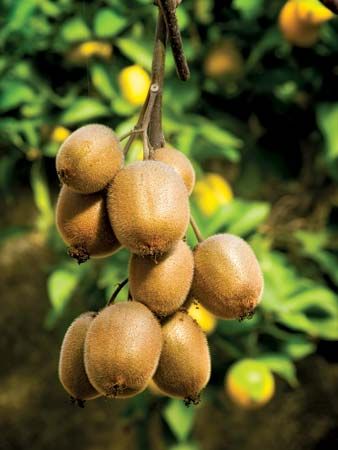
Once pollinated, the female plant develops the fruit, which is botanically classified as a true berry. The fruit features a characteristic ellipsoidal shape with a furry, brownish-green skin. Inside, the firm, translucent green flesh contains numerous small, edible purple-black seeds arranged around a white center. The plant itself is characterized by deciduous leaves that grow alternately on long stems, with young foliage often covered in fine reddish hairs.7
What other plant families are in the order Ericales?
The order Ericales is a diverse group of flowering plants comprising 22 families and over 12,000 species. These families are organized into several distinct groupings based on molecular studies.8
The families included in the order Ericales are:
- Ericaceae group: Ericaceae, Clethraceae, and Cyrillaceae.8
- Balsaminaceae group: Balsaminaceae, Marcgraviaceae, and Tetrameristaceae.8
- Polemoniaceae group: Polemoniaceae and Fouquieriaceae.8
- Pentaphylacaceae group: Pentaphylacaceae and Sladeniaceae.8
- Styracaceae group: Styracaceae, Symplocaceae, and Diapensiaceae.8
- Primulaceae group: Primulaceae, Sapotaceae, and Ebenaceae.8
- Sarraceniaceae group: Sarraceniaceae, Actinidiaceae, and Roridulaceae.8
- Lecythidaceae group: Lecythidaceae.8
- Isolated family: Theaceae.8
Sources
- Actinidiaceae — Encyclopædia Britannica
- Actinidiaceae — Merriam-Webster
- Ericales - Actinidiaceae — Encyclopædia Britannica
- liana — Encyclopædia Britannica
- Tropical rainforest - General structure of the rainforest — Encyclopædia Britannica
- reptile - Clinging and climbing — Encyclopædia Britannica
- Kiwi — Encyclopædia Britannica
- Ericales — Encyclopædia Britannica
- Ericaceae — Encyclopædia Britannica
- Ericales - Ericaceae — Encyclopædia Britannica
Published on · 3 min read