Addax
The addax (Addax nasomaculatus) is a highly specialized antelope uniquely adapted to the Sahara environment. Its most prominent physical feature is a pair of…
What are the unique physical characteristics of the addax antelope?
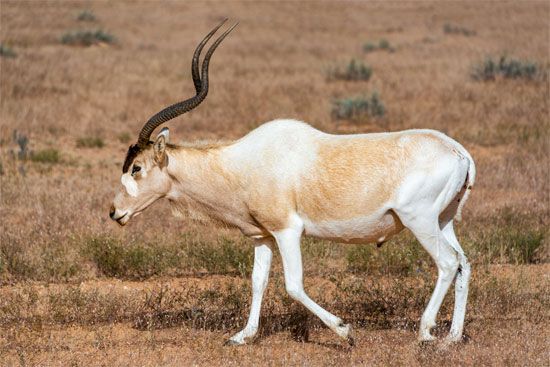
The addax (Addax nasomaculatus) is a highly specialized antelope uniquely adapted to the Sahara environment. Its most prominent physical feature is a pair of long, spiraling horns that can reach lengths of 76–109 cm (30–43 inches).1
The animal possesses a stocky build with sturdy, relatively short legs, which provide endurance rather than speed. To navigate the desert’s shifting terrain, the addax is equipped with broad hooves specifically adapted for traveling efficiently on sand.1
Its coat is highly reflective, shifting from a light color in summer to a smoky gray in winter. The animal also features a distinctive white face mask, underparts, and legs, which contrast with a dark brown forehead tuft and a short brownish beard on the throat. Physiologically, the addax can tolerate significant fluctuations in body temperature and is capable of extracting all necessary moisture from desert plants, conserving water by producing concentrated urine and dry fecescom/science/urine) and dry feces.1
How do male and female addax differ in appearance and behavior?
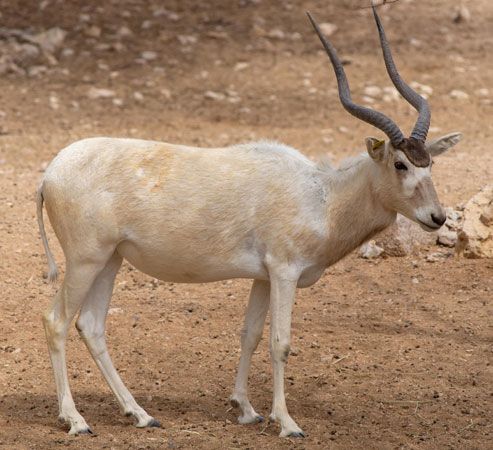
Male and female addaxes share many physical traits, but they exhibit subtle differences in size and horn structure. Males typically weigh between 100 and 135 kg (220–300 pounds) and stand 95–115 cm (37–45 inches) at the shoulder. Females are nearly as tall as males but are 10–20 percent lighter in weight. While both sexes possess long, spiraling horns of similar length (76–109 cm, or 30–43 inches), the horns of the female are thinner than those of the male.1
Regarding behavior, the provided search results do not detail specific differences between the sexes. Generally, the addax is a highly desert-adapted antelope that lives in small herds of 2–20 animals, though they may aggregate into much larger groups following rainfall. Both males and females utilize the same physiological adaptations to survive in the Sahara, such as resting during the heat of the day and feeding at night to conserve water.1
What is the diet of the addax antelope, and how does it obtain food and water in its harsh environment?
The addax (Addax nasomaculatus) is a highly specialized antelope that survives in the Sahara by utilizing a diet of coarse desert grasses. When these grasses are unavailable, it browses on acacias, leguminous herbs, and water-storing vegetation, including melons and tubers.1
To thrive in such a harsh environment, the addax has developed remarkable physiological adaptations for obtaining and conserving resources:
- Water Acquisition: The addax obtains all necessary moisture directly from the plants it consumes. It is particularly active during the night and early morning, when food plants have absorbed maximum moisture from the air.1
- Water Conservation: It minimizes water loss by excreting dry feces and highly concentrated urine.1
- Thermoregulation: To avoid dehydration during the hottest parts of the day, the addax rests and waits for cooler temperatures to feed. It can also tolerate a rise in body temperature of up to 6 °C (11 °F) before it must resort to nasal panting to cool down.1
How successful have captive breeding programs been in maintaining addax populations, and what challenges do they face?
Captive breeding programs are currently considered the most promising strategy for the survival of the addax as a wild species. While the wild population has dwindled to fewer than 100 individuals due to historical poaching, several hundred addaxes are successfully maintained in zoos and on private ranches across Europe and America.1
The primary challenge for these programs is the successful transition of captive-bred animals back into the wild. The long-term goal is to reintroduce these populations into securely protected areas within the species’ original natural range. Efforts to restore wild populations are currently underway in Tunisia and Morocco, which serve as critical testing grounds for these conservation initiatives.1
The success of these programs is vital, as the addax remains a critically endangered species that faces ongoing threats from human encroachment and habitat loss in its native desert environments.1
Sources
- addax — Encyclopædia Britannica
- Sahara - Animal life — Encyclopædia Britannica
- Africa - Conservation of Africa — Encyclopædia Britannica
Published on · 3 min read