Antelope
Antelopes primarily communicate through chemical and visual signals, which are essential for maintaining territories and conveying information to other…
How do antelopes communicate with each other?
Antelopes primarily communicate through chemical and visual signals, which are essential for maintaining territories and conveying information to other members of their species.12
Chemical Communication
Antelopes utilize various exocrine glands to deposit complex chemical secretions on grass, twigs, or other substrates.1
- Preorbital Glands: Located in front of the eyes, these glands are particularly important for territorial marking. Species like the bontebok and gazelle press their heads against vegetation to leave scent marks.1
- Fecal Middens: Territorial boundaries are often marked with dung patches, which serve as both visual markers and substrates for glandular secretions. Males may also use pedal glands to add scent to these sites.1
- Function: These complex scents allow individuals to distinguish between their own markings and those of others, while also providing information about the age of the scent, helping recipients determine if an intruder is recent or past.1
Visual Communication
Antelopes also employ visual signals to communicate, such as the “flagging” behavior seen in many mammals, where an animal lifts its tail to reveal a white underside as an alarm signal when fleeing from a threat.2
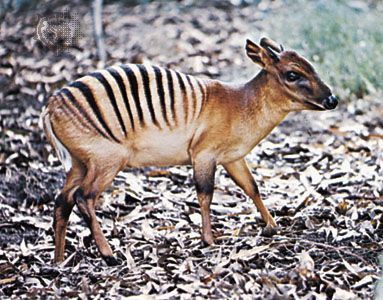
How fast can antelopes run, and which species is considered the fastest?
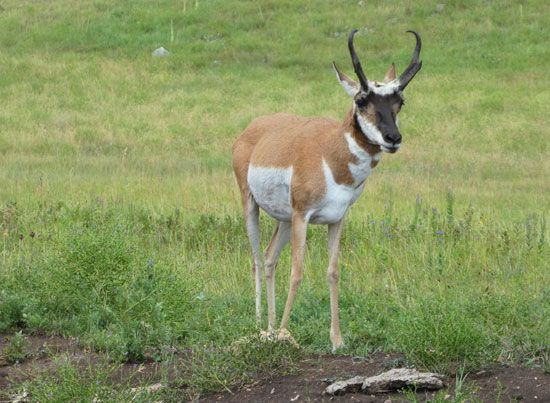
It is a common misconception to classify the pronghorn as an antelope; while it is often called the “American antelope,” it belongs to a distinct family, Antilocapridae, whereas true antelopes belong to the family Bovidae and are native to Africa and Asia.4
When discussing speed, the pronghorn is the fastest long-distance runner in the animal kingdom, capable of maintaining speeds of nearly 35 miles per hour over several miles and reaching top sprint speeds of about 55 miles per hour.5
Among true antelopes, several species are highly adapted for speed in open habitats:
- Springbok: Can reach speeds of 55 miles per hour (88 km/h) when pursued.56
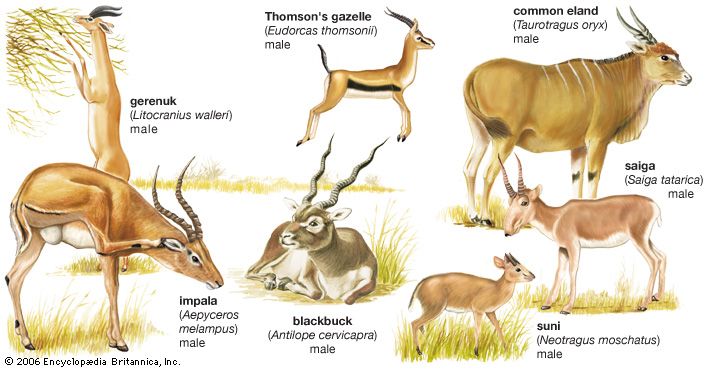
- Thomson’s gazelle: Capable of reaching speeds of 50 miles per hour (80 km/h).7
- Blue wildebeest: Has been clocked at 50 miles per hour.5
While these animals are remarkably fast, the pronghorn is considered faster than any Old World antelope.4
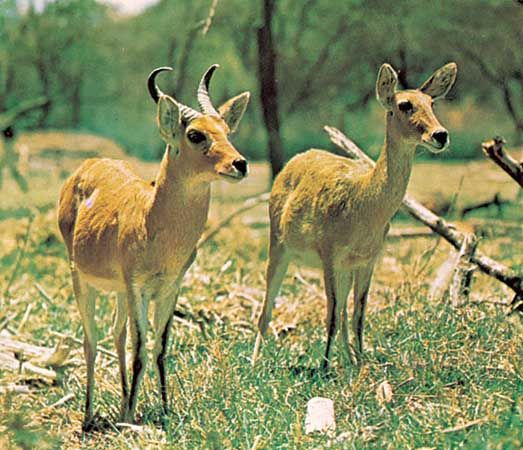
How do antelopes differ from other similar animals like deer or gazelles?
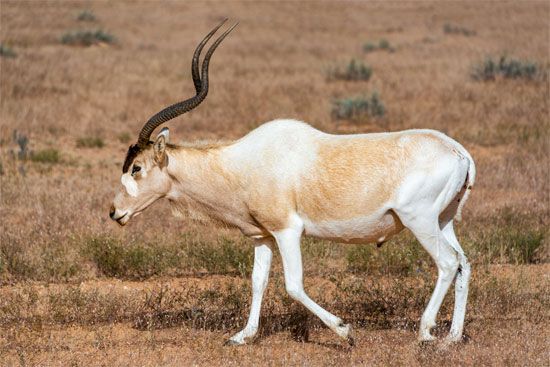
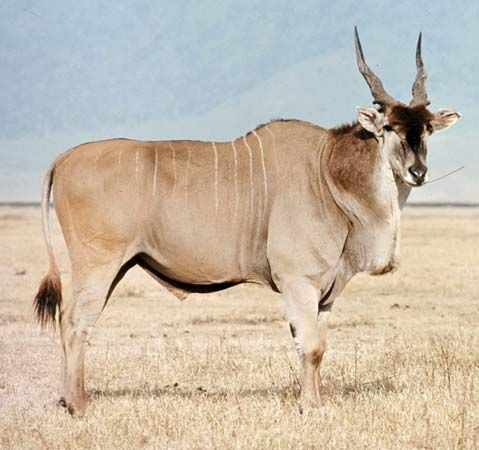
Antelopes are a diverse group of over 90 species of Old World ruminants belonging to the family Bovidae. While they are often confused with other hoofed mammals, they differ significantly in their biological characteristics:89
Antelopes vs. Deer
The primary distinction between antelopes and deer (family Cervidae) lies in their headgear. Antelopes, as bovids, possess true horns consisting of a keratin sheath over a bony core; these horns are never shed and do not branch. In contrast, deer grow antlers, which are made of bone, typically branch, and are shed and regrown annually.109
Antelopes vs. Gazelles
Gazelles are not a separate group from antelopes; rather, they are a specific tribe (Antilopini) within the antelope family. While “antelope” is a broad, non-taxonomic term for many bovid species, gazelles are defined by their specific adaptations to arid environments, such as slender limbs, level backs, and the ability to extract moisture from their food.84
Antelopes vs. Pronghorns
Although the North American pronghorn is frequently called an “American antelope,” it belongs to a completely different family, Antilocapridae. Unlike true antelopes, pronghorns have unique, branching horns that are shed annually.89
How many species of antelopes exist, and where are they primarily found?
There are more than 90 species of antelopes in existence today. These animals are not a single taxonomic group but rather a diverse collection of Old World ruminants belonging to the family Bovidae.811
Antelopes are primarily found in Africa and Asia:
- Africa: This continent is the primary home of antelopes, hosting approximately 71 species.8
- Asia: There are about 14 species of antelopes found across the Asian continent, most of which belong to the gazelle tribe (Antilopini).811
It is important to note that while the North American pronghorn is often referred to as an “American antelope,” it is not a true antelope; it belongs to a separate family, Antilocapridae, and is native only to North America.811
Sources
- Chemoreception - Territorial behavior — Encyclopædia Britannica
- elephant - Sound production and water storage — Encyclopædia Britannica
- Alarm signal — Encyclopædia Britannica
- What is the difference between a pronghorn and an antelope? — Encyclopædia Britannica
- The Fastest Animals on Earth — Encyclopædia Britannica
- springbok — Encyclopædia Britannica
- artiodactyl - Locomotion — Encyclopædia Britannica
- antelope — Encyclopædia Britannica
- gazelle — Encyclopædia Britannica
- bovid — Encyclopædia Britannica
- artiodactyl - Areas of distribution — Encyclopædia Britannica
- goat antelope — Encyclopædia Britannica
Published on · 3 min read