Admiral
Admirals are a group of fast-flying butterflies belonging to the family Nymphalidae. Their most distinctive physical characteristic is their striking…
What are the distinctive physical characteristics of admiral butterflies?
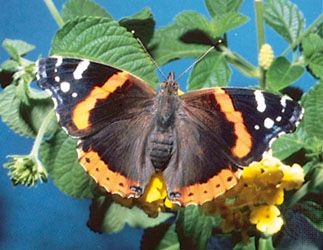
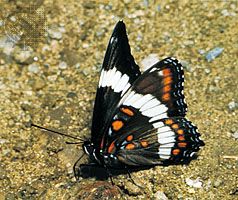
Admirals are a group of fast-flying butterflies belonging to the family Nymphalidae. Their most distinctive physical characteristic is their striking coloration, which typically features black wings accented by white bands and reddish-brown or orange-red markings.12
Specific variations include:
- Red Admiral (Vanessa atalanta): Notable for having broad orange-red bands across its forewings. The Indian red admiral (V. indica) is distinguished by having a red band on the forewings that is wider than that of V. atalanta.21
- White Admiral (L. arthemis): This species exhibits two distinct forms: a white-banded form and a red-spotted purple form.1
- Weidemeyer’s Admiral (L. weidemeyerii): A species found in the western United States that shares the characteristic black-and-white coloration typical of the group.1
These butterflies are highly regarded by collectors for these vivid patterns.1
Where are admiral butterflies typically found, and what are their preferred habitats?
Admiral butterflies are widely distributed across the Northern Hemisphere, with specific species occupying diverse geographic regions:
- Red Admiral (Vanessa atalanta): This migratory species is widespread throughout Europe, Scandinavia, North America, and North Africa.1
- White Admiral (L. arthemis): Found across North America and ranging from Great Britain across Eurasia to Japan.1
- Weidemeyer’s Admiral (L. weidemeyerii): Typically found in the western United States.1
- Indian Red Admiral (V. indica): Located in the Canary Islands and India.1
Regarding their habitats, these butterflies are often associated with the specific plants they require for feeding. For instance, the red admiral relies on stinging nettles, while the white admiral feeds on honeysuckle.1
What are the different species of admiral butterflies, and how do they differ from each other?
Admiral butterflies are a group of fast-flying species within the family Nymphalidae. While they share a general aesthetic of black wings with white bands and reddish-brown markings, they are categorized into distinct species with unique traits and geographic ranges.1
Notable Admiral Species
- Red Admiral (Vanessa atalanta): A highly migratory species found across Europe, Scandinavia, North America, and North Africa. It is characterized by its reliance on stinging nettles as a food source.1
- White Admiral (L. arthemis): This species is notable for its two distinct forms: a white-banded form and a red-spotted purple form. It is found in North America and ranges from Great Britain across Eurasia to Japan. Unlike the red admiral, it feeds on honeysuckle.1
- Weidemeyer’s Admiral (L. weidemeyerii): This species is primarily located in the western United States.1
- Indian Red Admiral (V. indica): Found in the Canary Islands and India, this species is physically distinguished from the common red admiral by a wider red band on its forewings.1
What is the life cycle of an admiral butterfly?
Like all members of the order Lepidoptera, the admiral butterfly undergoes a complete life cycle consisting of four distinct stages:1
- Egg: The cycle begins when an adult female lays eggs on a specific host plant.
- Larva: The egg hatches into a larva, commonly known as a caterpillar. During this stage, the insect feeds extensively on host plants—such as stinging nettles for the red admiral or honeysuckle for the white admiral—to fuel its growth.41
- Pupa: The caterpillar eventually transforms into a pupa, or chrysalis, within which it undergoes metamorphosis.1
- Adult: The final stage is the adult butterfly (imago), which emerges from the chrysalis to feed on nectar and reproduce.1
These stages are vital to local food webs, and the survival of these populations depends on access to pesticide-free habitats that provide both host plants for larvae and nectar sources for adults.1
Sources
- admiral — Encyclopædia Britannica
- red admiral — Merriam-Webster
- brush-footed butterfly — Encyclopædia Britannica
- butterfly — Encyclopædia Britannica
Published on · 3 min read