Aechmea
Aechmea is a genus of epiphytes—plants that grow on other plants and utilize aerial roots—belonging to the pineapple family (Bromeliaceae). Native to…
What is Aechmea?
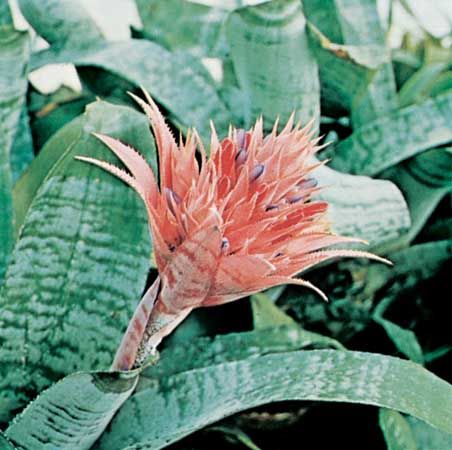
Aechmea is a genus of epiphytes—plants that grow on other plants and utilize aerial roots—belonging to the pineapple family (Bromeliaceae). Native to tropical America, this genus includes over 180 species characterized by spiny-edged leaves that grow in a rosette pattern.1
These plants are widely recognized for their central spikes of vibrant red and yellow flowers, which often feature blue tips. Due to their striking foliage and showy blooms, many species are popular as indoor ornamental plants. Additionally, the fibrous leaves of A. magdalenae are utilized in the production of rope and twine.1
What are epiphytes and how do they survive?
An epiphyte is a plant that grows on another plant or object solely for physical support rather than nourishment. Unlike parasitic plants, epiphytes do not derive nutrients from their host; they are often called “air plants” because they do not require soil to survive.23
Survival Strategies
Epiphytes thrive by occupying niches that provide better access to sunlight, particularly in dense tropical forests. They utilize several specialized methods to obtain resources:
- Water Absorption: Most species absorb water from rain and vapor using their roots, though many also possess specialized leaves capable of taking in moisture directly from the air.3
- Nutrient Acquisition: While some minerals are gathered from rainfall, most nutrients are absorbed from organic debris and leaf litter that collects on the host plant.3
- Attachment: Many epiphytes, such as orchids and Tillandsia species, use adventitious roots to anchor themselves firmly to non-soil surfaces like tree branches or rocks.34
What are some other plants in the bromeliad family?
The Bromeliaceae family is diverse, encompassing over 3,000 species across 56 genera. Beyond Aechmea, several other notable genera and species include:56
- Ananas: Best known for the edible pineapple (A. comosus).56
- Tillandsia: A large genus of epiphytes, including the well-known Spanish moss (T. usneoides).576
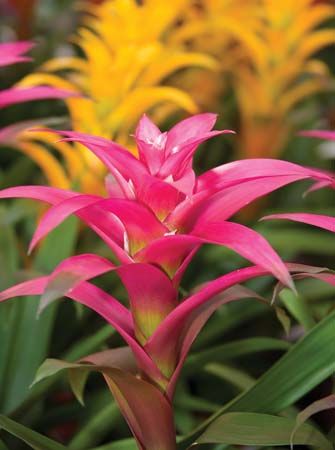
- Guzmania: Popular indoor plants prized for their handsome foliage and showy, colorful bracts.89
- Billbergia: Known for their tubular shape and often pendant flower stalks.96
- Puya: Includes the giant Puya raimondii, which can reach heights of over 10 meters.56
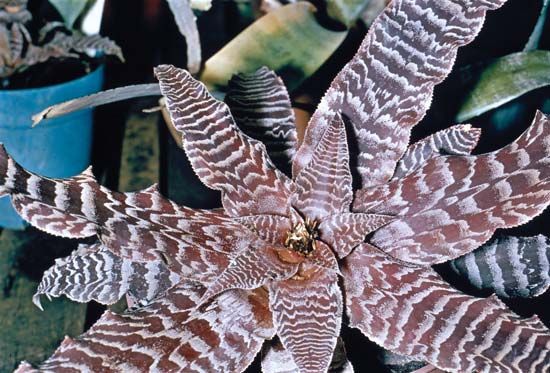
- Cryptanthus: Often called “earth stars,” these terrestrial plants form flattened rosettes with striking, patterned leaves.9
- Neoregelia and Nidularium: Known for flowers that bloom deep within the center of the leaf rosette, often surrounded by brilliant crimson leaves.96
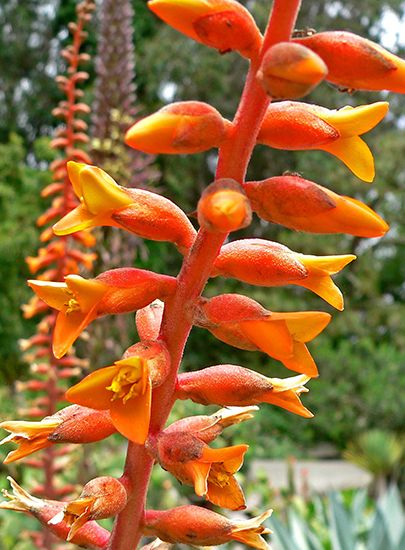
- Dyckia, Hechtia, and Vriesea: Other significant genera within the family.6
How do tropical plants adapt to their environment?
Tropical plants have evolved a variety of sophisticated adaptations to survive the intense competition for resources and the constant pressure from herbivores in their environment.1213
Competition for Light
Because only about 1 percent of sunlight reaches the forest floor, plants compete intensely for light.12
- Growth Strategies: Many trees and shrubs remain as slow-growing seedlings or dormant seeds until a gap in the canopy—caused by tree death or wind damage—allows sunlight to reach the ground, triggering rapid growth.12
- Mechanical Dependence: To avoid the energy cost of building large trunks, some plants use other vegetation for support. Lianas use hook-like devices to climb toward the canopy, while epiphytes grow on branches to access sunlight without needing soil contact.12
- Stranglers: Strangler figs begin as epiphytes and eventually grow roots that encase the host tree, eventually replacing it.12
Nutrient Acquisition and Defense
- Nutrient Cycling: Because nutrients are often scarce at depth, many plants rely on mycorrhizal fungi to absorb minerals and utilize shallow root systems to capture nutrients from decomposing organic matter.12
- Herbivore Defense: To counter constant herbivory, plants employ chemical defenses like alkaloids, terpenes, and latex, or structural defenses such as spines, thorns, and toughened leaves. Some plants even use “decoy” structures or mutualistic relationships, such as ants that defend the plant against insects.13
Sources
- Aechmea — Encyclopædia Britannica
- Did you know? — Merriam-Webster
- epiphyte — Encyclopædia Britannica
- adventitious root — Encyclopædia Britannica
- Bromeliaceae — Encyclopædia Britannica
- Tillandsia — Encyclopædia Britannica
- Guzmania — Encyclopædia Britannica
- guzmania — Merriam-Webster
- houseplant - Foliage plants — Encyclopædia Britannica
- houseplant — Encyclopædia Britannica
- list of plants in the family Bromeliaceae — Encyclopædia Britannica
- Tropical rainforest - General structure of the rainforest — Encyclopædia Britannica
- Eating the rainforest — Encyclopædia Britannica
- community ecology - Specialization in grazing — Encyclopædia Britannica
- Agricultural technology - Essential plant nutrients — Encyclopædia Britannica
- nutrition - Nutrition in plants — Encyclopædia Britannica
Published on · 3 min read