African Bullfrog
The African bullfrog (Pyxicephalus adspersus) is a large species of frog native to Southern Africa, found in habitats ranging from grasslands to marshes. It…
What is an African bullfrog?
The African bullfrog (Pyxicephalus adspersus) is a large species of frog native to Southern Africa, found in habitats ranging from grasslands to marshes. It is one of the largest frog species, with males reaching up to 2 kg (4 pounds) and 25.5 cm (10 inches) in length.1
These frogs are known for their burrowing behavior, spending much of their time underground. During the dry season, they enter a state of estivation, protected by a waterproof cocoon of dead skin. They are aggressive predators that feed on insects, rodents, birds, and even other frogs. Unlike the North American bullfrog, they do not secrete venom, though they possess fanglike projections on their lower jaw.1
While their population is declining, they are not currently listed as endangered by the IUCN. Males are notable for guarding their tadpoles during the 18-day development period.1
Where do African bullfrogs live?
African bullfrogs (Pyxicephalus adspersus) are primarily found in Southern Africa. They are highly adaptable and inhabit a wide variety of environments, including:1
- Grasslands
- Shrublands
- Freshwater lakes
- Marshes
- Farmland1
These animals are classified as burrowing frogs, meaning they spend the majority of their time partially or entirely buried in moist holes that they excavate using their strong hind legs. During the dry season, they remain underground in a state of estivation, encased in a protective, waterproof cocoon made of dead skin to prevent water loss.1
What do African bullfrogs look like?
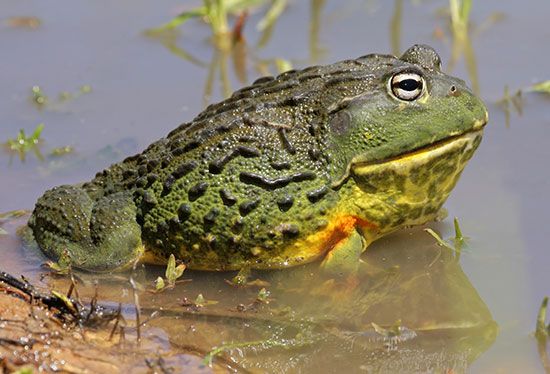
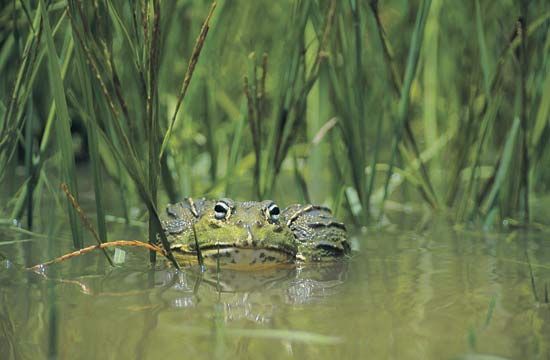
African bullfrogs (Pyxicephalus adspersus) are physically distinct, characterized by their large, chubby bodies and broad heads. Their skin is marked by textured ridges along their backs.1
Key physical features include:
- Size: They are among the largest frog species. Males are significantly larger than females, reaching up to 25.5 cm (10 inches) in length and weighing as much as 2 kg (4 pounds).1
- Coloration: Adults are typically a dull green. In contrast, young African bullfrogs are brightly patterned and often feature a yellow stripe running down their backs.1
- Throat (Dewlap): The color of the loose skin hanging from the throat, known as the dewlap, differs by sex: it is yellow or orange in males and cream-colored in females.1
- Defensive Features: They possess fanglike projections on their lower jaw and have the ability to puff themselves up to appear larger when threatened.1
What do African bullfrogs eat?
African bullfrogs are opportunistic carnivores with a diverse and varied diet. Because of their large size and aggressive nature, they are capable of consuming a wide range of prey, including:13
Their feeding behavior is highly adaptable, allowing them to take advantage of available food sources within their environment. Notably, African bullfrogs exhibit cannibalistic tendencies; adults and even tadpoles may consume other members of their own species. While adult African bullfrogs are carnivorous, it is important to note that during their larval stage, they—like most tadpoles—are primarily herbivorous, feeding on algae and plant matter to support their rapid development. on algae and plant matter to support their rapid development.13
Sources
- African bullfrog — Encyclopædia Britannica
- bullfrog — Encyclopædia Britannica
- What do frogs eat? — Encyclopædia Britannica
Published on · 2 min read