African Penguin
The African penguin (Spheniscus demersus) typically breeds twice a year, with nesting occurring in colonies along the coasts of Namibia and South Africa.…
What is the breeding cycle of African penguins, and how do they care for their young?
The African penguin (Spheniscus demersus) typically breeds twice a year, with nesting occurring in colonies along the coasts of Namibia and South Africa. Breeding is generally year-round, though it peaks between March and May in South Africa and November and December in Namibia.12
These penguins are largely monogamous, and pairs often return to the same nest site. They create depressions for their two eggs in sand, guano deposits, or under rocks and bushes. Both parents share incubation duties for 38–40 days.12
Once the chicks hatch, both parents alternate guarding and feeding them for the first 30 days. After this period, the chicks join a “crèche”—a group of young birds that provides protection from predators—while both parents forage at sea. The parents identify their own chicks within the group by voice and appearance to provide regurgitated food. The fledging period lasts until the chicks are two to four months old, at which point they become independent and head to sea.21
What are the physical characteristics that distinguish African penguins from other penguin species?
African penguins (Spheniscus demersus) are distinguished from other penguin species by several specific physical traits:
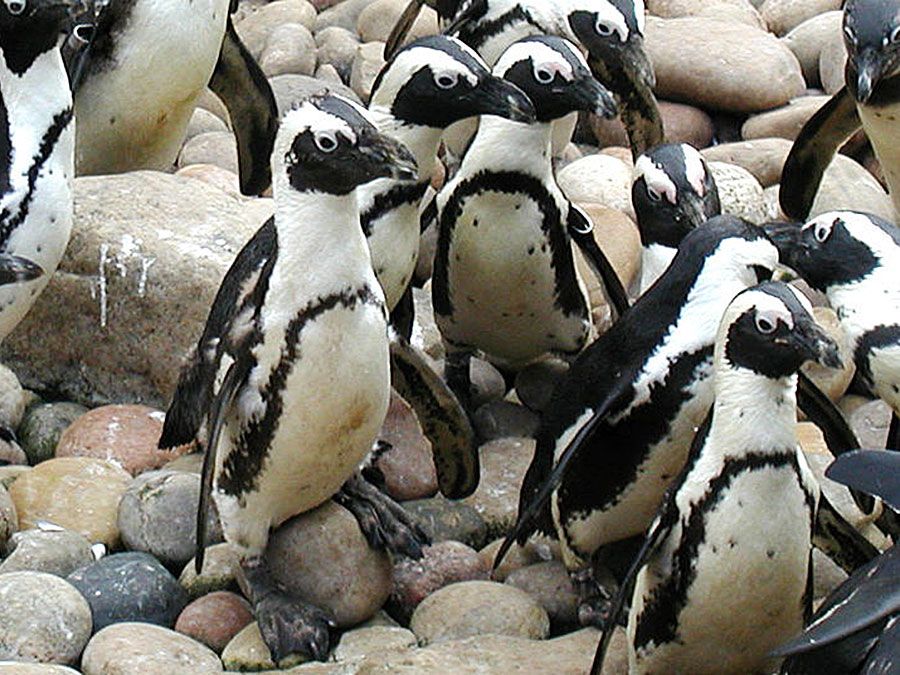
- Distinctive Markings: They possess a single black band of feathers that cuts across the breast and prominent C-shaped white regions on both sides of the head.3
- Facial Features: A unique characteristic is the circle of featherless skin that completely surrounds each eye.3
- General Appearance: Adults have black plumage on the chin and back with white breast plumage. They reach lengths of 60–68 cm and weigh between 3.7 and 4 kg, with males typically being slightly larger than females.23
- Developmental Stages: Juveniles are easily identified by their gray head and back feathers with white undersides, while chicks are covered in gray to brown-gray fluff.23
Additionally, they are sometimes called “jackass penguins” because they produce a call similar to the braying of a donkey to attract mates.3
How long do African penguins typically live, both in the wild and in captivity?
The average life span of an African penguin is roughly 10 to 15 years. However, some individuals in the wild have been known to live between 10 and 27 years, and they can live even longer when kept in captivity.2
What is the diet of African penguins, and how do they hunt for food?
African penguins (Spheniscus demersus) rely on a diet consisting primarily of fish, which serves as the basic element of their nutrition. Their specific prey includes:4
- Pacific sardines (Sardinops sagax)2
- Southern African pilchards (S. ocellatus)2
- Horse mackerel (Trachurus trachurus)2
- Anchovies (Engraulis)2
- Squid2
These penguins hunt for food at sea, where they are highly active foragers. During the breeding season, parents alternate between guarding their chicks and foraging at sea to secure these food sources. Once chicks reach the crèche stage—a group formed for protection—both parents leave the nest to forage independently.2
Unfortunately, the commercial fishing industry poses a significant threat to the species, as it harvests the same shoaling fishes that the penguins rely on for survival. This competition for food, alongside other environmental pressures, has contributed to their classification as a critically endangered species.23
Sources
- penguin - Reproduction — Encyclopædia Britannica
- African penguin — Encyclopædia Britannica
- African penguin: Top Questions — Encyclopædia Britannica
- penguin - Food habits — Encyclopædia Britannica
Published on · 2 min read