Africanized Honeybee
The Africanized honeybee (Apis mellifera scutellata × A. mellifera) is a hybrid honeybee resulting from the accidental release of East African lowland…
What are Africanized honeybees?
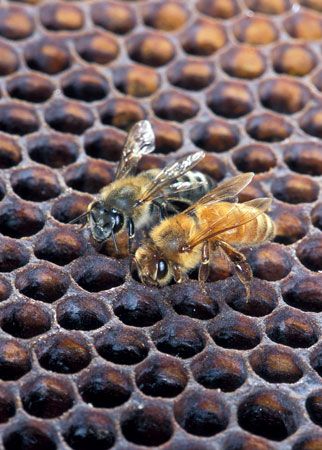
The Africanized honeybee (Apis mellifera scutellata × A. mellifera) is a hybrid honeybee resulting from the accidental release of East African lowland honeybees in Brazil in 1957. These bees subsequently crossbred with local European honeybees, spreading throughout the Western Hemisphere and into the southern United States.12
Often sensationally dubbed “killer bees,” they are physically similar to European honeybees but are noted for their extreme defensiveness. When disturbed, they react more quickly, attack in larger numbers, and pursue threats over greater distances than their European counterparts. While their venom is not more toxic, their tendency to deliver significantly more stings makes them potentially dangerous to humans, pets, and livestock.21
Despite these risks, they provide essential ecosystem services like pollination and can be managed by skilled beekeepers. They are considered invasive in parts of their range and are less selective about nesting sites than European varieties.1
How do Africanized honeybees differ from regular honeybees?
Africanized honeybees and European honeybees are physically similar, though Africanized bees tend to be slightly smaller and are difficult to distinguish without laboratory analysis. While both produce honey and wax and possess venom of equal toxicity, they differ significantly in behavior and biology.2
Key Differences
- Defensiveness: Africanized honeybees are far more defensive. They react to disturbances more quickly, attack in greater numbers, and pursue threats over longer distances and for longer durations than European bees.2
- Nesting: They are less selective about nesting sites, often choosing ground cavities, discarded objects, or even exposed locations, whereas European bees prefer more protected cavities.2
- Colony Dynamics: Africanized colonies grow faster, produce more drones, and swarm or abscond (abandon the nest) more frequently in response to resource availability.2
- Resilience: They are more resistant to pests and parasites but struggle to survive in cold climates, unlike European honeybees.2
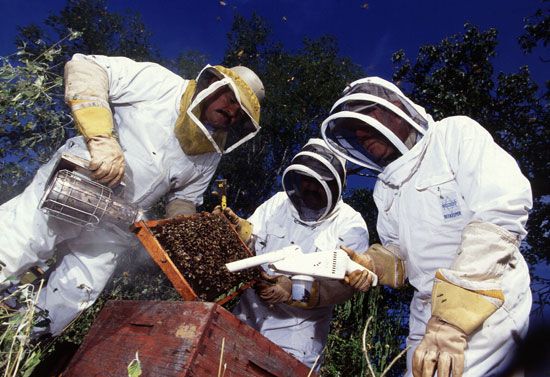
Despite their reputation as “killer bees,” they provide similar ecosystem services and can be managed by skilled beekeepers using specialized techniques.2
Where did Africanized honeybees originally come from?
Africanized honeybees originated in southeastern Brazil during the late 1950s. In 1956, a Brazilian scientist imported East African lowland honeybees (Apis mellifera scutellata) from Africa to participate in a selective breeding program designed to create a hybrid bee that combined the high honey productivity and tropical climate tolerance of the African bees with the more docile temperament of European honeybees.1
The project was interrupted in 1957 when several African honeybee queens and numerous drones escaped from an experimental apiary. These bees subsequently mated with local feral and commercial European honeybee populations in the wild, resulting in the Africanized honeybee (A. mellifera scutellata × A. mellifera). Since their accidental release, these bees have expanded their range throughout South and Central America, eventually reaching the United States in 1990.21
We could dive deeper into the specific environmental factors that limit their northward expansion or discuss the safety precautions recommended when encountering these colonies.
Why are Africanized honeybees sometimes called ‘killer bees’?
Africanized honeybees are sensationally dubbed “killer bees” by news media and in movies due to their extreme defensiveness and aggressive colony protection behaviors.2
While their venom has the same toxicity as that of European honeybees, Africanized bees react to disturbances much more quickly and attack in far greater numbers. When a colony is startled, these bees may inflict up to 10 times as many stings as European honeybees, pursuing perceived threats over greater distances and for longer durations.2
Because of this intense response, they have been known to kill people and animals, posing a particular danger to those who are allergic to bee venom or individuals with limited mobility who cannot quickly move away from an attack. Despite this reputation, they are not inherently malicious; they are simply highly protective of their hives, and skilled beekeepers can manage them by using specialized techniques to minimize disturbances.2
Sources
- Africanized bee — Merriam-Webster
- Africanized honeybee — Encyclopædia Britannica
- stingless bee — Encyclopædia Britannica
Published on · 3 min read