Apocrita
The suborder Apocrita, which includes ants, bees, and wasps, represents the most highly evolved group within the order Hymenoptera.
What are the main characteristics that define the Apocrita suborder of insects?
The suborder Apocrita, which includes ants, bees, and wasps, represents the most highly evolved group within the order Hymenoptera.1
The primary characteristics defining this group include:
- Constricted Abdomen: A diagnostic feature of the suborder is the presence of a narrow petiole, or “waist,” which attaches the abdomen to the thorax.12
- Propodeum: During development, the first abdominal segment becomes fused with the thorax, forming a structure known as the propodeum.3
- Larval Form: Unlike the caterpillar-like larvae of the suborder Symphyta, Apocrita larvae are typically legless and maggotlike in appearance.4
- Development: The pupae are exarate, meaning the developing appendages, such as wings and legs, are free from the body rather than molded to its surface.3
While some species are agricultural pests, the majority are considered beneficial to humans, serving as essential pollinators or as parasites that help control insect pest populations.1
How have Apocrita evolved over time, and what adaptations have they developed?
The suborder Apocrita, which includes ants, bees, and wasps, represents the most highly evolved group within the order Hymenoptera. While the fossil record indicates that ancient insect societies were as complex as those of their modern relatives, the specific reproductive behaviors and displays used by these insects have evolved over time.16
Key Evolutionary Adaptations
Apocrita have developed several sophisticated adaptations that have contributed to their success:
- Morphological Specialization: A diagnostic feature is the constricted “waist,” which separates the abdomen from the thorax. Mouthparts have also evolved from simple biting structures to specialized sucking apparatuses in higher forms like bees.17
- Reproductive Sophistication: Apocrita exhibit some of the most advanced reproductive behaviors in the insect world, including extreme insect sociality. This includes complex brood-care systems and the use of pheromones for communication.87
- Communication and Cooperation: Social species have developed intricate methods of information exchange, such as the dancelike movements of honeybees used to communicate food locations. Trophallaxis, the mutual exchange of food between adults and larvae, further reinforces colony cohesion.7
- Diverse Life Strategies: Many species have evolved as parasites or hyperparasites, allowing them to exploit various ecological niches. Some have even developed polyembryony, where a single egg produces multiple individuals.17
How do Apocrita differ from other insect suborders, particularly within Hymenoptera?
The suborder Apocrita represents the most highly evolved group within the order Hymenoptera, distinguished primarily from the other suborder, Symphyta, by several key anatomical and developmental characteristics.1
Primary Differences
- Abdominal Structure: The most diagnostic feature of Apocrita is a constricted base of the abdomen, which creates a narrow “waist” between the abdomen and the thorax. In contrast, Symphyta lack this constriction, possessing a broad junction between the two body segments.1
- Larval Morphology: Apocrita larvae are typically legless and maggotlike, with relatively soft and thin head coverings. Conversely, Symphyta larvae are usually caterpillar-like, often featuring three pairs of thoracic legs and six or eight pairs of abdominal legs, along with a tougher, more heavily sclerotized head.2
- Developmental Biology: While both suborders undergo complete metamorphosis, Apocrita larvae are generally sedentary and either feed as parasites or are provisioned by adults within a nest. Their digestive systems also differ; in most Apocrita, the stomach remains a blind sac until the final larval stage.12
What are some common examples of insects that belong to the Apocrita suborder?
The suborder Apocrita includes a vast array of insects, most notably ants, bees, and wasps. These insects are highly diverse, ranging from social colonies to solitary parasitic species.12
Common Examples of Apocrita
- Ants (Family Formicidae): This group includes various specialized types such as carpenter ants, fire ants, leafcutter ants, and weaver ants.2
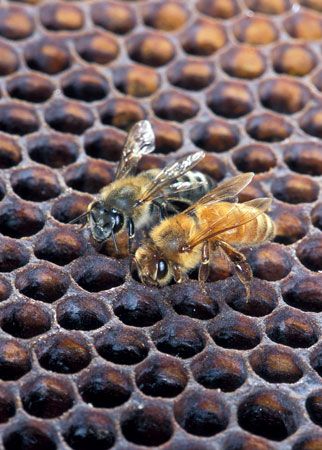
- Bees (Superfamily Apoidea): This category encompasses both social and solitary species, including honeybees, bumblebees, mason bees, and sweat bees.2
- Wasps: The suborder contains numerous wasp families with varied life strategies:
- Parasitic Wasps: These include ichneumon wasps, chalcid wasps, braconid wasps, and ensign wasps.12
- Social and Solitary Wasps: Examples include hornets, yellow jackets, paper wasps, spider wasps, and cuckoo wasps.2
While some species are considered pests, many Apocrita are highly beneficial to humans, particularly as pollinators or as natural controllers of insect pest populations.1
Sources
- Apocrita — Encyclopædia Britannica
- list of ants, bees, and wasps — Encyclopædia Britannica
- wasp — Encyclopædia Britannica
- Hymenoptera - Egg and larva — Encyclopædia Britannica
- Hymenoptera - Pupa — Encyclopædia Britannica
- Reproductive behaviour - Insects — Encyclopædia Britannica
- Hymenoptera - Size range and diversity of structure — Encyclopædia Britannica
- Reproductive behaviour - Evolution of reproductive behaviour — Encyclopædia Britannica
- Hymenoptera - General features — Encyclopædia Britannica
- crustacean - Evolution and paleontology — Encyclopædia Britannica
- primate - Eocene — Encyclopædia Britannica
- branchiopod - Evolution and paleontology — Encyclopædia Britannica
- acarid - Reproduction and life cycle — Encyclopædia Britannica
- insect - Insect phylogeny — Encyclopædia Britannica
- Hymenoptera - Solitary forms — Encyclopædia Britannica
Published on · 3 min read