Al-Hasa
The Al-Hasa oasis is uniquely distinguished as the largest oasis in Saudi Arabia. Its ecological significance is rooted in its ability to sustain a vast…
How does the oasis ecosystem in Al-Hasa contribute to its uniqueness?
The Al-Hasa oasis is uniquely distinguished as the largest oasis in Saudi Arabia. Its ecological significance is rooted in its ability to sustain a vast, fertile environment within a desert landscape, supported by a perennial supply of fresh water from more than 60 artesian springs.12
This abundant water source allows for extensive agricultural productivity, featuring approximately 30,000 acres of land dedicated to palm groves and various other crops. The oasis is home to over three million trees, which produce many varieties of dates—a staple of oasis economies. By providing a reliable habitat for both sedentary populations and diverse vegetation, the Al-Hasa ecosystem serves as a vital center of life and agriculture in the eastern region of the country.12
Are there any notable archaeological sites or historical landmarks in Al-Hasa?
Al-Hasa is home to significant cultural and historical recognition, most notably through its designation as a UNESCO World Heritage site. The area is officially recognized as the Al-Ahsa Oasis, an Evolving Cultural Landscape, which highlights its long-standing history as a center of human settlement and agricultural development in the region.1
While the region’s early history remains somewhat obscure, it has served as a vital crossroads for centuries, transitioning through periods of independence, Ottoman sovereignty, and eventual integration into the Kingdom of Saudi Arabia. The oasis itself, with its extensive network of artesian springs and millions of date palms, acts as a living historical landmark that has sustained populations for generations.4
Beyond the oasis, the region’s primary towns—Al-Hufuf, Al-Dammām, and Al-Mubarraz—serve as the modern centers of the area, reflecting the profound transformation brought about by the discovery of petroleum in the 1930s.4
What is the geographical location and significance of Al-Hasa in Saudi Arabia?
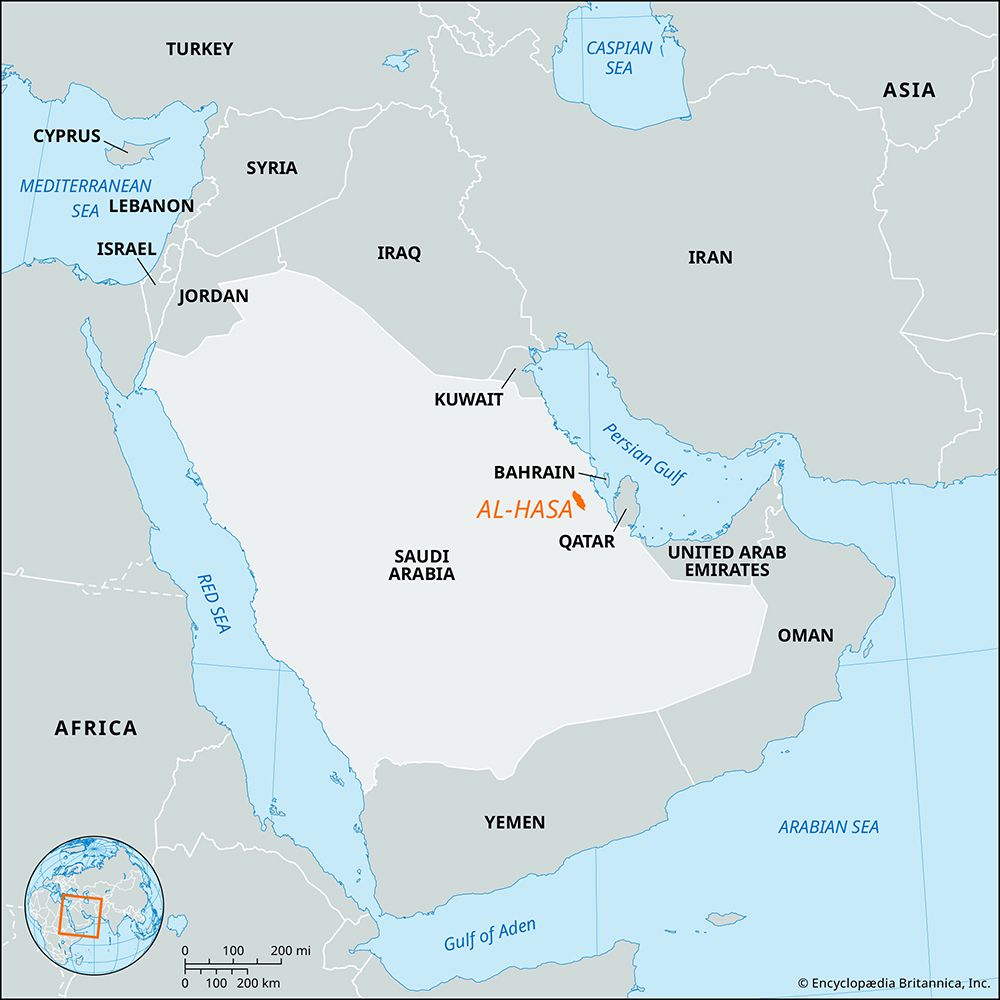
The Al-Hasa region is located in eastern Saudi Arabia, situated approximately 40 miles west of the Persian Gulf. It is bounded by Kuwait to the north, the Rubʿ al-Khali desert to the south, and the Dahnā sand belt to the west.15
Al-Hasa is significant primarily as the largest oasis in the kingdom, containing over 30,000 acres of palm groves irrigated by more than 60 artesian springs. Historically, it served as a vital, independent crossroads before being incorporated into the Saudi state.15
The region’s modern importance is defined by its role as the heart of the nation’s petroleum industry. Following the discovery of massive oil deposits in the 1930s, the area underwent a profound economic transformation. Today, it remains a critical hub, with major towns like Al-Hufuf, Al-Dammam, and Al-Mubarraz connected by modern infrastructure, including railways and highways that link the region to Riyadh.15
How has the presence of oil resources impacted the development of Al-Hasa?
The discovery of massive petroleum deposits in the 1930s near Al-Dammam served as a catalyst for the profound transformation of the Al-Hasa region and the broader kingdom of Saudi Arabia.16
The impact of this development includes:
- Economic Transformation: The region evolved from a traditional agricultural and oasis-based economy into one of the most progressive areas of the kingdom. It became the heart of the nation’s oil industry, with major fields—including Al-Ghawar, one of the world’s largest—operated by Saudi Aramco.16
- Infrastructure Growth: To support the burgeoning industry, significant infrastructure projects were completed, including a railway and paved highways that linked the principal towns of Al-Hasa, such as Al-Hufuf and Al-Mubarraz, with Riyadh.16
- Demographic Shifts: The industrial expansion attracted a significant population of international professionals, including Europeans and Americans, who moved to the region to work in the petroleum sector.1
By the early 1960s, these oil fields were producing over one million barrels per day, fundamentally altering the region’s status and economic trajectory.1
Sources
- Al-Hasa — Encyclopædia Britannica
- oasis — Encyclopædia Britannica
- Sahara - Resources — Encyclopædia Britannica
- list of World Heritage sites - Saudi Arabia — Encyclopædia Britannica
- Al-Hasa — Merriam-Webster
- Al-Sharqiyyah — Encyclopædia Britannica
Published on · 3 min read