Bajío
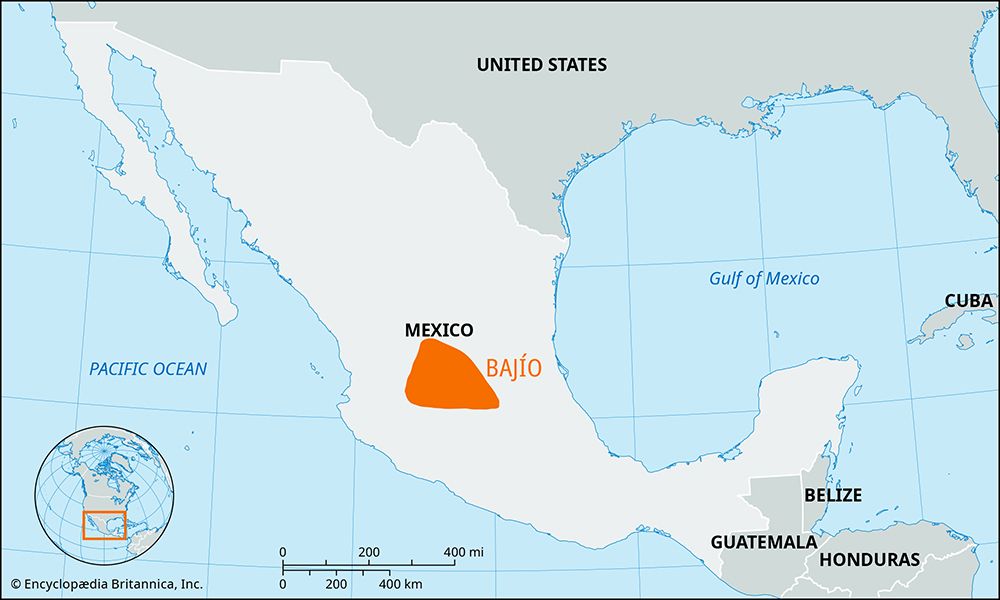
The Bajío region’s agricultural importance is primarily driven by its favorable environmental conditions, which have historically earned it the reputation as…
How does the Bajío’s climate and topography contribute to its agricultural importance?
The Bajío region’s agricultural importance is primarily driven by its favorable environmental conditions, which have historically earned it the reputation as the “breadbasket of Mexico.”
Its productivity is supported by several key factors:
- Climate and Rainfall: The region benefits from a temperate climate and adequate rainfall, which provide a stable environment for growing a variety of crops, including wheat, corn (maize), chickpeas, beans, vegetables, peanuts, and strawberries.12
- Topography and Soil: Situated on the Mexican Plateau at elevations between 5,100 and 5,900 feet, the Bajío features fertile soil that is highly conducive to farming. The region’s landscape is defined by a drainage basin formed by the Lerma River and its tributaries, which have channeled through rich lacustrine deposits, volcanic tuff, and basaltic rocks.1
- Strategic Location: Its proximity to major urban markets has historically bolstered its role as a significant agricultural center, even as other regions like the Northwest have expanded their commercial production.2
What are the main agricultural products grown in the Bajío region?
The Bajío region has been a vital agricultural center since the 19th century, benefiting from fertile soil, a temperate climate, and reliable rainfall. The principal agricultural products grown in the region include:
Additionally, the broader state of Guanajuato, which encompasses much of the Bajío, also produces alfalfa, potatoes, and chilies, and serves as one of Mexico’s leading pork producers.4
How has the Bajío region’s history influenced its cultural development?
The history of the Bajío region has profoundly shaped its cultural identity, primarily through its role as a crucible for Mexican independence and its development as a vital agricultural and economic hub.
A Catalyst for Independence
The Bajío’s most significant historical contribution to Mexican culture is its role in the wars of independence. In 1810, the region became the birthplace of the independence movement when the priest Miguel Hidalgo y Costilla launched the Grito de Dolores. Because the Bajío was a rich agricultural and mining zone that had suffered severe economic hardship, its rural and urban workers were particularly receptive to Hidalgo’s call for resistance against colonial elites. This movement, which mobilized thousands under the banner of the Virgin of Guadalupe, transformed the region into a symbol of national struggle and social reform.1
Cultural Integration
Culturally, the Bajío is often associated with the “West” region of Mexico, which is credited with the origins of many iconic symbols of Mexican identity, including tequila, mariachi music, and the traditional charro (gentleman rancher) costume. The region’s history as the “breadbasket of Mexico” fostered a large rural population and a unique social fabric that blends its agricultural heritage with rapid modern industrialization in cities like León, Celaya, and Querétaro.56
What are the major cities and economic centers within the Bajío region?
The Bajío region is a densely populated area in west-central Mexico known for its significant agricultural output and growing industrial base. Several key cities serve as major urban and economic centers within this region:
- León: The largest city in the state of Guanajuato, León is a primary hub for manufacturing and services, with a strong focus on footwear, textiles, and other industrial products.1
- Querétaro: An important urban center that has developed significant industrial capabilities alongside its role as a regional hub.64
- Celaya: A prominent city in the region that serves as a center for both agricultural trade and industrial activity.71
- Irapuato: Known as a key city for services and manufacturing within the Bajío’s economic landscape.71
- Salamanca: A vital industrial center, particularly noted for its role in refined petroleum and other manufacturing sectors.1
- Guanajuato City: The state capital, which functions as a market and service center for the surrounding mining and agricultural areas, while also being a significant cultural and educational hub.13
- Valle de Santiago: Another notable urban center located within this densely populated region.7
These cities benefit from the region’s fertile soil and strategic location, which have historically supported its status as the “breadbasket of Mexico” while facilitating modern industrial growth.761
Sources
- Bajío — Encyclopædia Britannica
- Mexico - Agriculture — Encyclopædia Britannica
- Mesa Central — Encyclopædia Britannica
- Guanajuato — Encyclopædia Britannica
- history of Latin America - Mexico and Central America — Encyclopædia Britannica
- Mexico - Cultural regions — Encyclopædia Britannica
- Guanajuato — Encyclopædia Britannica
Published on · 3 min read