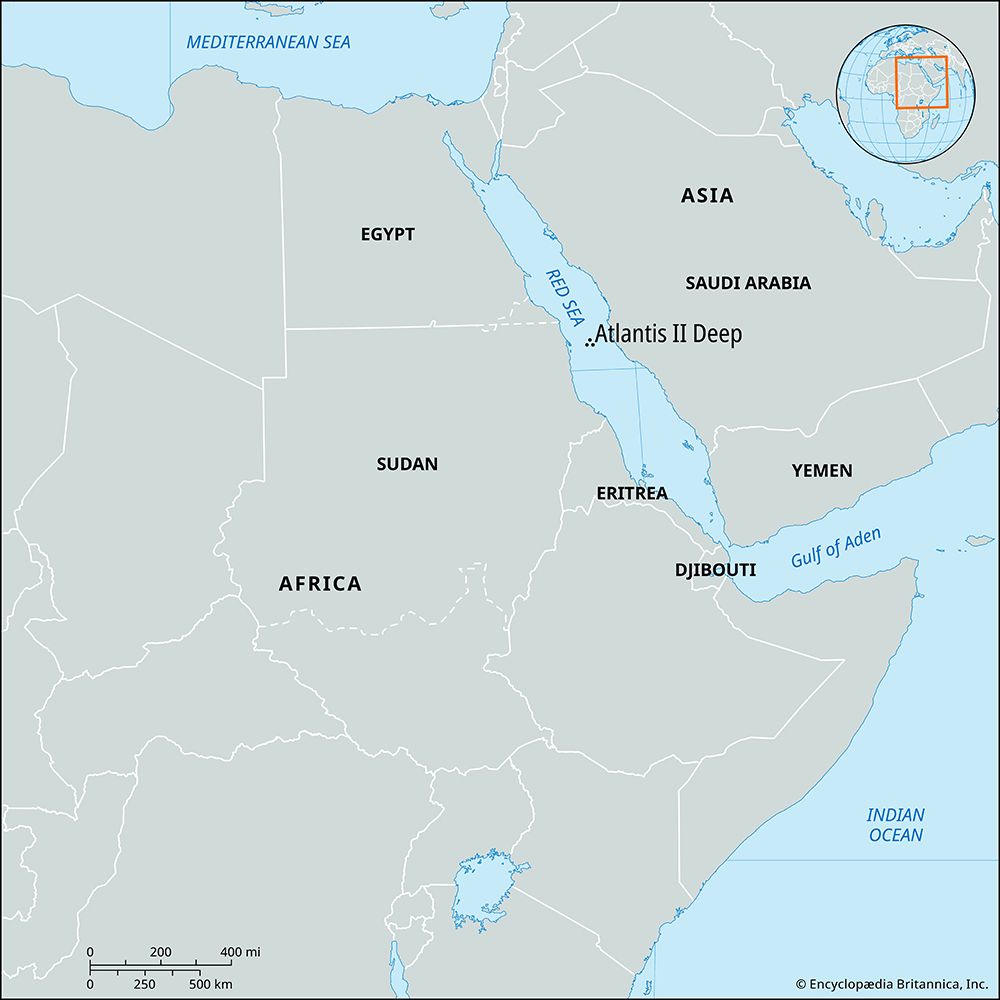
Atlantis II Deep
Sorry, the Britannica knowledge base does not contain information regarding the specific discovery date or the circumstances surrounding the initial…
How was the Atlantis II Deep discovered, and when did this occur?
Sorry, the Britannica knowledge base does not contain information regarding the specific discovery date or the circumstances surrounding the initial identification of the Atlantis II Deep.
While the provided records detail its physical characteristics, such as its extreme salinity and high temperatures, as well as its significant zinc, copper, and cobalt deposits, they do not document the history of its exploration or discovery.
What unique geological features characterize the Atlantis II Deep basin?
The Atlantis II Deep is a unique submarine basin located in the Red Sea that is defined by several extreme geological and hydrological characteristics:
- Hot Brine Pools: The basin contains pools of hot, hypersaline water that reach temperatures up to 140 °F (60 °C). These waters are devoid of oxygen and exhibit salinities as high as 270 parts per thousand—approximately 7.5 times the salinity of normal seawater.13
- Metallic Enrichment: The deep is notable for its high concentrations of metallic trace elements, including zinc, copper, and cobalt. These elements are present in concentrations roughly 1,000 times greater than those found in standard seawater.1
- Sediment Deposits: The basin contains significant sediment layers, reaching up to 300 feet (90 meters) in thickness, with the upper 33 feet (10 meters) holding economically valuable metal deposits.1
- Depth: It reaches a maximum depth of 7,160 feet (2,170 meters).1
What is the temperature range within the Atlantis II Deep, and how does it compare to the surrounding waters?
The Atlantis II Deep is characterized by extreme thermal conditions that contrast sharply with the surrounding Red Sea environment.
Within the basin, the hot brine pools reach temperatures ranging from approximately 133 °F (56 °C) to nearly 140 °F (60 °C). In comparison, the water conditions in the deeper portions of the Red Sea trough—outside of these specific brine pools—are significantly cooler, stabilizing at approximately 72 °F (22 °C) below the transition zone at depths of about 1,300 feet.13
The high temperatures in the Atlantis II Deep are a result of heating from below, which renders the brine pools unstable and causes their contents to mix with the overlying water column, eventually integrating into the sea’s general circulation system. Unlike the surrounding waters, these brine pools are also entirely devoid of oxygen and possess a much higher salinity, reaching up to 270 parts per thousand, compared to the average Red Sea salinity of approximately 36 parts per thousand.31
How deep is the Atlantis II Deep, and how does its depth compare to other parts of the Red Sea?
The Atlantis II Deep reaches a maximum depth of 7,160 feet (2,170 meters).
When compared to the rest of the Red Sea, this depth is significant but not the absolute deepest point of the sea. The Red Sea has a recorded maximum depth of 9,974 feet (3,040 meters). Within the Red Sea’s deep trough, there are other notable basins, such as the Discovery Deep, which reaches a maximum depth of 7,283 feet (2,220 meters), and the Chain Deep, which has a maximum depth of 6,778 feet (2,066 meters).
These basins are situated within the deepest portions of the Red Sea trough, where water conditions are generally stabilized below a transition zone that extends to approximately 1,300 feet.
Sources
- Atlantis II Deep — Encyclopædia Britannica
- Red Sea - Resources — Encyclopædia Britannica
- Red Sea - Hydrology — Encyclopædia Britannica
- Red Sea - Physiography and submarine morphology — Encyclopædia Britannica
- Red Sea — Encyclopædia Britannica
- Red Sea - Geology — Encyclopædia Britannica
Published on · 2 min read