Badacsony
Badacsony is a basalt-covered residual butte located in the Balaton Highlands of western Hungary, rising to an elevation of 1,437 feet (438 metres) on the…
What is Badacsony?
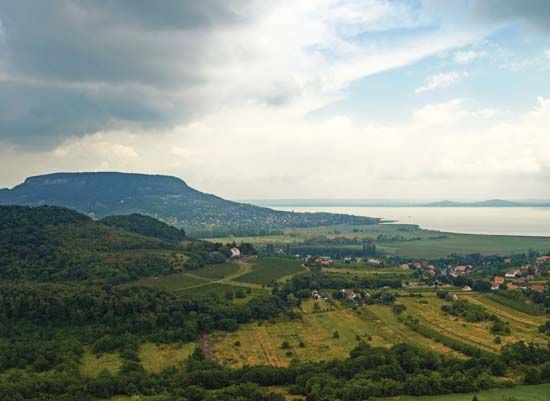
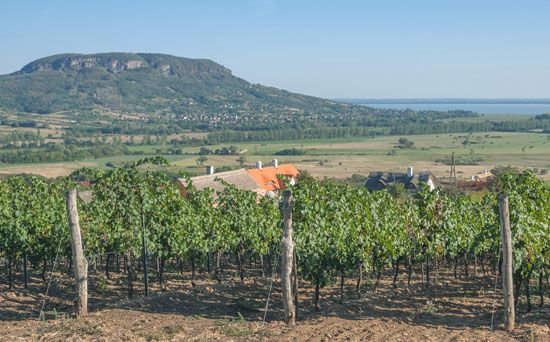
Badacsony is a basalt-covered residual butte located in the Balaton Highlands of western Hungary, rising to an elevation of 1,437 feet (438 metres) on the north bank of Lake Balaton.1
Formed at the end of the Pliocene Epoch, the butte features a truncated cone shape characterized by eroded basaltic pillars known as “organ pipes”. The region is historically significant for its viticulture; vineyards have been cultivated on the southern slopes since Roman times, producing renowned wines such as Graumönch and Kéknyelű. Today, the area is protected as part of the Balaton Highlands National Park and remains a celebrated subject in Hungarian art and literature.1
How are basaltic organ pipes formed?
Basaltic organ pipes, or columnar jointing, are formed through the contraction of igneous rock as it cools.2
When molten rock—such as that found in sills and dikes—cools and consolidates, it undergoes a process of contraction that creates a system of fractures. This process typically results in three sets of joints that intersect at angles of approximately 120°, creating polygonal columns.23
The physical characteristics of these columns are directly influenced by the rate of cooling:
- Cooling Rate: Faster cooling leads to the formation of smaller columns, while slower cooling results in larger ones.3
- Dimensions: These columns can range significantly in size, from approximately 7–8 centimetres (3 inches) to as large as 6 metres (19 feet) in diameter.3
While crustal movement is a primary cause of jointing in many rock types, the specific “organ pipe” structure is a distinct result of the cooling and crystallization process inherent to volcanic and intrusive igneous formations.23
What makes the soil near Lake Balaton good for vineyards?
The high quality of the vineyards near Lake Balaton is largely attributed to the unique volcanic soils found to the northwest of the lake.1
These volcanic soils, particularly those surrounding formations like Badacsony, provide a nutrient-rich foundation that has supported viticulture since Roman times. The combination of this specific geological composition and the region’s continental climate—which features warm, sunny weather from May through October—creates an ideal environment for cultivating grapes. These conditions have historically allowed the region to produce renowned wines, such as the Graumönch and the local Kéknyelű variety.41
What other landmarks are found in the Balaton Highlands National Park?
The Balaton Highlands National Park encompasses several notable geological and cultural landmarks in western Hungary. Key features include:
- Badacsony: A prominent basalt-covered residual butte that rises above the northern shore of Lake Balaton. It is famous for its “basaltic organ pipes”—large, standing pillars formed by the erosion of the basalt layer—and its long-standing tradition of viticulture.1
- Tihany Peninsula: A significant landform that projects into the lake, narrowing it to just one mile wide. This area is a remnant of the dividing ridges that once separated smaller lakes in the region. It is home to a wildlife reserve and the historic settlement of Tihany, which is well-known for its museum and biological station.5
- Keszthely Reedbeds: Located near the town of Keszthely, these extensive wetlands serve as a vital wildlife reserve and a nesting ground for rare water birds.5
Sources
- Badacsony — Encyclopædia Britannica
- igneous rock - Fractures — Encyclopædia Britannica
- joint — Encyclopædia Britannica
- Lake Balaton — Encyclopædia Britannica
- Bakony Mountains — Encyclopædia Britannica
- Hungary - Relief — Encyclopædia Britannica
Published on · 2 min read