Aldabra Islands
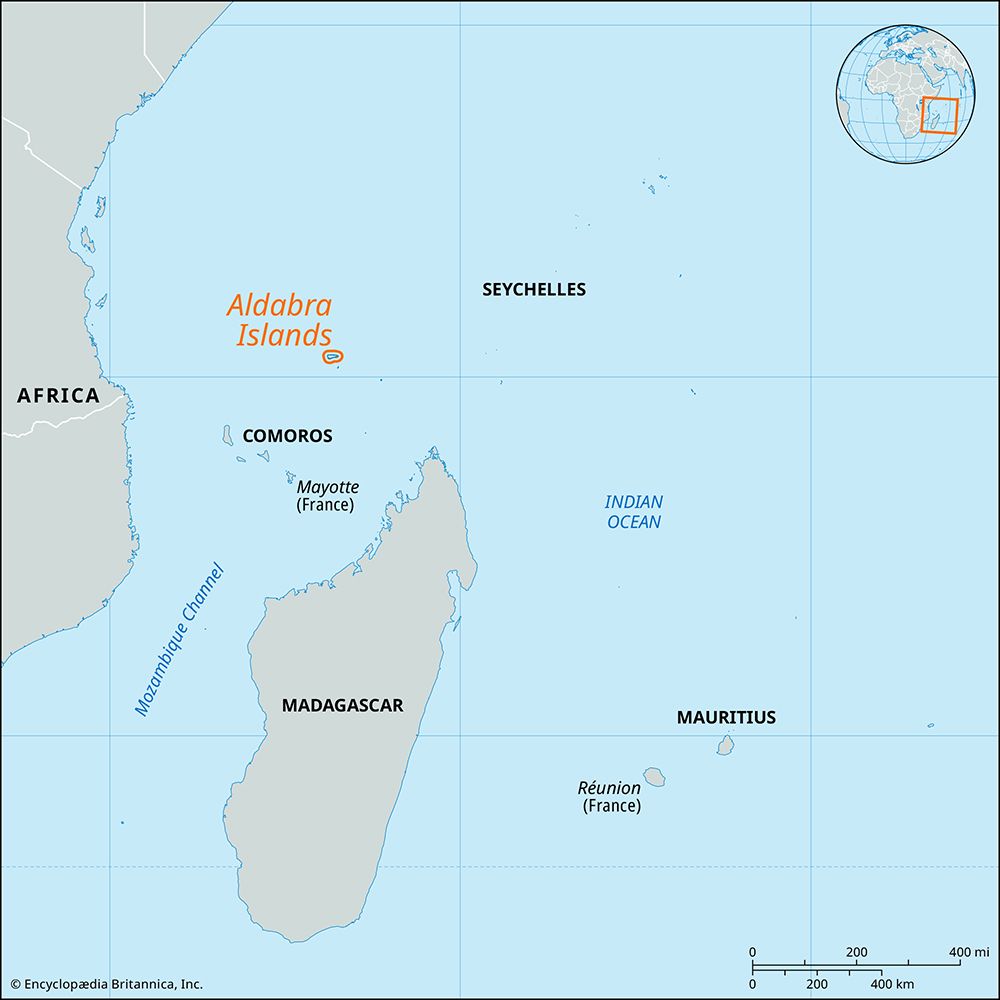
The Aldabra Islands are located in the Indian Ocean, approximately 600 miles (1,000 km) southwest of the Seychelles group, to which they belong.
Where are the Aldabra Islands located, and what is their geological formation?
The Aldabra Islands are located in the Indian Ocean, approximately 600 miles (1,000 km) southwest of the Seychelles group, to which they belong.1
Regarding their geological formation, the islands are volcanic in origin. However, they are specifically categorized as a raised atoll formed through uplift. Unlike islands formed by the accretion of reef debris, the Aldabra Islands were created when crustal movements raised a submarine reef system above sea level. This process resulted in a low, plateaulike feature characterized by rocky terrain, cliffs, and surfaces sculpted by solution weathering, known as karst. The islands enclose a large, shallow lagoon and are divided into four main islands by channels.12
What unique flora and fauna can be found on the Aldabra atoll?
The Aldabra atoll is a significant ecological sanctuary, recognized as a UNESCO World Heritage site for its remarkable biodiversity.14
Fauna
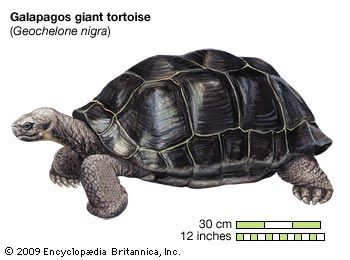
The most iconic animal inhabitant of the Aldabra Islands is the Aldabra giant tortoise (Geochelone gigantea). These creatures, which are among the world’s oldest living animals, were once threatened with extinction but have been successfully protected within a nature reserve established in 1976. Today, the population is estimated to exceed 100,000 individuals, with some areas supporting high densities of 30 to 160 tortoises per hectare. In addition to these tortoises, the atoll serves as a habitat for various other marine and terrestrial species, including green sea turtles.154
Flora
The vegetation of the Aldabra atoll is characterized by the presence of mangrove forests, which thrive in the coastal and lagoon environments of the islands.5
What is the history of human settlement on the Aldabra Islands?
The Aldabra Islands have a history marked by limited human presence and resource exploitation rather than permanent settlement. Throughout the late 20th century, the islands were officially classified as uninhabited.1
Historically, the primary human activity on the atoll was the extraction of guano, a valuable fertilizer derived from bird droppings. This resource was heavily harvested and sold during the early 1950s until the deposits were nearly exhausted.1
Politically, the islands have transitioned through various jurisdictions. From 1965 to 1976, they were part of the British Indian Ocean Territory before being returned to the Seychelles upon that nation’s independence in 1976. Following this transition, the establishment of a nature reserve and the subsequent designation of the atoll as a UNESCO World Heritage site in 1982 shifted the focus of the islands entirely toward ecological preservation and the protection of native species.1
How does the Aldabra atoll compare to other atolls in the Indian Ocean?
The Aldabra atoll is distinguished primarily by its massive scale, ranking among the largest atolls in the world. Measuring approximately 19 miles (30.5 km) in length and 8 miles (13 km) in width, it encloses a vast, shallow lagoon that sets it apart from many smaller coral formations in the Indian Ocean.11
While many islands in the Seychelles group are volcanic in origin, Aldabra shares this geological characteristic with about half of the other islands in the region. However, its unique status is cemented by its ecological preservation; unlike many other atolls that have seen significant human development or resource depletion, Aldabra was designated a UNESCO World Heritage site in 1982. This status, supported by the establishment of a nature reserve in 1976, ensures the protection of its distinct biodiversity, most notably the Aldabra giant tortoise, which thrives in a density rarely matched elsewhere.1
Sources
- Aldabra Islands — Encyclopædia Britannica
- coral island — Encyclopædia Britannica
- Aldabra — Merriam-Webster
- turtle - Habitats — Encyclopædia Britannica
- Seychelles - Plant and animal life — Encyclopædia Britannica
Published on · 3 min read