Sea Turtle
There are seven recognized species of sea turtles, which are divided into two families: Dermochelyidae, represented by the leatherback sea turtle, and…
How many species of sea turtles exist, and which ones are endangered?
There are seven recognized species of sea turtles, which are divided into two families: Dermochelyidae, represented by the leatherback sea turtle, and Cheloniidae, which includes the green, flatback, loggerhead, hawksbill, and ridley turtles.1
Most of these species are considered threatened or endangered due to their slow maturation rates, long lifespans, and migratory nature, which often lead to them being captured in coastal fisheries before they can reproduce. According to the International Union for Conservation of Nature and Natural Resources (IUCN), their conservation statuses are as follows:12
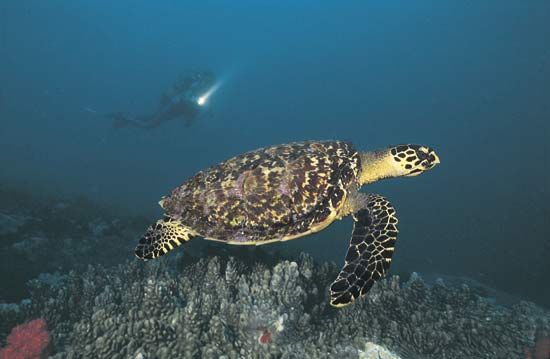
- Critically Endangered: Kemp’s ridley sea turtle and hawksbill sea turtle.12
- Vulnerable: Olive ridley, leatherback, and loggerhead sea turtles.12
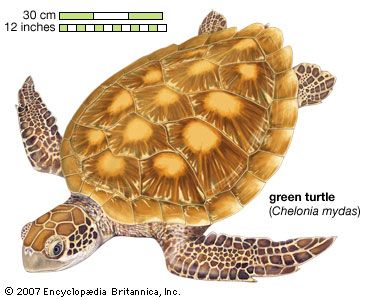
- Least Concern: The green sea turtle, which was reclassified from endangered to least concern in 2025 following a significant population recovery.12
What unique adaptations do sea turtles have for living in marine environments?
Sea turtles possess a variety of specialized adaptations that allow them to thrive in marine environments:
- Locomotion: Unlike other aquatic tetrapods that use their hind limbs for propulsion, sea turtles have evolved bladelike flippers. Their forelimbs act as the primary propulsive units, moving in a figure-eight pattern to provide both lift and thrust, while their hind feet function primarily as rudders for steering.3
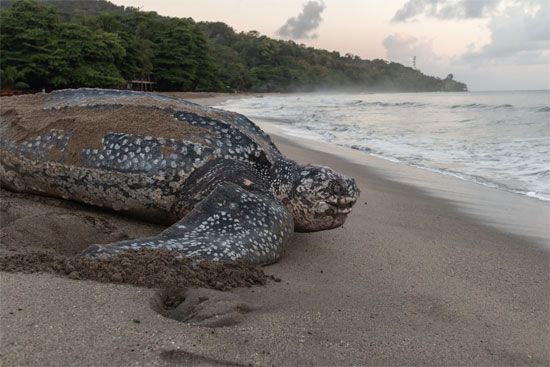
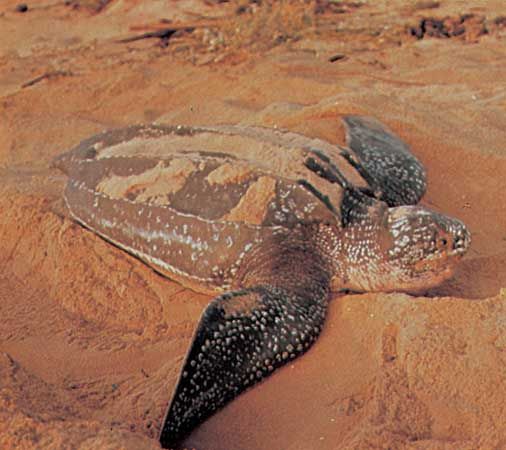
- Shell Morphology: Sea turtles have evolved highly streamlined shells to reduce drag, which is essential for efficient swimming. While most species have a hard carapace, the leatherback sea turtle is a notable exception, possessing a leathery skin over a bony matrix, which helps it remain flexible and hydrodynamic.45
- Thermoregulation: Leatherbacks, in particular, have adapted to cold waters through their large body size and a layer of insulating fat. They also utilize a specialized network of blood vessels in their limbs to exchange heat, warming blood before it returns to the heart.5
- Respiration and Diving: Sea turtles are highly efficient breathers. Their lungs are complex, with extensive branching to facilitate rapid gas exchange. Some species, such as the leatherback, can even expel waste gases through their skin, allowing them to remain submerged for up to 85 minutes.65
- Navigation: Sea turtles exhibit remarkable homing abilities. They imprint on the unique magnetic field signature of their natal beach, allowing them to navigate across vast oceanic distances to return to the same location for nesting as adults.7
How are human activities impacting sea turtle populations, and what conservation efforts are in place?
Human activities pose significant threats to sea turtle populations, primarily through habitat destruction and accidental capture in commercial fisheries. Because sea turtles are long-lived and slow to mature, these pressures can severely impact their ability to sustain populations.15
Human-Driven Threats
- Bycatch: Sea turtles are frequently caught as bycatch in commercial fishing operations, including trawls, gill nets, and longlines. This accidental capture often leads to drowning or fatal physical trauma.10
- Habitat Degradation: Nesting beaches are increasingly threatened by coastal construction, automobile traffic, and pollution. Additionally, rising sea levels and erosion linked to global warming reduce available nesting space.5
- Ingestion of Debris: Sea turtles, particularly those that feed on jellyfish, often mistake plastic bags and other marine debris for food, which can be lethal.5
- Direct Exploitation: In some regions, turtles and their eggs continue to be harvested for food or commercial sale.5
Conservation Efforts
- Technological Solutions: To mitigate bycatch, researchers have developed turtle excluder devices—barriers within nets that allow turtles to escape if captured.10
- Monitoring and Protection: Organizations like the World Wildlife Fund, the Sea Turtle Conservancy, and the Leatherback Trust utilize satellite tracking to monitor migration patterns and protect nesting sites from poachers and environmental hazards.5
- Legal Frameworks: International and national regulations, such as the prohibition of large-scale drift nets, have been implemented to reduce the impact of commercial fishing on non-target marine life.10
What are the differences in diet between various sea turtle species?
While most sea turtle species are primarily carnivorous, their specific diets vary significantly based on their ecological niche and physical adaptations.
- Green sea turtles: Unlike most other sea turtles, these are predominantly herbivorous as adults, feeding primarily on marine grasses and algae.11112
- Leatherback sea turtles: These are specialized carnivores that feed almost exclusively on gelatinous prey, such as jellyfish and salps. They often migrate to follow seasonal blooms of these organisms.11112
- Loggerhead sea turtles: These turtles are carnivorous and possess powerful jaws adapted for crushing the shells of large mollusks, such as whelks.111
- Hawksbill sea turtles: Commonly found in coral reef habitats, they feed primarily on sponges and various other invertebrates.1
- Ridley and Flatback sea turtles: Both the Kemp’s ridley, the olive ridley, and the flatback sea turtle are largely carnivorous, consuming a wide variety of crustaceans and other invertebrates.1
Sources
- sea turtle — Encyclopædia Britannica
- sea turtle: Top Questions — Encyclopædia Britannica
- turtle - Form and function — Encyclopædia Britannica
- Locomotion - Tetrapodal vertebrates — Encyclopædia Britannica
- leatherback sea turtle — Encyclopædia Britannica
- Respiratory system - Reptiles — Encyclopædia Britannica
- Biosphere - Salinity — Encyclopædia Britannica
- chondrichthyan - Salt and water balance — Encyclopædia Britannica
- Homing — Encyclopædia Britannica
- bycatch — Encyclopædia Britannica
- What do turtles eat? — Encyclopædia Britannica
- turtle - Feeding behaviour — Encyclopædia Britannica
Published on · 4 min read