Alligator Snapping Turtle
The alligator snapping turtle (Macrochelys temminckii) is the largest species of freshwater turtle in North America and one of the largest in the world.…
What is an alligator snapping turtle?
The alligator snapping turtle (Macrochelys temminckii) is the largest species of freshwater turtle in North America and one of the largest in the world. Belonging to the family Chelydridae, these turtles are native to the United States, primarily inhabiting rivers, lakes, and swamps in southern and central regions.12
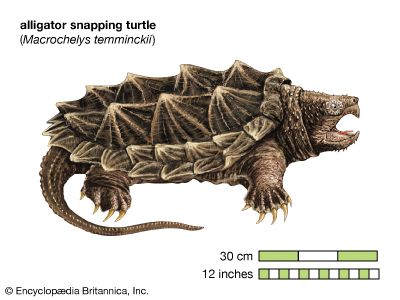
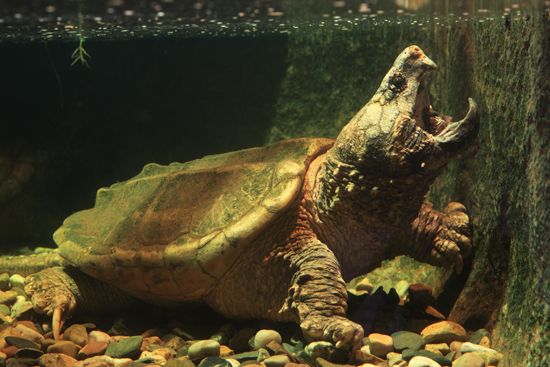
Distinguished by their “prehistoric” appearance, they possess a dark, armored shell featuring three prominent longitudinal ridges, or keels, that contain spikes. They have large, pointed heads with hooked beaks and eyes positioned on the sides of the head. Adults can reach weights of 70 to 90 kg (about 154 to 198 pounds) and shell lengths of up to 80–100 cm.12
A unique characteristic of the alligator snapping turtle is the pink, wormlike appendage on its tongue, which it uses as a lure to attract fish and frogs while lying motionless on the water bottom with its mouth open. They are powerful hunters and scavengers with a bite capable of breaking bone. Currently classified as a vulnerable species, they face threats from habitat loss and illegal harvesting.12
Where does the alligator snapping turtle live?
The alligator snapping turtle (Macrochelys temminckii) is native exclusively to the United States, where its range extends from Texas in the west to Georgia and Florida in the east, and from Illinois and Kansas in the north down to the Gulf Coast.3
Within these regions, adult turtles typically inhabit the deeper waters of lakes, canals, swamps, and rivers, while juveniles and hatchlings are generally found in smaller streams. While these areas constitute their native range, non-native populations have been established in various other states and in South Africa, where the species is considered invasive.31
What does an alligator snapping turtle look like?
The alligator snapping turtle (Macrochelys temminckii) is known for its distinct, “prehistoric” appearance, often compared to a dinosaur due to its stocky, armored build.1
Key physical characteristics include:
- Shell (Carapace): The shell is dark brown and features three prominent longitudinal ridges, or keels, that run from front to back and are covered in spikes. Because they spend much of their time motionless underwater, algae often grows on their backs, providing natural camouflage.13
- Head and Jaws: They possess a large, triangular-shaped head with a powerful, hooked beak. Unlike other snapping turtles, their eyes are positioned on the sides of the head.13
- Lure: A unique feature is the pink, wormlike appendage on the floor of the mouth, which the turtle uses to lure prey while lying still with its mouth open.213
- Size: As the largest freshwater turtle in North America, they can reach lengths of 80–100 cm (31.5–39.3 inches) and weigh between 70 and 90 kg (154–198 pounds).21
- Tail and Skin: They have long, thick, scale-covered tails and skin that ranges from brown to grayish, with lighter coloration on the underside.1
How does the alligator snapping turtle hunt for food?
The alligator snapping turtle (Macrochelys temminckii) is a skilled hunter that employs both passive luring and active foraging to secure its food.
Luring Strategy
During the day, the turtle often remains motionless in murky water with its mouth held wide open. It utilizes a unique, red, wormlike appendage located on its tongue as a lure. This structure wiggles to mimic a worm, attracting unsuspecting fish or frogs directly into the turtle’s reach.13
Active Foraging and Scavenging
While famous for its lure, the alligator snapping turtle is also an active hunter and scavenger. It is capable of using a chemical sense to track down prey, such as mud turtles and musk turtles. Its diet is diverse, consisting of:
- Fish and mollusks
- Frogs, snakes, and snails
- Small mammals and insects
- Aquatic plants3
The turtle is most active at night when it may forage more broadly. Once prey is within range, the turtle uses its extremely powerful, hooked jaws to strike, exerting enough force to easily crush bone.3
Sources
- snapping turtle — Encyclopædia Britannica
- alligator snapping turtle — Merriam-Webster
- alligator snapping turtle — Encyclopædia Britannica
- 7 of the World’s Most Dangerous Lizards and Turtles — Encyclopædia Britannica
Published on · 3 min read