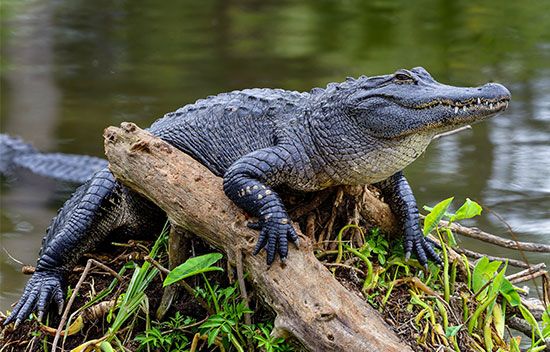
Alligator
Alligators are often confused with other reptiles, particularly crocodiles. While they share general crocodilian traits—such as long snouts, powerful tails…
What are the key physical characteristics that distinguish alligators from other reptiles?
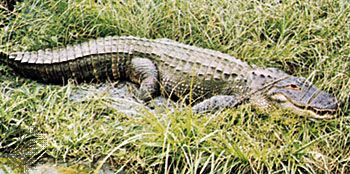
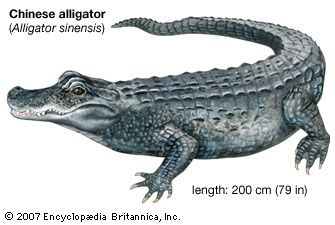
Alligators are often confused with other reptiles, particularly crocodiles. While they share general crocodilian traits—such as long snouts, powerful tails, short legs, and bony-plated backs—alligators possess specific physical characteristics that distinguish them from their relatives.123
The primary distinguishing features include:
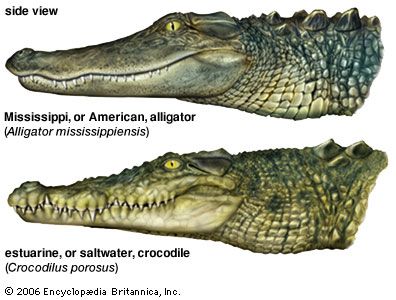
- Snout Shape: Alligators have a broad, U-shaped snout, whereas true crocodiles have a narrower, V-shaped snout.134
- Teeth and Jaw: Alligators exhibit an “overbite,” meaning the teeth of the lower jaw fit within the teeth of the upper jaw when the mouth is closed. Consequently, the lower teeth are typically not visible. In contrast, a crocodile’s large fourth lower tooth remains visible outside the snout when the mouth is shut.134
- Coloration: Alligators generally appear gray or black, while crocodiles tend to be olive or tan.1
These anatomical differences, particularly regarding skull and jaw structure, are key to their taxonomic classification within the order Crocodylia.4
How do alligators differ from crocodiles in terms of appearance and behavior?
Alligators and crocodiles are distinct members of the order Crocodylia that can be differentiated by several physical and behavioral traits.15
Appearance
- Snout Shape: Alligators possess a broad, U-shaped snout, whereas crocodiles have a narrower, V-shaped snout.15
- Teeth: Alligators exhibit an “overbite,” where the lower teeth fit into sockets in the upper jaw and are generally not visible when the mouth is closed. In contrast, a crocodile’s large fourth lower tooth remains visible outside the upper jaw when the mouth is shut.15
- Coloration: Alligators are typically darker, appearing gray or black, while crocodiles often display olive or tan hues.1
Behavior and Habitat
- Aggression: Crocodiles are generally considered more aggressive than alligators.1
- Environment: Alligators prefer freshwater habitats, such as lakes and swamps, while crocodiles are more commonly found in saltwater environments.15
- Communication: Both groups utilize vocalizations like hissing and roaring, particularly during the breeding season, and rely on chemical signals for communication.53
What is the typical life cycle of an alligator, from egg to adult?
The life cycle of an American alligator is a complex process involving parental care, environmental sex determination, and a long maturation period.
Reproduction and Nesting
The breeding season begins in April, during which males compete for mates and nesting areas. Females construct nests using plant debris and rotting vegetation. In early summer, they deposit clutches typically containing 35 to 39 eggs, though some may hold 50 or more.7
Incubation and Sex Determination
The sex of the offspring is determined by the incubation temperature. When the average nest temperature remains between approximately 32 and 32.5 °C (86.9 and 90.5 °F), the eggs are more likely to develop into males. The female remains near the nest to defend it from predators until the young emerge in late August or early September.7
Growth and Maturity
Upon hatching, the young remain in the care of their mother for one to two years, often joining “pods” with offspring from other clutches. They typically reach sexual maturity after age 10, once they have grown to a length of at least 1.8 meters (5.9 feet). In the wild, alligators generally live for 35 to 50 years, though they can survive for more than 70 years in captivity.78
How do alligators communicate with each other and with other species?
Alligators and other members of the order Crocodylia utilize a variety of methods to communicate, relying on vocalizations, physical displays, and chemical signals to interact with one another and their environment.11
Vocal Communication
Vocalization is a primary means of interaction. Hatchlings produce squeaking and grunting sounds to signal their presence or distress. Adults utilize a range of sounds, including grunts, growls, and hisses, often as a defensive response to threats. During the breeding season, both sexes may produce a loud roar; this display involves tensing the body muscles, lifting the head and tail out of the water, and vibrating the flanks so intensely that water is sprayed into the air.11
Chemical and Social Signaling
Beyond sound, these reptiles communicate using chemical signals. Glands located in the mandible and cloaca excrete oily substances, which are believed to play a role in social interaction, though the specific functions remain under study. Furthermore, these animals establish dominance hierarchies to manage access to resources like nesting and sunning sites.11
Sources
- What’s the Difference Between Alligators and Crocodiles? — Encyclopædia Britannica
- crocodile — Encyclopædia Britannica
- alligator — Encyclopædia Britannica
- crocodile - Distinguishing taxonomic features — Encyclopædia Britannica
- crocodile - Annotated classification — Encyclopædia Britannica
- crocodile - Behavior — Encyclopædia Britannica
- How long can alligators live? — Encyclopædia Britannica
- American alligator — Encyclopædia Britannica
- crocodile - Life cycle — Encyclopædia Britannica
- reptile - Embryonic development and parental care — Encyclopædia Britannica
- How fast are alligators? — Encyclopædia Britannica
Published on · 3 min read