Yinlong
The provided search results do not contain information regarding other specific dinosaur species that lived alongside Yinlong in the Junggar Basin during the…
What other dinosaur species lived alongside Yinlong?
The provided search results do not contain information regarding other specific dinosaur species that lived alongside Yinlong in the Junggar Basin during the Late Jurassic. While the text notes that Yinlong shares skeletal features with the ornithopod Heterodontosaurus and various pachycephalosaurians, it does not explicitly state that these animals coexisted with Yinlong in the same environment.1
How does Yinlong’s name relate to Chinese mythology?
The name Yinlong is not directly derived from Chinese mythology, though it is often associated with it due to its meaning. The genus name translates from Chinese to “hiding dragon.” This name was chosen because the fossil was discovered near a filming location used for the movie Crouching Tiger, Hidden Dragon (2000), rather than as a direct reference to a specific mythological figure.1
Yinlong is significant in paleontology as the most primitive known ceratopsian dinosaur, dating back to the Jurassic Period. Its discovery in the Junggar Basin has provided researchers with vital clues regarding the evolutionary relationships between ceratopsians and pachycephalosaurians.1
How did Yinlong’s skull structure differ from later ceratopsians?
Yinlong possesses a unique skull structure that distinguishes it from more advanced ceratopsian dinosaurs. While later ceratopsians are characterized by their massive, specialized skulls featuring prominent horns and expansive neck frills, Yinlong retains several primitive characteristics shared with pachycephalosaurians that are absent in its descendants.1
Key differences include:
- Pachycephalosaurian Traits: Yinlong exhibits specific skull features common to pachycephalosaurians, suggesting a close evolutionary relationship between the two groups. These traits are not found in more derived ceratopsians, which evolved highly specialized, distinct cranial morphologies over time.1
- Lack of Advanced Specializations: Unlike later ceratopsids, which developed elaborate horn arrays and large bony neck shields for defense, display, or thermoregulation, Yinlong lacks these advanced, derived structures.12
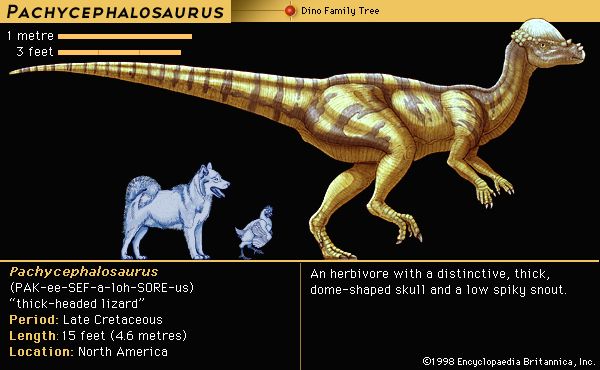
- Evolutionary Transition: The skull of Yinlong represents a more basal state. As ceratopsians evolved, their skeletons became significantly more derived, moving away from the primitive features shared with pachycephalosaurians toward the specialized, quadrupedal forms seen in later groups like Protoceratops and Triceratops.12
What are the key physical characteristics of Yinlong?
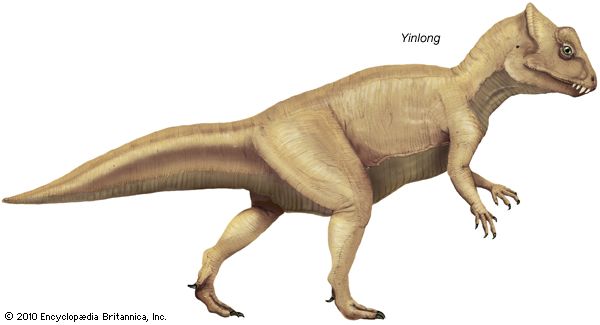
Yinlong is recognized as the most primitive ceratopsian dinosaur discovered to date. Its physical characteristics provide significant insight into the evolutionary history of ornithischian dinosaurs.1
Key physical features include:
- Size: Yinlong was a small herbivorous dinosaur, measuring approximately 1.2 meters (about 4 feet) in length.1
- Locomotion: Unlike most later ceratopsians, which were quadrupedal, Yinlong walked on two legs (bipedally), a trait it shared with pachycephalosaurians.1
- Skull Morphology: The skull of Yinlong is particularly notable for possessing primitive characteristics that are absent in more advanced ceratopsians. These features are similar to those found in pachycephalosaurians, supporting the theory that the two groups are closely related.1
- Skeletal Traits: The skeleton of Yinlong displays a unique combination of features shared with both Heterodontosaurus (an ornithopod) and pachycephalosaurians, marking it as a basal member of the ceratopsian lineage.1
Sources
- Yinlong — Encyclopædia Britannica
- dinosaur - Ceratopsia — Encyclopædia Britannica
Published on · 2 min read