Is an Alligator a Reptile?
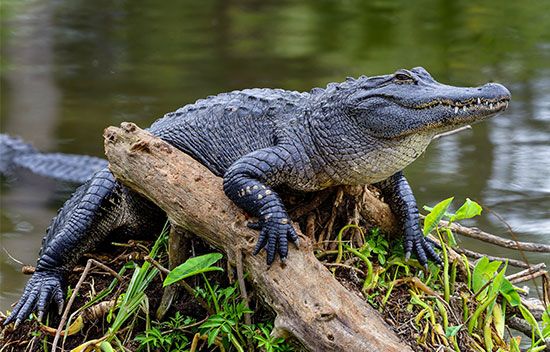
Yes, an alligator is a reptile. They are classified within the class Reptilia and the order Crocodilia.
Is an alligator a reptile?
Yes, an alligator is a reptile. They are classified within the class Reptilia and the order Crocodilia.12
Alligators exhibit several key reptilian characteristics that define this classification:
- Physical Traits: They possess tough, scaly skin that helps prevent water loss, which is a vital adaptation for life on land. These scales are composed of keratin.13
- Metabolism: Like other reptiles, alligators are cold-blooded, often basking in the sun to regulate their body temperature and increase their metabolism.12
- Reproduction: They reproduce by laying shelled eggs on land. Female alligators construct nests of vegetation and mud and provide parental care by guarding the eggs until they hatch.142
What are the main differences between alligators and crocodiles?
Although alligators and crocodiles are both large reptiles with similar body shapes, they can be distinguished by several key physical and behavioral traits:
- Snout Shape: Alligators have a broad, U-shaped snout, whereas crocodiles possess a narrower, V-shaped snout.56
- Teeth: When an alligator’s mouth is closed, its lower teeth are typically hidden. In contrast, a crocodile’s lower teeth—particularly the large fourth tooth—remain visible when its mouth is shut.56
- Coloration: Alligators generally appear gray or black, while crocodiles tend to be olive or tan.5
- Habitat: Alligators prefer freshwater environments, such as swamps and rivers. Crocodiles are more commonly associated with saltwater habitats.5
- Behavior: Crocodiles are typically considered more aggressive than alligators.5
While both animals are powerful predators that use their tails for swimming and defense, these differences provide reliable ways to identify them in the wild.56
How do cold-blooded animals regulate their body temperature?
Cold-blooded animals, or ectotherms, regulate their body temperature primarily by relying on external environmental sources rather than generating heat internally. Because they do not maintain a constant internal temperature, they utilize several strategies to survive:89
Behavioral Thermoregulation
Ectotherms maintain optimal body temperatures for activities like hunting or escaping predators through behavioral adjustments:810
- Sun and Shade: They move between sunny and shaded areas to absorb or lose heat.811
- Postural Changes: Animals may orient their bodies toward solar radiation or adjust how much of their body surface is in contact with warm surfaces like rocks or soil.810
- Shelter: During extreme temperatures, they may retreat into burrows or move to the bottom of water bodies to find more stable conditions.109
- Huddling: Some species huddle together in cold weather to conserve heat.11
Biochemical Adaptations
When behavioral methods are insufficient, ectotherms employ internal chemical strategies:
- Heat Stress: They release heat-shock proteins to stabilize other proteins and prevent damage from high temperatures.9
- Cold Tolerance: To survive freezing, some species produce cryoprotectants—such as sugars, alcohols, or specialized proteins—that lower the freezing point of their tissues and prevent ice crystal formation.9
What are some other examples of animals in the reptile class?
The class Reptilia is a diverse group of air-breathing vertebrates characterized by internal fertilization, amniotic development, and epidermal scales. Beyond alligators and crocodiles, the major living groups of reptiles include:133
- Turtles (Order Testudines): These reptiles are easily recognized by their bony shells, which encase their bodies. This group includes a wide variety of species, such as sea turtles, snapping turtles, and tortoises13.14
- Lizards (Order Squamata): As the most diverse group of modern reptiles, lizards vary significantly in size and form. Examples range from small geckos and iguanas to large monitor lizards.1315
- Snakes (Order Squamata): Also part of the order Squamata, snakes are distinguished by their limbless, elongated bodies. They have evolved specialized features, such as a venom-conducting system in many species and a highly flexible vertebral column.131617
- Tuatara (Order Rhynchocephalia): Endemic to New Zealand, the tuatara is the sole survivor of an ancient lineage that diverged from lizards and snakes approximately 250 million years ago.1318
Sources
- Is an alligator a reptile? — Encyclopædia Britannica
- Vertebrate: Top Questions — Encyclopædia Britannica
- reptile - General features — Encyclopædia Britannica
- American alligator — Encyclopædia Britannica
- What’s the Difference Between Alligators and Crocodiles? — Encyclopædia Britannica
- alligator — Encyclopædia Britannica
- crocodile - Behavior — Encyclopædia Britannica
- Why are reptiles cold-blooded? — Encyclopædia Britannica
- Thermoreception - Environment and thermoreception — Encyclopædia Britannica
- Thermoreception - Reptiles and amphibians — Encyclopædia Britannica
- Ectotherm — Encyclopædia Britannica
- Did you know? — Merriam-Webster
- reptile — Encyclopædia Britannica
- reptile - Annotated classification — Encyclopædia Britannica
- lizard - General features — Encyclopædia Britannica
- list of turtles — Encyclopædia Britannica
- tuatara — Encyclopædia Britannica
- snake - Vertebrae — Encyclopædia Britannica
- snake — Encyclopædia Britannica
Published on · 3 min read