Alluvial Deposit
An alluvial deposit, also known as alluvium, is material transported and deposited by rivers. This sediment typically consists of silt, sand, clay, and…
What is alluvial deposit?
An alluvial deposit, also known as alluvium, is material transported and deposited by rivers. This sediment typically consists of silt, sand, clay, and gravel, often mixed with organic matter.12
These deposits form when a river’s flow velocity decreases—such as when it enters a lake or overflows its banks—and are most extensive in the lower reaches of a river, where they create floodplains and deltas. Alluvial deposits are highly valued for their fertility, supporting productive agricultural regions like the deltas of the Mississippi, Nile, and Ganges rivers.12
Beyond agriculture, these deposits are economically significant as they contain much of the world’s tin ore, as well as gold, platinum, and various gemstones. When these minerals are concentrated by stream water, they form alluvial placers, which have historically been a primary source of gold production.123
How do river deltas form?
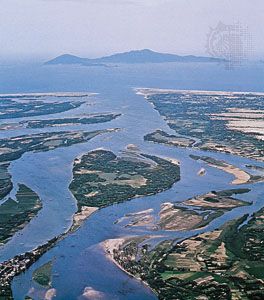
A delta forms when a river enters a body of standing water—such as an ocean or lake—and delivers sediment at a rate faster than marine processes can remove it. As the river’s flow velocity decreases upon reaching the standing water, it loses its capacity to transport sediment, causing the material to accumulate and build a depositional plain.567
The formation and morphology of a delta are determined by a balance between the sediment supplied by the river and the energy of the shoreline, such as waves, tides, and currents. Deltas typically consist of three distinct physiographic parts:5
- Upper Delta Plain: The subaerial portion above the highest tidal level, where the river often branches into multiple channels.7
- Lower Delta Plain: The zone occasionally covered by tidal water, featuring tidal flats and mangrove swamps.7
- Subaqueous Delta: The portion located below sea level, which forms the topographic bulge on the continental shelf as sediment is deposited seaward of the river channels.7
Geologically, these features are characterized by a specific stratigraphic sequence: horizontal topset beds (subaerial), inclined foreset beds (subaqueous delta front), and fine-grained bottomset beds (prodelta zone).6
Why is alluvial soil so fertile for farming?
Alluvial soil is highly fertile primarily because it is composed of a nutrient-rich mixture of silt, sand, clay, and gravel, which often contains significant amounts of organic matter2.2
This material, known as alluvium, is deposited by rivers during flooding events when the water overflows its banks and slows down, allowing suspended sediments to settle on the floodplain or delta. Because these deposits are frequently replenished by fresh sediment during periodic inundation, they maintain a high level of productivity. For example, the khadar—new alluvium found on the Indo-Gangetic floodplain—is prized for being extremely fertile and uniform in texture. Additionally, the presence of sandy aquifers in these regions often provides reliable access to groundwater, further supporting intensive agriculture in areas like the Nile, Mississippi, and Ganges river basins.1291011
What are alluvial placers and how do they trap gold?
Alluvial placers, also known as stream placers, are natural concentrations of heavy, chemically resistant minerals that have been weathered from their original rock matrix and transported by flowing water. These deposits are among the most significant sources of gold, as the metal’s high specific gravity and durability allow it to persist and accumulate in stream, river, and floodplain environments.1415
Gold is trapped in these environments primarily through the physical action of water flow. Because the ability of a stream to transport solid material is related to its velocity, heavy minerals like gold settle out of the water much more rapidly than lighter materials (such as sand or silt) whenever the current slows down.1416
This process of gravity concentration occurs naturally in streambeds where the water velocity decreases, causing gold to drop out of the flow and accumulate in the gravel. Miners have historically replicated this natural trapping mechanism using techniques like panning or sluicing, where riffles or basins are used to intentionally retard the water current, forcing the dense gold to settle and be caught while lighter sediments are washed away.1416
Sources
- alluvial deposit — Encyclopædia Britannica
- alluvium — Encyclopædia Britannica
- mineral deposit - Alluvial placers — Encyclopædia Britannica
- river - Floodplain deposits, origins, and features — Encyclopædia Britannica
- river - Deltas — Encyclopædia Britannica
- river - Morphology of deltas — Encyclopædia Britannica
- river - Deposits and stratigraphy — Encyclopædia Britannica
- river - Sedimentation in estuaries — Encyclopædia Britannica
- river - Floodplains — Encyclopædia Britannica
- floodplain — Encyclopædia Britannica
- India - Alluvial soils — Encyclopædia Britannica
- hydrosphere - Congruent and incongruent weathering reactions — Encyclopædia Britannica
- river - Environments of deposition — Encyclopædia Britannica
- placer deposit — Encyclopædia Britannica
- How is gold formed? — Encyclopædia Britannica
- placer mining — Encyclopædia Britannica
Published on · 3 min read