Mangrove
Mangroves are keystone species that provide essential services to tropical and subtropical coastal ecosystems. Their ecological roles include:
What ecological roles do mangroves play in coastal ecosystems?
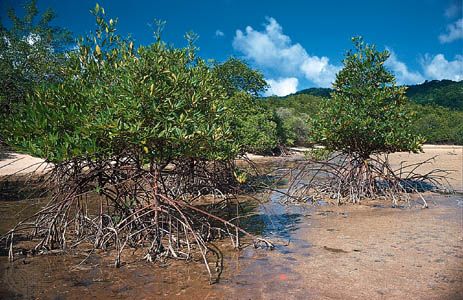
Mangroves are keystone species that provide essential services to tropical and subtropical coastal ecosystems. Their ecological roles include:12
- Coastal Protection: Mangroves act as a natural buffer between marine and terrestrial environments, shielding shorelines from damaging winds, waves, and floods. Their dense root systems reduce erosion and help mitigate the impact of storm surges.132
- Habitat and Biodiversity: These forests serve as critical nursery habitats for various fish, crabs, shrimp, and shellfish, which rely on them for breeding and spawning. They also provide nesting sites for many birds and support a diverse array of terrestrial organisms1.32
- Water Quality: By trapping sediments and filtering pollutants from land runoff, mangroves improve water quality, which is vital for the health of nearby coral reefs and seagrass beds.12
What threats do mangrove forests face and what conservation efforts are being made to protect them?
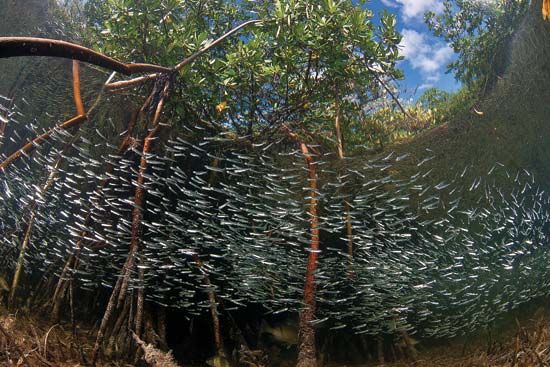
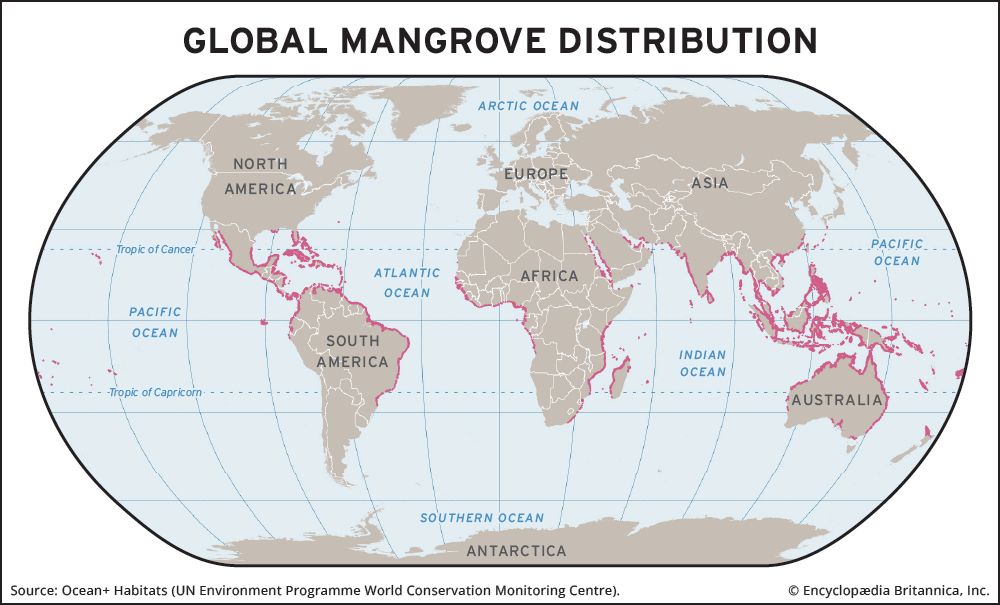
Mangrove forests are currently facing severe threats, primarily driven by human activity and environmental shifts. Key pressures include coastal development, urban expansion, aquaculture, tourism, and agriculture, all of which have led to widespread clearing and destruction of these habitats. Furthermore, water pollution and the alteration of natural water flow through dams or drainage systems significantly degrade these ecosystems. Climate change exacerbates these issues through rising sea levels, increased storm intensity, and temperature fluctuations, causing many species to be classified as vulnerable, endangered, or critically endangered on the IUCN Red List.14
Conservation efforts are essential to reverse these trends. Protecting and restoring mangroves is increasingly recognized as a vital strategy for both environmental health and human safety, as these forests provide significant economic and physical protection against flooding and storm damage. Countries like Belize have demonstrated that maintaining healthy mangrove ecosystems is a powerful tool for climate change mitigation and adaptation. Ongoing initiatives focus on preserving these natural buffers to ensure the survival of coastal biodiversity and the stability of local fisheries.24
What role do mangroves play in stabilizing shorelines and preventing erosion?
Mangroves serve as a vital buffer between marine and terrestrial environments, playing a critical role in stabilizing shorelines and mitigating coastal erosion.11
Their effectiveness in protecting the coast is primarily due to their complex physical structure:
- Sediment Trapping: The dense, tangled root systems of mangroves act as a physical barrier that slows the flow of water. This allows suspended sediments to settle out of the water column, which helps build up and stabilize the soil along the coast.12
- Wave and Wind Attenuation: By forming vast, impermeable thickets, mangroves absorb the energy of incoming waves and reduce the force of damaging winds. This protection significantly lessens the impact of floods and storm surges during extreme weather events like hurricanes.12
- Colonization: Because of their high salt tolerance, mangroves are often among the first species to colonize mud and sandbanks. By anchoring these unstable substrates, they prevent the loss of land and create a foundation that allows other life to thrive.12
How do mangroves reproduce and disperse their seeds?
Mangroves have evolved unique reproductive strategies to survive in challenging, saline coastal environments. A key feature for many species, such as the common mangrove (Rhizophora mangle), is vivipary, where the seed germinates while still attached to the parent tree.15
The Reproductive Process
- Development: While the fruit remains on the parent branch, the embryonic root emerges from the seed and begins to grow rapidly downward.1
- Elongation: In many species, the root end of the embryo elongates, passing through the seed and the ovary wall. This root can grow to a significant length before the seedling, known as a propagule, eventually separates from the parent tree.51
- Establishment: When the propagule falls, its developed root is often already in the correct position to anchor itself directly into the mud, allowing the young plant to establish itself immediately.15
Seed Dispersal
Mangroves rely heavily on hydrochory, or dispersal by water. Because their seeds and seedlings are buoyant, they can be carried by tides and currents over long distances to colonize new mud and sandbanks. This waterborne dispersal is essential for the expansion and survival of mangrove populations across tropical and subtropical coastlines.31
Sources
- mangrove: Top Questions — Encyclopædia Britannica
- Amazing Mangroves — Encyclopædia Britannica
- mangrove — Encyclopædia Britannica
- Mangroves Matter - Learn more — Encyclopædia Britannica
- Seed dispersal - Hydrochory: dispersal by water — Encyclopædia Britannica
- Myrtales - Characteristic morphological features — Encyclopædia Britannica
Published on · 3 min read