Alster River
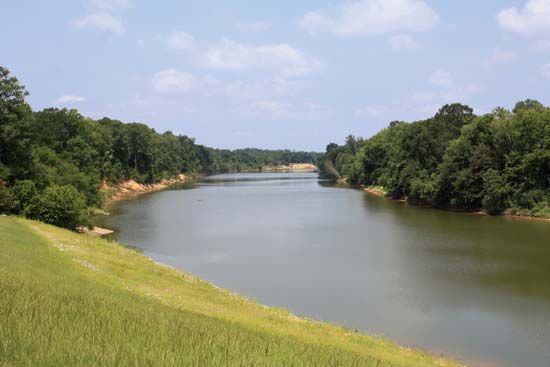
The Alster River is a tributary of the Elbe River located in northern Germanybe-River) located in northern Germany. It originates southeast of Kaltenkirchen…
What is Alster River?
The Alster River is a tributary of the Elbe River located in northern Germanybe-River) located in northern Germany. It originates southeast of Kaltenkirchen and flows south for approximately 30 miles (50 km) toward Hamburg.12
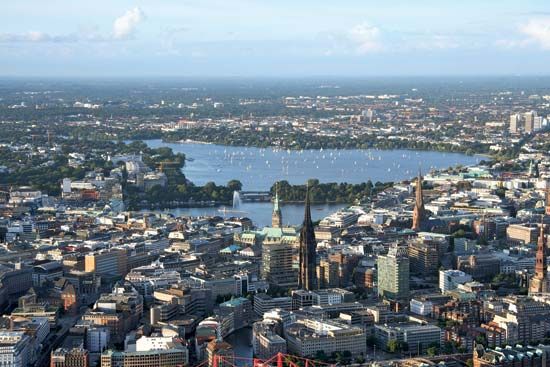
In the Middle Ages, the river was dammed, creating a large lake at the heart of Hamburg. This lake is divided by the Lombardsbrücke into two sections: the Binnenalster (Inner Alster) and the Aussenalster (Outer Alster). Beyond the dam, the river continues to the Elbe via two parallel canals, which historically served as a boundary between the older eastern section of the city and its newer western expansion. The river has played a vital role in the city’s development, serving as a harbor site for early medieval trade and connecting to the city’s network of Fleete (canals).234
What is the significance of the Elbe River to Hamburg?
The Elbe River is fundamental to the identity and economic success of Hamburg, which has long been known as Germany’s “gateway to the world.” Its significance can be summarized through its historical, commercial, and logistical roles:5
- Foundation and Growth: Hamburg originated in the 9th century on a site between the Alster and Elbe rivers. The Elbe provided a vital outer roadstead for the city’s early harbor, and by the 13th century, Hamburg secured its prosperity by controlling navigation along the river’s lower course, eventually becoming a leading member of the Hanseatic League.25
- Economic Hub: As one of Europe’s largest seaports, Hamburg relies on the Elbe to connect to international trade routes. The river serves as a major artery for transporting goods to the interior of Germany, Berlin, and the Czech Republic via an extensive network of connecting waterways and canals.67
- Logistical Infrastructure: The river is essential for modern trans-European traffic. The city has integrated the Elbe into its infrastructure through tunnels and extensive port facilities that span both banks, allowing for the efficient handling of containers and general cargo.657
How did the Hanseatic League influence Hamburg’s growth?
The Hanseatic League was instrumental in transforming Hamburg from a small settlement into a major commercial power. As the league evolved from local merchant associations into a widespread network of north German cities, Hamburg secured a position of prominence, second only to Lübeck.8
The league influenced Hamburg’s growth through several key mechanisms:
- Security and Cooperation: As early as 1210, Hamburg and Lübeck established a common legal framework, leading to a formal alliance in 1241. This partnership allowed for collective action against piracy and land robbers, ensuring the safety of vital trade routes.9
- Control of Trade Routes: Hamburg became a major entrepôt for trade between Russia and Flanders. To safeguard this commerce, the city acquired land along the Elbe River and its estuary, eventually gaining control over navigation on the river’s lower course.8
- Economic Leverage: By participating in the league’s monopolistic and protectionist policies, Hamburg benefited from the broader east-west trade currents, connecting the industrial west with the resource-rich “colonial” lands of eastern Europe.28
What are the differences between the Binnenalster and the Aussenalster?
The Alster River in Hamburg was dammed in the Middle Ages, creating a large lake that was later divided into two distinct sections by 17th-century fortifications and the Lombardsbrücke (Lombard Bridge).13
The differences between the two sections are primarily defined by their location and character:
- Binnenalster (Inner Alster): This is the southern portion of the lake, situated at the heart of the city center. It is closely associated with the urban core and the historic layout of the city.13
- Aussenalster (Outer Alster): This is the northern portion of the lake. It is surrounded by elegant residential suburbs such as Rotherbaum, Harvestehude, and Uhlenhorst. Unlike the more urban Binnenalster, the Aussenalster is fed by many waterways that are navigable by pleasure boats, giving it a more recreational character.3
Together, these two bodies of water form a central feature of the Hamburg landscape, with the bridge separating them providing a famous vantage point for viewing the city’s skyline.3
Sources
- Alster River — Encyclopædia Britannica
- Hamburg - Early settlement and medieval growth — Encyclopædia Britannica
- Hamburg - The city layout — Encyclopædia Britannica
- Hamburg - Site — Encyclopædia Britannica
- Elbe River — Encyclopædia Britannica
- Hamburg - Evolution of the modern city — Encyclopædia Britannica
- Germany - Seaports — Encyclopædia Britannica
- Hanseatic League — Encyclopædia Britannica
- Hanseatic League - The League at its outset — Encyclopædia Britannica
- Altona — Encyclopædia Britannica
Published on · 3 min read