Black Warrior River
The Black Warrior River is a river located in western Alabama, United States. It is formed by the confluence of the Locust and Mulberry forks approximately…
What is Black Warrior River?
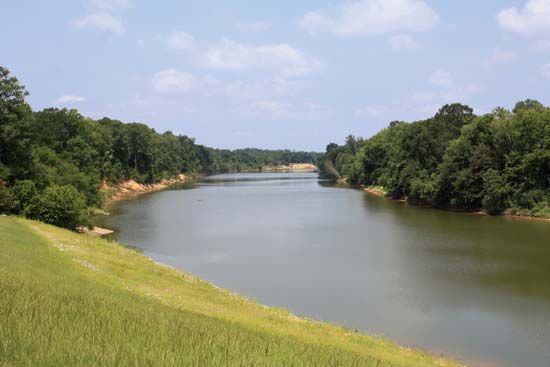
The Black Warrior River is a river located in western Alabama, United States. It is formed by the confluence of the Locust and Mulberry forks approximately 20 miles west of Birmingham and flows roughly 180 miles southwest until it joins the Tombigbee River near Demopolis.1
The river drains a basin of 6,275 square miles and serves as a vital inland waterway connecting Birmingham to the port city of Mobile. Its name is a translation of the Choctaw term tuscaloosa, derived from the words tashka (warrior) and lusa (black).1
Who was the Choctaw leader Tuscaloosa?
Tuscaloosa was a Choctaw chief whose name translates to “Black Warrior.” He is historically significant for leading his people in a fierce resistance against the Spanish explorer Hernando de Soto in 1540.3
During their encounter, Tuscaloosa’s warriors engaged de Soto’s expedition in a major battle, which resulted in the slaughter of several thousand Indigenous people. This confrontation is recognized as one of the bloodiest single encounters between Europeans and Indigenous peoples in North America. The city of Tuscaloosa, Alabama, and the nearby Black Warrior River are both named in his honor.43
How do inland waterways support commerce?
Inland waterways, including both natural rivers and artificial canals, serve as essential conduits for global commerce. They provide a highly economical method for transporting bulk commodities—such as coal, grain, ore, petroleum, and chemicals—where speed is less critical than cost-efficiency.567
These systems support trade through several key mechanisms:
- Engineering and Navigation: To ensure consistent transit, rivers are often regulated through dredging and the use of locks, which allow vessels to navigate varying water levels. Modern infrastructure, such as the St. Lawrence Seaway, has historically catalyzed industrial expansion in bordering regions.587
- Technological Efficiency: Modern towboats can haul massive, rigid platforms of barges, sometimes carrying up to 80,000 tons of cargo. Technologies like radar, GPS, and automatic port loaders enable around-the-clock operations, significantly reducing turnaround times.67
- Intermodal Connectivity: Inland waterways often connect to broader networks, such as the Intracoastal Waterway or the Great Lakes, allowing for seamless movement of goods from inland ports to international destinations.67
What are the major rivers in Alabama?
Alabama is defined by a robust network of waterways, with six major rivers providing approximately 1,300 miles of navigable routes that have historically driven the state’s economic development.910
The primary river systems include:
- Alabama River: Formed by the confluence of the Coosa and Tallapoosa rivers near Montgomery, this river flows southwest to join the Tombigbee River before discharging into Mobile Bay.91
- Tombigbee River: This river drains the western portion of the state and serves as a vital link in the inland waterway system.111
- Black Warrior River: A major tributary of the Tombigbee, this river connects Birmingham to the broader navigation network.11
- Tennessee River: Located in the north, this river drains the Cumberland Plateau region toward the northwest, with its flow managed by the Tennessee Valley Authority.1
- Cahaba River: A significant tributary that joins the Alabama River southwest of Selma9.
These systems are further integrated by the Tennessee-Tombigbee Waterway, a major canal that links the state’s primary river networks to facilitate commerce.10
Sources
- Black Warrior River — Encyclopædia Britannica
- Black Warrior — Merriam-Webster
- Tuscaloosa — Encyclopædia Britannica
- Alabama - European rivalry, settlement, and growth — Encyclopædia Britannica
- canals and inland waterways — Encyclopædia Britannica
- Mississippi River - Modern commercial activity — Encyclopædia Britannica
- canals and inland waterways - Medieval revival — Encyclopædia Britannica
- canals and inland waterways - Economic significance — Encyclopædia Britannica
- Alabama River — Encyclopædia Britannica
- Alabama - Transportation — Encyclopædia Britannica
- Alabama - Drainage — Encyclopædia Britannica
- Alabama — Merriam-Webster
Published on · 2 min read