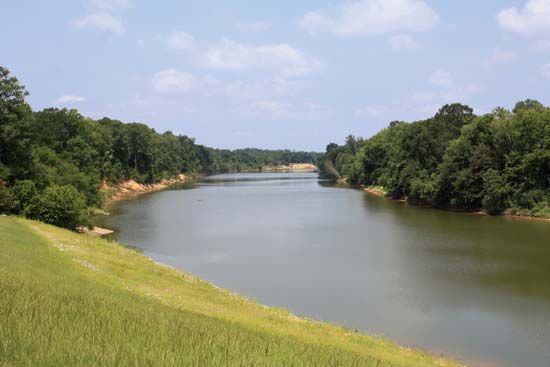
Blackstone River
The Blackstone River is a 50-mile (80 km) waterway that rises in south-central Worcester county, Massachusetts. It flows southeast through Massachusetts…
What is Blackstone River?
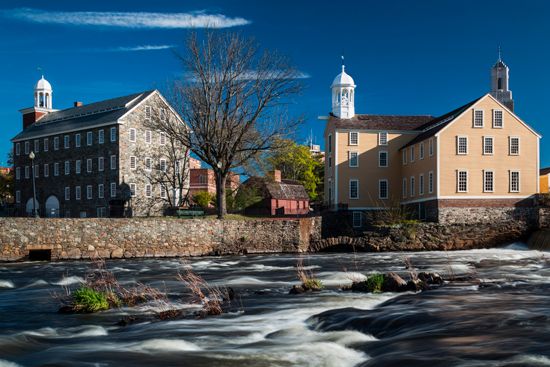
The Blackstone River is a 50-mile (80 km) waterway that rises in south-central Worcester county, Massachusetts. It flows southeast through Massachusetts, passing the city of Worcester and Northbridge, before continuing into the northeast corner of Rhode Island.
As it travels through Rhode Island, the river passes Woonsocket, Central Falls, and Pawtucket, eventually becoming the Seekonk River. Historically, the river has been vital to the region, providing power to a highly industrialized area. It is named after William Blackstone, the first European settler in what is now Cumberland, Rhode Island.1
How did the river power the Industrial Revolution?
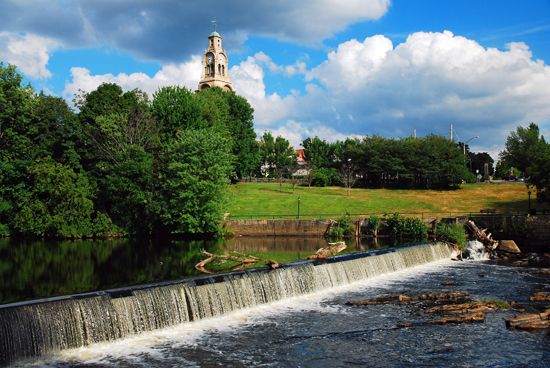
The Blackstone River served as a critical engine for the early Industrial Revolution in America by providing essential waterpower to drive manufacturing machinery.21
The river’s potential was famously harnessed in 1793 when Samuel Slater established the first successful water-powered cotton mill in North America in Pawtucket, Rhode Island2. At this location, the river drops approximately 50 feet over a rocky landscape, creating the kinetic energy necessary to operate spinning and carding equipment. This technological breakthrough transformed the region into a highly industrialized hub, as the river’s consistent flow allowed for the expansion of mills throughout the Blackstone Valley.12
By utilizing the river’s natural descent, early industrialists were able to transition from manual labor to mechanized production, setting a precedent for the textile industry across New England.34
Who was William Blackstone?
It is important to clarify that there are two distinct historical figures named William Blackstone, as the name refers to different individuals in legal and regional history.
Sir William Blackstone (1723–1780)
Sir William Blackstone was a prominent English jurist best known for his four-volume work, Commentaries on the Laws of England (1765–69). His writings provided an authoritative description of English law and became the foundation for legal education in both England and North America. Following the American Declaration of Independence, his Commentaries served as the primary source of English legal knowledge in the United States.51
William Blackstone (Settler)
The Blackstone River is named after a different William Blackstone, who was the first European settler in what is now Cumberland, Rhode Island. This individual is distinct from the famous English jurist mentioned above.6
What is the difference between a river and a canal?
The primary difference between a river and a canal lies in their origin and purpose. A river is a natural waterway that follows the contours of a valley, whereas a canal is an artificial, man-made passageway for water.78
Waterways are generally categorized into three types:
- Natural Rivers: These are formed by nature and are subject to environmental variables such as drought, floods, and seasonal changes. Navigation on natural rivers often requires efforts to stabilize banks and maintain a consistent channel.8
- Canalized Rivers: These are natural rivers that have been modified to improve navigation. This often involves the construction of locks, weirs, and sluices to manage water levels and create a series of steps for vessels.8
- Artificial Canals: These are entirely human-made channels. Unlike rivers, which are bound to natural valleys, artificial canals can be routed through hills, watersheds, and across other streams. They require careful engineering to prevent erosion and seepage, and they often rely on reservoirs or pumps to maintain necessary water levels for transport.89
Sources
- Blackstone River — Encyclopædia Britannica
- Samuel Slater — Encyclopædia Britannica
- Pawtucket — Encyclopædia Britannica
- Merrimack River — Encyclopædia Britannica
- Sir William Blackstone — Encyclopædia Britannica
- Common law - Influence of Blackstone — Encyclopædia Britannica
- canal — Merriam-Webster
- river — Merriam-Webster
- canals and inland waterways - Characteristics of basic types — Encyclopædia Britannica
- canals and inland waterways - Ancient works — Encyclopædia Britannica
Published on · 3 min read