Pelican Spider
The pelican spider (family Archaeidae) is a unique group of nearly 30 species of spiders found in Madagascar, South Africa, and Australia. They are named for…
What is pelican spider?
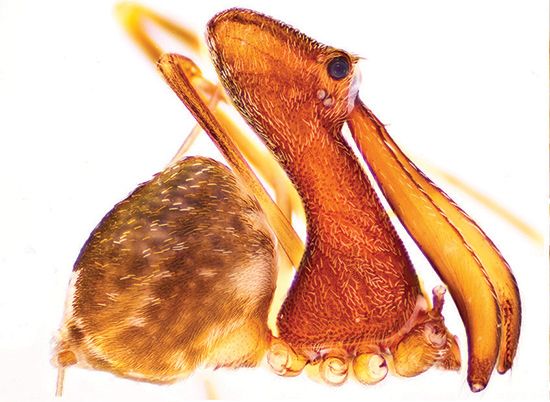
The pelican spider (family Archaeidae) is a unique group of nearly 30 species of spiders found in Madagascar, South Africa, and Australia. They are named for their distinctive, arching cephalothorax and elongated chelicerae (jaws), which give them a profile resembling a pelican.12
Often called “assassin spiders,” these small predators feed almost exclusively on other spiders. They are nocturnal ambush hunters that do not build webs; instead, they track the silk strands of other spiders to their prey, sometimes plucking the web to lure the victim closer. They use their long jaws to impale prey from a distance, protecting themselves from defensive bites.12
Once thought to be extinct, pelican spiders are considered “living fossils” because they have an ancient fossil record dating back more than 165 million years. Their rediscovery in modern times led them to be classified as a “Lazarus taxon”—a group that reappears after being presumed extinct.1
What is a Lazarus taxon and why are pelican spiders classified as one?
A Lazarus taxon is a species or group of organisms that reappears in the fossil record or is discovered alive after having been presumed extinct. The term is named after the biblical Lazarus, who was said to have been raised from the dead.1
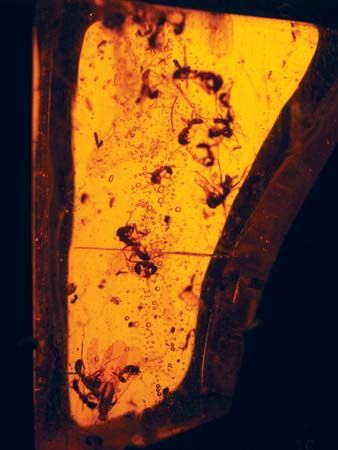
Pelican spiders (family Archaeidae) are classified as a Lazarus taxon because they were initially known only from specimens preserved in amber dating back to the Eocene Epoch. Because these ancient specimens were discovered long before any living examples were identified, scientists assumed the family had gone extinct millions of years ago.
The classification was updated when researchers eventually discovered living pelican spiders in Madagascar, followed by subsequent findings in South Africa and Australia. Their “resurrection” from the fossil record into the modern world serves as a classic example of a Lazarus taxon.1
How does continental drift explain the distribution of pelican spiders across different continents?
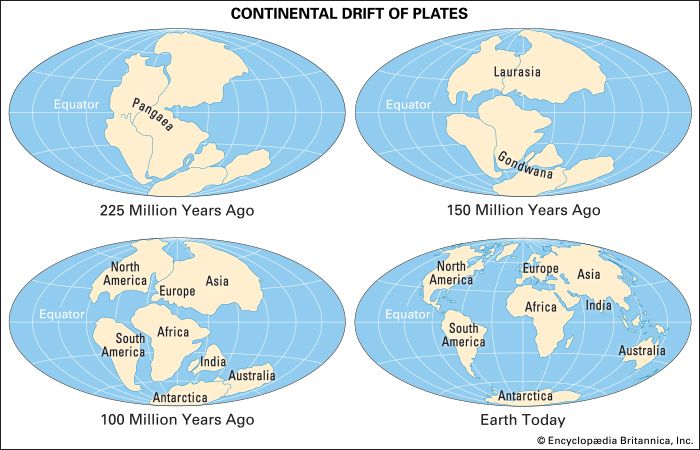
Continental drift provides a compelling explanation for the current geographic distribution of pelican spiders, which are found in Madagascar, South Africa, and Australia.13
As “living fossils” with a fossil record extending back more than 165 million years, these spiders existed long before the modern arrangement of the continents. During the Mesozoic Era, these landmasses were part of the supercontinent Gondwana5. It is believed that the ancestors of these spiders were widespread across this unified landmass. As Gondwana fragmented and the continents drifted apart, the populations of pelican spiders became geographically isolated on the resulting landmasses, where they have persisted to the present day.156
This theory is supported by broader geologic evidence, such as the presence of similar fossil terrestrial organisms in pre-Jurassic rocks across these same regions, which would be difficult to account for if the continents had not once been connected.6
What other animals are considered living fossils?
A living fossil is an organism that has remained essentially unchanged from earlier geologic times and whose close relatives are typically extinct. Beyond the pelican spider, several other animals are recognized as living fossils:8
- Coelacanth: Once thought to have gone extinct approximately 66 million years ago, this lobe-finned fish was famously rediscovered in 1938. Coelacanths have existed for about 400 million years, appearing during the Devonian Period, and are considered a classic example of a species that has persisted long after its relatives vanished from the fossil record.9
- Horseshoe crab: Often cited as a quintessential living fossil, these marine arthropods have maintained a similar body plan for hundreds of millions of years, showing remarkably little evolutionary change compared to their ancient ancestors.8
These organisms are significant to science because they provide a rare window into the biology and morphology of life forms from the distant past.
Sources
- pelican spider — Encyclopædia Britannica
- Archaea — Encyclopædia Britannica
- pelican spider: Top Questions — Encyclopædia Britannica
- Lazarus — Merriam-Webster
- Earth sciences - The theory of plate tectonics — Encyclopædia Britannica
- plate tectonics - Continental reconstructions — Encyclopædia Britannica
- segmented spider — Encyclopædia Britannica
- living fossil — Merriam-Webster
- coelacanth — Encyclopædia Britannica
- Jurassic Period - Protists and invertebrates — Encyclopædia Britannica
- reptile - Historical development — Encyclopædia Britannica
- fossil — Merriam-Webster
- fossil — Encyclopædia Britannica
- index fossil — Encyclopædia Britannica
Published on · 3 min read