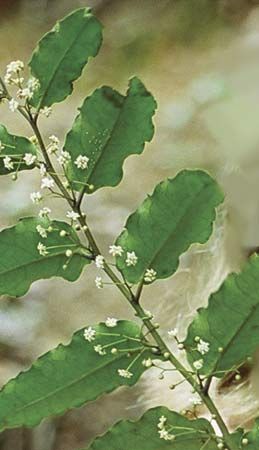
Amborellales
Amborellales, represented by the single species Amborella trichopoda, is considered the earliest diverging branch of the angiosperm tree. Its structure…
How does the structure of Amborellales differ from other flowering plants?
Amborellales, represented by the single species Amborella trichopoda, is considered the earliest diverging branch of the angiosperm tree. Its structure differs from most other flowering plants in several primitive ways:
- Vessel-less Wood: Unlike most angiosperms, which utilize a vessel system for efficient water conduction, Amborella lacks vessels entirely, relying instead on tracheids.12
- Floral Morphology: The flowers are small and lack differentiated sepals and petals, possessing instead 5–8 tepals. The reproductive structures are also considered primitive: the stamens are flattened and leaflike, and the carpels are not completely sealed. Furthermore, the stigma is attached directly to the top of the ovary, lacking an elongated style.1
- Chemical Composition: While most basal angiosperms contain ethereal oils as a potential defense mechanism, A. trichopoda apparently lacks these cells.12
- Reproductive Habit: The plant is dioecious, meaning male and female flowers occur on separate individuals.1
How do Amborellales reproduce, and what makes their reproductive process unique?
The reproductive process of Amborella trichopoda, the sole member of the order Amborellales, is characterized by several primitive features that offer insight into the early evolution of angiosperms.
- Dioecious Habit: The plant is dioecious, meaning male (pollen-producing) and female (ovule-producing) flowers are borne on separate individual plants rather than on the same flower or individual.
- Floral Structure: The flowers are small and lack a clear distinction between sepals and petals, possessing instead 5–8 tepals. The reproductive organs themselves are considered structurally primitive:
- Stamens: These are flattened and leaflike rather than the slender filaments found in more derived flowering plants.
- Carpels: The female reproductive structures are not completely sealed.
- Stigma: The stigma is attached directly to the top of the ovary, lacking the elongated style typically seen in other angiosperms.
- Fruit Development: Each carpel develops into a small, single-seeded red fruit at maturity.
Because Amborella represents the earliest diverging branch of the flowering plant tree, these traits are viewed as ancestral states that preceded the more specialized reproductive structures found in later-evolving plant lineages.1
What is the significance of Amborellales in the study of plant evolution?
The order Amborellales, which consists of the single species Amborella trichopoda, is of profound significance in the study of plant evolution because it is considered the earliest diverging branch among all living angiosperms, or flowering plants.1
By serving as a “living fossil” of sorts, Amborella provides a window into the ancestral states of flowering plants before they diversified into the vast array of species seen today. Its structural characteristics are particularly revealing:
- Vessel-less Wood: Unlike the majority of angiosperms that utilize a highly efficient vessel system for water conduction, Amborella lacks vessels entirely, relying instead on primitive tracheids. This trait highlights the evolutionary transition from the water-conducting systems of gymnosperms to the more advanced systems of modern flowering plants.12
- Primitive Floral Morphology: The plant exhibits simple, undifferentiated tepals and lacks an elongated style, with the stigma attached directly to the ovary. Its stamens are flattened and leaflike, and its carpels are not fully sealed, offering a glimpse into the early, less specialized forms of reproductive structures.1
How has genetic research on Amborellales contributed to our understanding of angiosperm evolution?
Genetic research on Amborella trichopoda, the sole member of the order Amborellales, has been pivotal in establishing its position as the earliest diverging lineage among all living angiosperms. By serving as a genomic baseline, Amborella allows scientists to reconstruct the ancestral state of flowering plants and understand the evolutionary transitions that occurred as they diversified.31
Key contributions of this research include:
- Defining Ancestral Traits: Genetic analysis confirms that Amborella retains primitive characteristics, such as the absence of vessel elements in its wood and simple, undifferentiated floral parts. These findings provide a reference point for identifying which features in later angiosperms are derived or specialized.1
- Evolutionary Timeline: By comparing the genome of Amborella with other plant groups, researchers can better calibrate the timeline of angiosperm evolution, helping to resolve the “abominable mystery” of how and when flowering plants first radiated across the globe.3
- Genomic Architecture: Studying its genome helps scientists understand the early evolution of reproductive mechanisms, such as the development of carpels and the transition toward the complex coevolutionary relationships with pollinators that define modern flowering plants.3
Sources
- Amborellales — Encyclopædia Britannica
- magnoliid clade - Vegetative structures — Encyclopædia Britannica
- angiosperm - Paleobotany and evolution — Encyclopædia Britannica
Published on · 3 min read